Insight
Keyword Research for Local SEO That Actually Wins Jobs
Helios Lab

Most advice on keyword research for local SEO starts in the wrong place. It begins with search volume, then adds a city name, then hopes Google treats the list like a market map. That shortcut misses how local search works, because the query isn't just about words, it's about proximity, intent, and whether the SERP is built to send a call, a direction request, or a booking.
Google's local search behavior makes that clear. 4 in 5 consumers use search engines to find local information, and 50% of smartphone local-search users visit a store within a day, compared with 34% on computers and tablets. Local searches also convert better than non-local searches, with 18% of smartphone local searches leading to a purchase within a day, versus 7% for non-local searches. Those numbers, from Google's local search research as summarized by BrightLocal, are why the best local keyword work isn't about collecting the biggest list, it's about finding the terms that match a real service need and a real page on your site. [BrightLocal summary of Google local search research]
Table of Contents
Why Most Local Keyword Lists Miss the Job
The usual local keyword list is a spreadsheet graveyard. It's full of service plus city terms, a few variations with “near me,” and maybe some competitor names pulled from a tool. That can look productive, but it often fails in the field because it ignores the thing that decides visibility in local search, whether the query is close enough to trigger a map result, a hire-ready intent, or an AI answer.
A plumber in Tampa and a lawyer in Tampa don't face the same SERP, even if the keyword tool gives them similar suggestions. One query may be proximity-heavy, with a map pack and business listings. Another may be dominated by directories, educational content, or branded legal firms. Treating both as if they obey the same volume and difficulty logic is how teams waste weeks on terms that never become calls.
Practical rule: if a term can't point to a service page, a location page, or a Google Business Profile category, it usually doesn't deserve a place on the target list.
The better filter is a three-part check. First, geographic relevance, meaning the term reflects the actual service area, neighborhood pattern, or proximity language buyers use. Second, SERP feature eligibility, meaning the query can realistically win map pack visibility or another local surface. Third, transactional strength, meaning the phrase signals a person who needs help now, not someone browsing for education.
That's why a 60-term list that maps cleanly to revenue pages beats a 600-term list with no destination. The longer list may feel safer, but rankability and revenue are tighter companions than raw volume. In local search, especially for contractors and firms that live or die by inbound calls, the right keyword is the one you can publish, optimize, and connect to a conversion path this week.
Building a Seed List From Real Services and Real Calls
The cleanest seed list starts with the business, not the tool. Pull every core service from the Google Business Profile, the main navigation, the footer, estimate forms, and any service-menu page. Then layer in what customers say on calls, chats, and intake forms, because clients rarely use the same words an industry insider would choose.
For a plumber, the seed list should include both formal service terms and problem language. “Water heater repair,” “drain cleaning,” and “sewer line inspection” belong next to phrases like “water heater stopped working” or “leak under kitchen sink.” For a roofer, that might mean “roof repair,” “storm damage roof inspection,” and “missing shingles after hail.” For a personal injury firm, “car accident lawyer” matters, but so does “how long after a car accident can you sue,” because the wording tells you which page type deserves the query.
Build the list in layers
Start with service inventory. Use the website and GBP categories to capture every line of work, including emergency variants, seasonal work, and specialty jobs.
Mine real customer language. Pull repeated phrases from recordings, chats, form submissions, and SMS threads. These are often closer to search behavior than internal jargon.
Add location modifiers. Use city names, counties, neighborhoods, ZIP clusters, and landmarks buyers reference.
Attach an intent tag. Mark each term as emergency, commercial, informational, comparison, or booking-ready.
Assign a destination page. Every candidate needs a home, whether that's a service page, a location page, or a GBP post.
A simple spreadsheet works fine if it has the right columns. I use Service, Customer phrasing, Modifier, Intent, and Destination. That structure prevents the classic mistake of collecting terms that can't be published.
Seed List Source Comparison for Local Keyword Research | What It Yields | Best For | Limitation |
|---|---|---|---|
Website service pages | Core offerings and terminology | Building the first draft of the list | Often too polished and not close enough to customer language |
Call recordings and chats | The phrases buyers actually use | Emergency and high-intent terms | Requires manual review and cleanup |
Intake forms | Problem statements and service context | Law firms and home services | Missing phrasing if forms are too rigid |
Google Business Profile | Category-aligned services and common requests | Local eligibility and page mapping | Usually incomplete on its own |
A law firm example makes the gap obvious. “Car accident lawyer” is a seed term, but so is “what to do after a rear-end collision.” One belongs on a money page, the other may support a FAQ or supporting article. The seed list gets strong only when you know the page each phrase should feed.
Reading the Local SERP Before You Trust a Tool
Tools hand you candidates. The live SERP gives you the verdict. Before I commit a term to production, I check what Google is rewarding for that query in the target area, because a keyword that looks promising in a dashboard can behave very differently on the results page.

Use a map-pack-first lens when evaluating local visibility, because the presence or absence of a local pack changes how a keyword should be judged. If the map pack is present, the query is often proximity-sensitive. If it isn't, the term may still be valuable, but the winning page type may be different.
Three questions matter most. First, does the query show a map pack? Second, are the top listings using the right GBP categories for your service? Third, do the organic results favor local businesses, national brands, or directories? When the first page is full of directories or national comparison sites, local businesses usually need a stronger content and authority signal before they can compete.
Intent mismatches are just as important. A term that returns how-to articles, Reddit threads, or YouTube videos is not a hire-now keyword, even if the volume looks healthy. The same goes for zero-click results and AI surfaces. If Google already answers the query directly, a service page may not win the click even if it ranks.
If the page is educational and the buyer is urgent, the term belongs in support content, not on the primary sales page.
The pass-fail rule is simple. A term stays in the list only if it clears proximity alignment, intent match, SERP feature fit, and a realistic path to the top three. If one of those fails, the term can still have value, but it shouldn't drive the content calendar.
Scoring and Prioritizing Local Keywords the Right Way
Scoring local keywords works best when the metrics reflect the local market, not a generic national average. Semrush notes that local keyword data can be pulled at the city, region, or sub-location level, including local volume, volume trend, keyword difficulty, competitive density, CPC, intent, and SERP analysis. That matters because a keyword's value changes once you judge it against an actual service area instead of a broad keyword universe. [Semrush keyword overview]
Use a four-factor score
I usually score four things: local volume, intent strength, SERP cleanliness, and competitor consistency. Intent should carry the most weight, because an emergency plumbing query is worth more than a research query with prettier volume. SERP cleanliness matters because a page crowded out by directories or national brands is harder to win than a cleaner local pack with weaker competition.
For plumbers, “burst pipe repair” should usually outrank a broad informational term, even if the broader term looks larger in the tool. For wrongful-death attorneys, a tightly framed query with strong case intent can be better than a generic legal phrase with mixed behavior. The point isn't to chase the biggest bucket, it's to identify the term whose local SERP gives you a path.
Local Keyword Scoring Matrix | Factor | Low Score 1 | High Score 5 |
|---|---|---|---|
Local demand | Search volume filtered to the target area | Thin or unreliable local demand | Clear local demand in the service area |
Intent | Urgency and likelihood of inquiry | Informational or mixed intent | Hire-ready or emergency intent |
SERP cleanliness | How readable the results page is | Packed with directories and generic brands | Local businesses dominate the top results |
Competitor consistency | Whether the same businesses keep appearing | Results shift wildly and lack stable competitors | A small set of competitors appears repeatedly |
A fast spreadsheet formula can keep this practical. I'd sort by a weighted total where intent and SERP cleanliness matter more than volume. Something as simple as Priority = (Volume x 2) + (Intent x 4) + (SERP Cleanliness x 3) + (Competitor Consistency x 2) is enough to rank a worklist without pretending the number is scientific.
The trick is not the formula. It's the discipline to remove any keyword that looks good in aggregate but fails in the local market you serve.
Mapping Neighborhoods, Landmarks, and Micro-Locations
City modifiers are too blunt for dense markets. A roofer does not get the same demand from “Tampa roof repair” that they get from a neighborhood-specific phrase or a landmark-based query, because buyers often describe where they live in narrower terms than the city itself. The useful map is the one that reflects the way people in that market name their area.
For this reason, I like to split the service area into neighborhoods, school districts, ZIP clusters, and landmarks. That's where the gap analysis becomes more honest. A broader city phrase may bring impressions, but a neighborhood phrase can show stronger booking behavior when the call comes from somebody who's closer to a decision point.
The keyword list gets smarter when it follows how people talk about place, not how the city is drawn on a map.
A Tampa roofing example makes the contrast obvious. “Tampa roof repair” is the obvious starting point, but phrases like “South Tampa roofer” and “near Raymond James Stadium” often reveal separate intent pockets. One may point to a service page, another to a location page, and another to a content fragment that supports local relevance without bloating the main list.
Add location pages only where the market truly supports them, because blank pages built from city swaps don't help. The page has to reflect real proximity signals, real service coverage, and a reason to exist beyond substituting a neighborhood name.
The practical test is simple. Compare the plain city modifier against a micro-location term, then review call notes, GBP insights, and any ZIP-level ranking data you already have. The terms that align with booked inspections or real inquiries should win. The terms that only inflate list size should get cut.
Turning Research Into Pages, Posts, and an Editorial Calendar
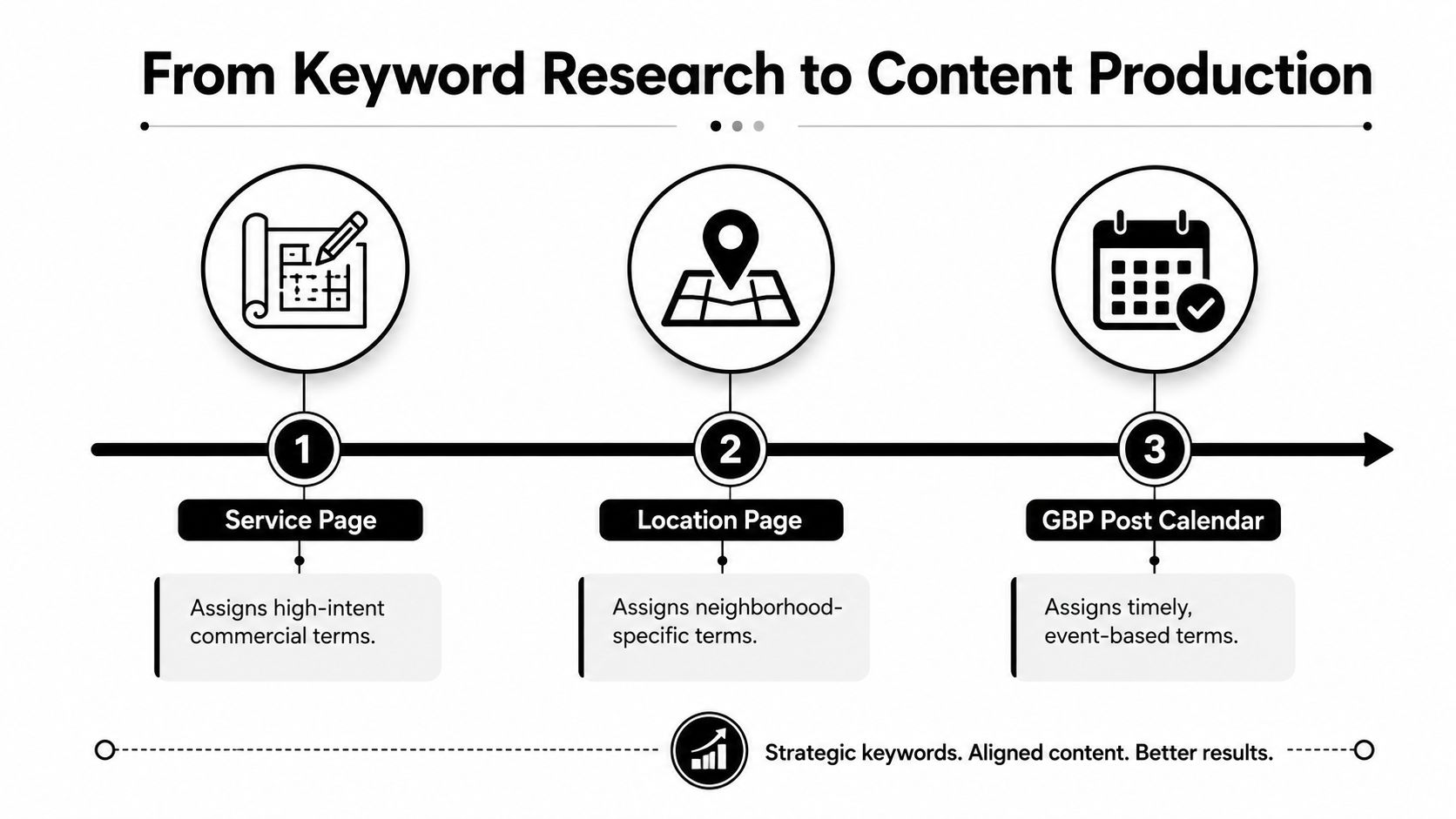
Keyword research only becomes useful when each term has a publishing destination. I split the output into three buckets, service pages, location pages, and GBP posts. That gives a contractor something concrete to hand to a writer without another round of interpretation.
High-intent terms should go to money pages. For a plumber, that means the primary service page gets “water heater repair,” while a secondary service-town page might get a localized variant if the SERP supports it. Medium-intent neighborhood phrases belong on location pages, provided the page adds real local context. Supporting terms, especially seasonal or timely ones like “burst pipe repair,” can feed GBP posts and reinforce the service category without cannibalizing core pages.
A simple production split
Service pages: Primary commercial terms, emergency services, and the queries most likely to trigger calls.
Location pages: Neighborhood, suburb, ZIP, or micro-location phrases that need local proof and local copy.
GBP posts: Timely promotions, seasonal reminders, and category reinforcement that keeps the profile active.
Keyword research meets the editorial calendar with this approach. A six-week plan is enough to get moving. Week one assigns the primary service page. Week two handles a location page for the strongest suburb or district. Week three ships the first GBP post. Weeks four through six repeat that cadence for the next service cluster and the next service town.
For teams that want help with the workflow itself, Helios Lab is one option that provides local keyword research, SEO content planning, and editorial calendar work as part of its local SEO and content-led services. That doesn't replace strategy, but it does mean the research can move directly into production instead of sitting in a spreadsheet.
If a keyword can't be tied to a page type, it's not ready for the calendar.
The benefit of this mapping is speed. Writers stop guessing. Editors stop rewriting page intent. The business gets a clean handoff from research to ranking work.
A Short Local Keyword Checklist and What Comes Next
The best local keyword plans are boring in the right way. They point each term to a page, a post, or a profile action, then they get shipped. Before anything else, I'd run four checks this week.
Map every keyword to a destination. Service page, location page, or GBP category. If none fits, cut it.
Validate the SERP. Confirm whether the map pack appears and whether the query is already answered by a zero-click or AI surface.
Score the term locally. Use local volume, intent, and competitor consistency, not national averages alone.
Queue the work. Put the strongest terms into the editorial calendar and assign a writer, editor, and publish date.
Use practical local SEO habits to keep the work tied to outcomes, because the calendar only helps when it turns into live pages and profile updates. The bigger shift happening now is that local discovery is getting more conversational, more zero-click, and more tied to profile signals like reviews and photos. That means the keyword list can't live only inside organic SEO anymore.
The smartest next move is narrow. Pick one service line and one neighborhood, run the full workflow, and publish two optimized pieces within seven days. If the page earns calls, direction requests, or stronger local visibility, the process has already paid for itself in one pay cycle.
If you want a local keyword list that's built for rankings, map-pack visibility, and real inbound calls, Helios Lab can help turn service terms, neighborhood phrases, and GBP priorities into pages your team can publish fast. The work starts with local SEO keyword research, then moves straight into content planning and execution, so you're not left with a spreadsheet that never reaches the site.