Insight
Google Map Pack: A Practical Guide to Ranking in 2026
Helios Lab

The Google Map Pack is a winner-take-most surface. In one widely cited local-search analysis, the top three listings captured roughly 44% of clicks on local-query results pages, with the #1 spot at about 17.6%, #2 at 15.4%, and #3 at 15.1%. If you're not treating that as a different economic game from organic search, you're already behind.
Table of Contents
What the Google Map Pack Is and Why the Top Three Matter
The Google Map Pack is the block of three local business listings that appears when Google thinks the search has local intent. It usually sits above the organic blue links, and on many searches it becomes the first thing a prospect sees, taps, or calls from. That's why the Map Pack isn't just a visibility feature, it's a conversion surface.
For service businesses, the key reality is simple. Being in the pack matters, but being in the top three matters far more. The click data is steep, not linear. A business at #4 or #5 isn't close to a business at #1 in practical lead volume, because the pack compresses attention into only three slots.
Eligibility starts with a Google Business Profile and a real location or defined service area. Google needs enough information to match your business to the query, the searcher's location, and the category of service. If the profile is thin or the service area is fuzzy, you're asking Google to guess.
Practical rule: treat the Map Pack as a three-slot auction for attention, not a listing directory.
Map Pack Position | Estimated Click Share | Cumulative Share |
|---|---|---|
#1 | about 17.6% | about 17.6% |
#2 | about 15.4% | about 33.0% |
#3 | about 15.1% | about 48.1% |
That concentration changes how you should think. The goal is not vague “local visibility.” The goal is to cross the top-three threshold and stay there long enough to turn clicks into calls. If you need the basics of setting up the listing correctly, start with this overview of what a Google company listing is and why your business needs one.
How Google Decides Who Appears in the Map Pack
Google has never hidden the core logic. The local-result system still revolves around relevance, distance, and prominence. Those three signals are the foundation, and everything else sits on top of them.
Relevance and distance are the gatekeepers
Relevance is the match between the search and your business. If someone searches for a plumber, Google wants a plumbing business, not a general contractor with a passing mention of plumbing services. Your primary category, service descriptions, and on-profile wording all feed that match.
Distance is more mechanical. Google compares the searcher's location, or the location they specify, against your business location or service area. You can't wish your way around geography, so businesses in dense metro areas have to win with precision, not broad claims.
Prominence is where the work compounds
Prominence is the part most owners underestimate. It reflects how established and trusted the business appears across reviews, citations, links, and brand mentions. Google's own framing is broad, but the operational version is narrower, more tactical, and more unforgiving.

The modern reality is that these signals don't operate in a vacuum. A business with stronger reviews and stronger profile completeness gets more attention, and that attention can reinforce future performance. Google's 2025 to 2026 ranking-factor survey put GBP signals at roughly 32%, review signals at about 20%, and on-page signals at about 15%, with those three categories making up about 67% of that survey model. That doesn't mean you can ignore proximity, it means you need to earn the right to matter when proximity is similar.
Google's local results are not won by one trick. They're won by stacking the right signals until Google has less reason to choose someone else.
The important takeaway is that the weights shift by category and competitor density. In a tight market, small differences in prominence can decide who lands in the top three. In looser markets, clean relevance may be enough to get you into the conversation.
Map Pack vs Organic Results
Map Pack rankings and organic rankings are cousins, not twins. They share some local inputs, but they behave differently enough that you can't use one playbook for both. If you do, you'll end up with decent traffic and weak lead quality.
Dimension | Google Map Pack | Organic Blue-Links |
|---|---|---|
User intent | Strong local intent, often ready to act | Broader intent, often research-first |
Click behavior | Concentrated on three listings | Spread across many results |
Primary actions | Calls, directions, website taps | Page visits, form fills, research |
Eligibility | Requires a verified Google Business Profile | Requires indexable pages |
Measurement | GBP insights, call tracking, lead outcomes | Search Console, rankings, on-site behavior |
Conversion pattern | Fast decision, often mobile-led | Slower comparison, more content-driven |
The big strategic difference is speed. Map Pack users are often looking to call, get directions, or confirm they've found the right provider. Organic users are more likely to compare options across several pages before they act. That's why a strong organic position doesn't automatically translate into Map Pack lead flow.
The measurement stack is different too. For the Map Pack, the signals that matter are calls, directions, website taps, and assisted conversions. Search impressions are flattering but not decisive. If a listing brings traffic but no calls, it's not doing its job.
The other mistake is assuming one channel can substitute for the other. It can't. Organic gives you depth, content authority, and broader query coverage. The Map Pack gives you compressed, high-intent exposure with a direct path to a lead. You need both, but they answer different business problems.
The Core Levers That Move Map Pack Rankings
Blunt. Google Business Profile work and reviews are the two levers that most often change Map Pack outcomes, while citations and links help stabilize the result. If you're spending most of your energy on directories and ignoring the profile itself, you're optimizing the wrong layer.
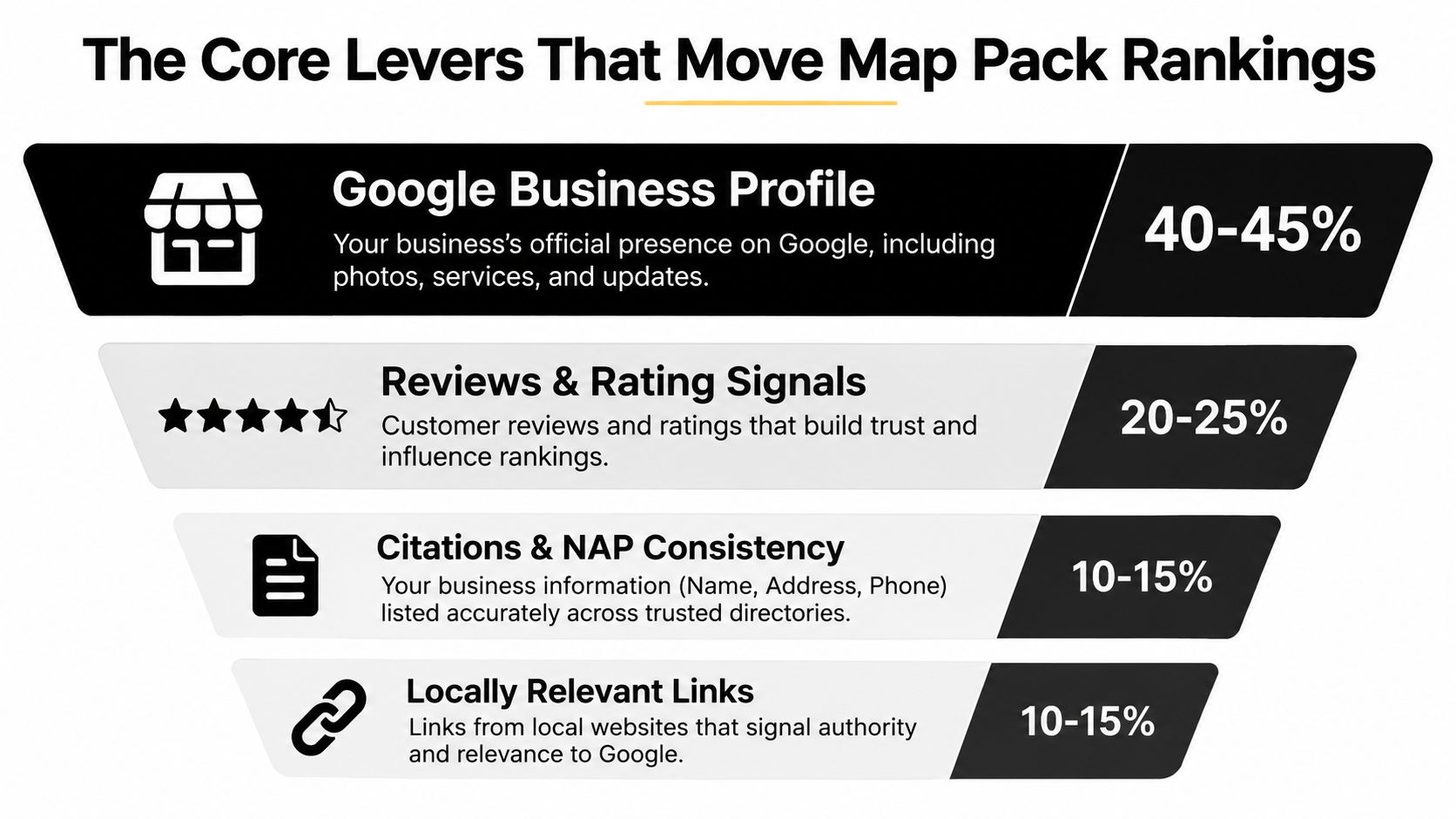
Google Business Profile comes first
Your Google Business Profile is the center of gravity. The primary category has to be exact, not close. Services need to match real search intent, not the internal language your team likes to use. Add weekly posts, keep Q&A active, and use photos consistently so the profile looks alive instead of abandoned.
Completeness matters because Google needs confidence. A thin profile makes it easier for a competitor with the same distance and better prominence to outrank you. In practice, many businesses lose before the ranking battle even starts.
Reviews change both trust and attention
Reviews do two jobs at once. They support prominence, and they also change how users behave once they see the listing. The verified data shows that 5-star businesses can attract about 69% of user attention, compared with 59% for 4-star businesses and 44% for 3-star businesses in local-pack contexts. That's not just reputation, that's click economics. The local pack analysis makes the point plainly.
If your review profile is thin, stale, or unresponsive, fix it. Don't wait for a perfect moment. Build a steady stream from real customer touchpoints, and make sure someone on your team responds to reviews quickly and professionally. If you need a system for that, this review-management guide is the right place to start.
Citations and links support stability
Citations and NAP consistency still matter because they confirm that your business is real, local, and consistent. Same name, same address, same phone number, everywhere that counts. For links, ignore generic spammy directory submissions. Focus on chamber memberships, local sponsorships with linked mentions, and earned local coverage.
Use the levers in the right order
GBP first: tighten category fit, services, hours, photos, and post activity.
Reviews second: build recency, volume, and response discipline.
Citations third: clean duplicates, standardize NAP, and confirm category alignment.
Local links fourth: earn relevance in your actual market, not in a directory farm.
That hierarchy is the part most agencies get wrong. They sell the easiest work, not the highest-value work.
Why Map Pack Rankings Are More Volatile Than Most Guides Admit
The static checklist model is outdated. Map Pack visibility moves, and it moves fast. A 2026 independent dataset across 11,500 Google Maps listings found that 27.5% of local pack businesses changed between January and March 2026 across 110 matched keyword-city comparisons. That's enough churn to make “set it and forget it” a losing strategy. The March 2026 dataset makes the instability hard to ignore.
Three things cause the churn
First, query-specific personalization changes what different users see, even in the same area. Second, Google keeps re-ranking intent matches as it interprets ambiguous searches. Third, competitor velocity matters. A rival who lands a burst of new reviews or refreshes their GBP can reshuffle the order overnight.
That means monitoring is not admin work. It's ranking work.
What good monitoring looks like
Use daily checks for priority keywords. Keep weekly GBP snapshots so you can spot profile changes, category edits, photo changes, and review momentum. Set alerts when you lose a top-three slot, because the window to react is short.
If you lost a pack position this week, don't wait for the monthly report to notice it.
The point is to diagnose fast, then act fast. If you're in a competitive home-services, legal, or multi-location market, the gap between “we noticed” and “we responded” can be the difference between holding the line and dropping out of the pack entirely. Treat volatility like a core ranking issue, because that's what it is.
A Decision Framework for Prioritizing Map Pack Work
Not every listing deserves the same effort. A high-revenue business sitting just outside the top three needs a different plan from a low-revenue business already holding position #1. If you don't separate those cases, you'll waste money on the wrong kind of optimization.
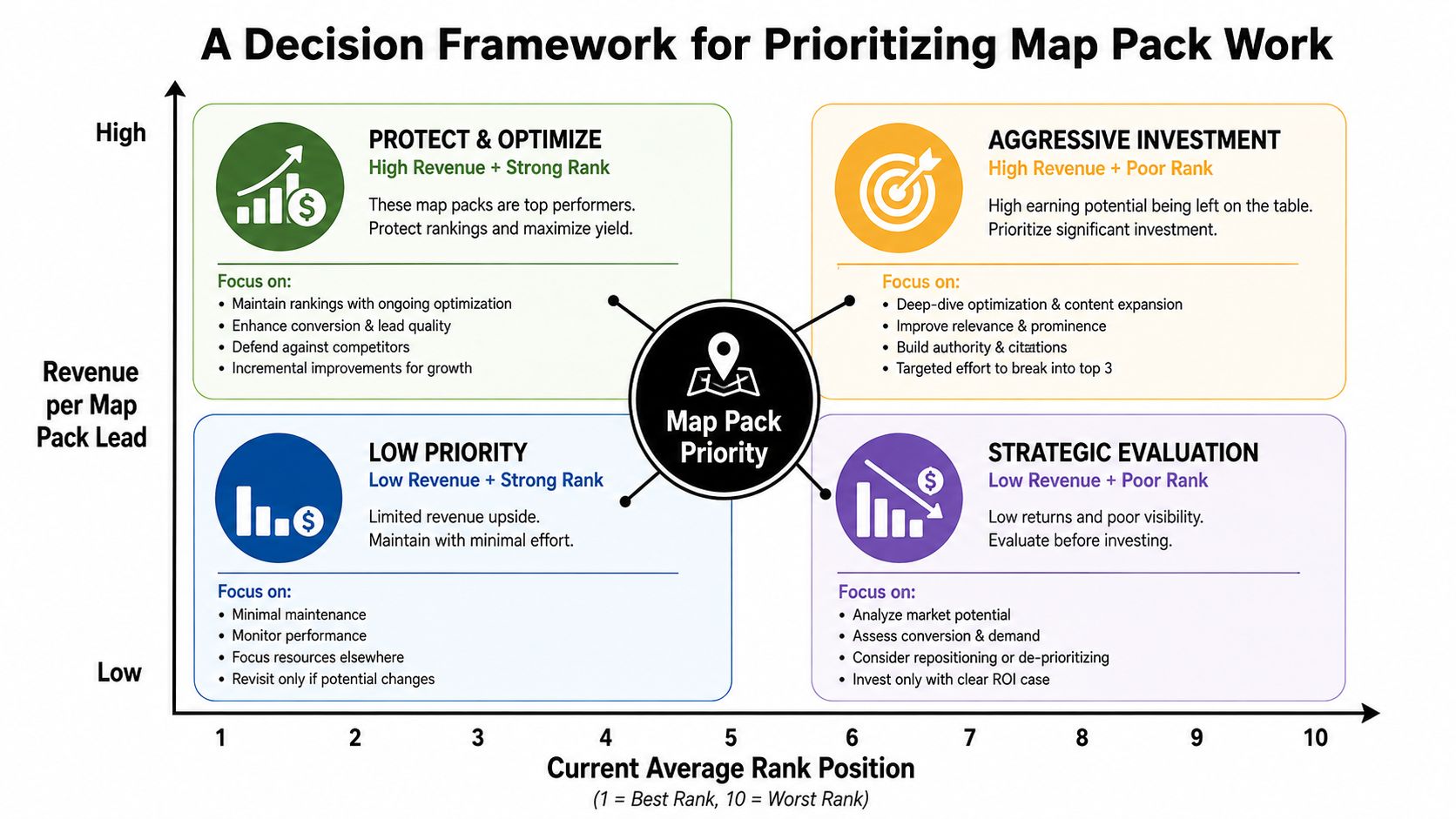
Use revenue and rank as the two axes
Put revenue per Map Pack lead on one axis and current average rank position on the other. High revenue plus a weak rank means aggressive investment. That's where you clean the profile, push reviews, and fix citations fast because the payoff is real.
High revenue plus a strong rank means defense mode. Hold the position with review velocity, profile freshness, and alerting. Low revenue plus a strong rank means harvest mode, you keep it stable but don't overinvest. Low revenue plus a weak rank gets deprioritized or tested on narrower keywords first.
The HVAC version of this is easy to see
A mid-size metro HVAC company with emergency repair demand has a clear incentive to fight for pack visibility on urgent keywords. A commercial-only maintenance provider may not need the same volume, or the same pace. The first business should spend heavily on the profile, reviews, and local authority. The second should decide whether the keyword is worth the chase.
That same logic applies to storefronts, multi-location brands, and ecommerce-adjacent local queries. Rank position only matters in relation to revenue. If a keyword doesn't create enough value, don't let it hijack your budget.
Bottom line: pack optimization is a portfolio decision, not a vanity contest.
The data makes the case. You're dealing with a surface where the top three capture a disproportionate share of clicks, and where rankings can move faster than most owners expect. That means your budget has to follow revenue, not ego.
Your 30-Day Map Pack Action Plan and What to Measure
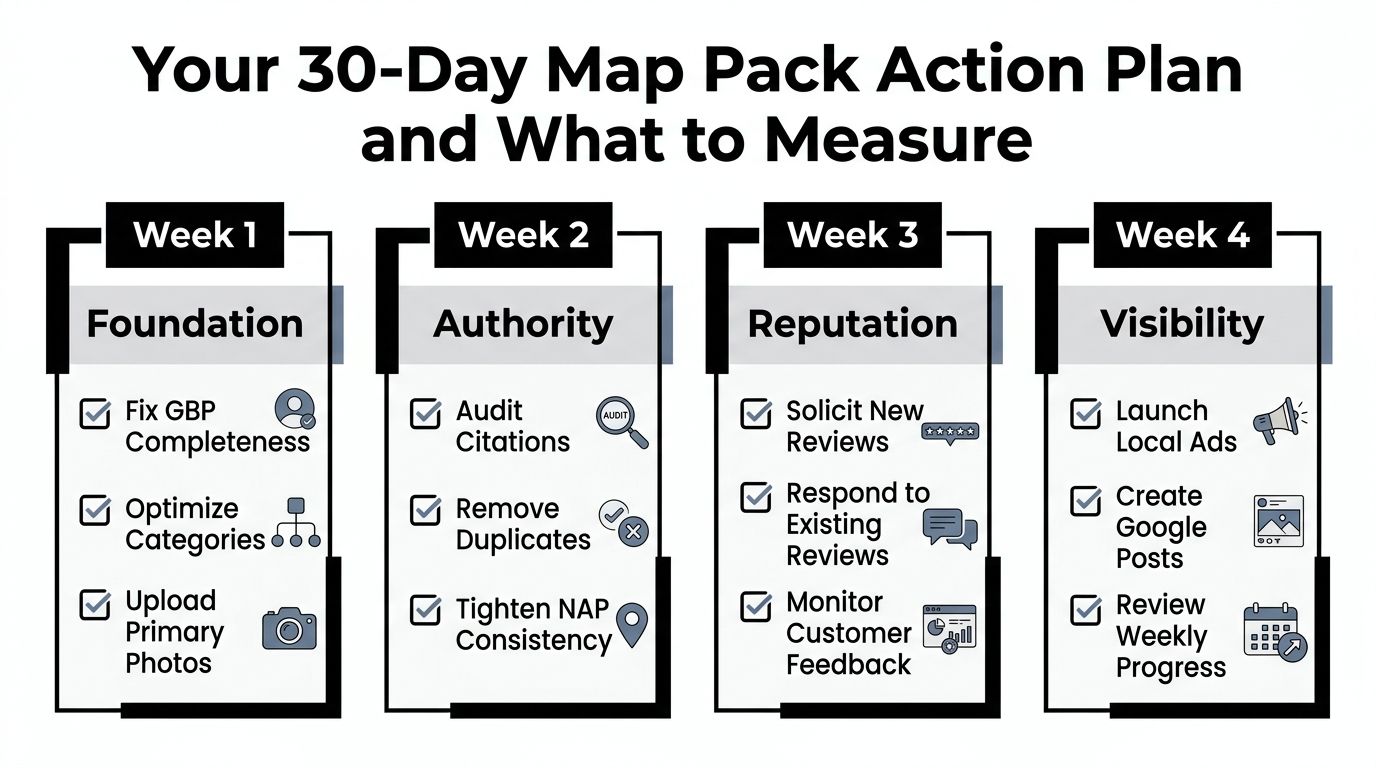
Week 1
Fix GBP completeness, confirm the primary category, and upload strong primary photos. Tighten services, hours, and business details so Google doesn't have to fill gaps on its own.
Week 2
Audit citations, remove duplicates, and make NAP consistency boringly exact. adding locations on Google Business becomes relevant for multi-location and service-area businesses that need every listing to line up cleanly.
Week 3
Launch a review-velocity push tied to real customer touchpoints. Ask at the point of service, after delivery, or after a completed job, not weeks later when the experience is already faded.
Week 4
Secure two to three locally relevant links, then stop chasing junk placements. Chamber listings, sponsor pages, and community coverage are the kinds of links that belong in a local authority plan.
Measure calls from GBP, direction requests, website clicks, and assisted conversions. Don't call impressions a win, and don't brag about average position if the phone isn't ringing. The only dashboard that matters is the one that ties local visibility back to revenue.
If you want this handled by a team that works on local visibility, review systems, and call-driven reporting, Helios Lab does that work for service businesses and multi-location brands. Start with a Helios Lab audit if you want a blunt read on where your Map Pack visibility is leaking and what to fix first.