Insight
10 Local SEO Tips to Win More Local Customers
Helios Lab

What do most local seo tips miss? They focus on getting more clicks, while customers are trying to decide who to trust, who to call, and who can show up fast enough to solve the problem. For service businesses, local SEO is less about vanity traffic and more about being visible at the exact moment of intent, especially on mobile, where Google's consumer research found that 50% of smartphone users who searched locally visited a store within a day, versus 34% on computer or tablet, and 18% of smartphone local searches led to a purchase within a day, versus 7% for non-local searches (BrightLocal's local SEO statistics summary).
The fastest wins come from the assets you control first, your Google Business Profile, your reviews, your citation consistency, and your service pages. After that, the work expands into geographic relevance, schema, backlinks, and content that can be understood by both Google and AI search surfaces. If you sequence the work in that order, you're building a local system, not just chasing rankings.
Table of Contents
2. Build a Strategic Review Generation and Management Program
6. Add Schema Markup So Google and AI Can Read Your Business
7. Write Content That Can Be Cited by Google and AI Assistants
9. Earn Backlinks From Trusted Local and Industry Publications
10. Use PR and Local Media to Build Visibility Beyond Rankings
1. Optimize Your Google Business Profile for the Local Pack
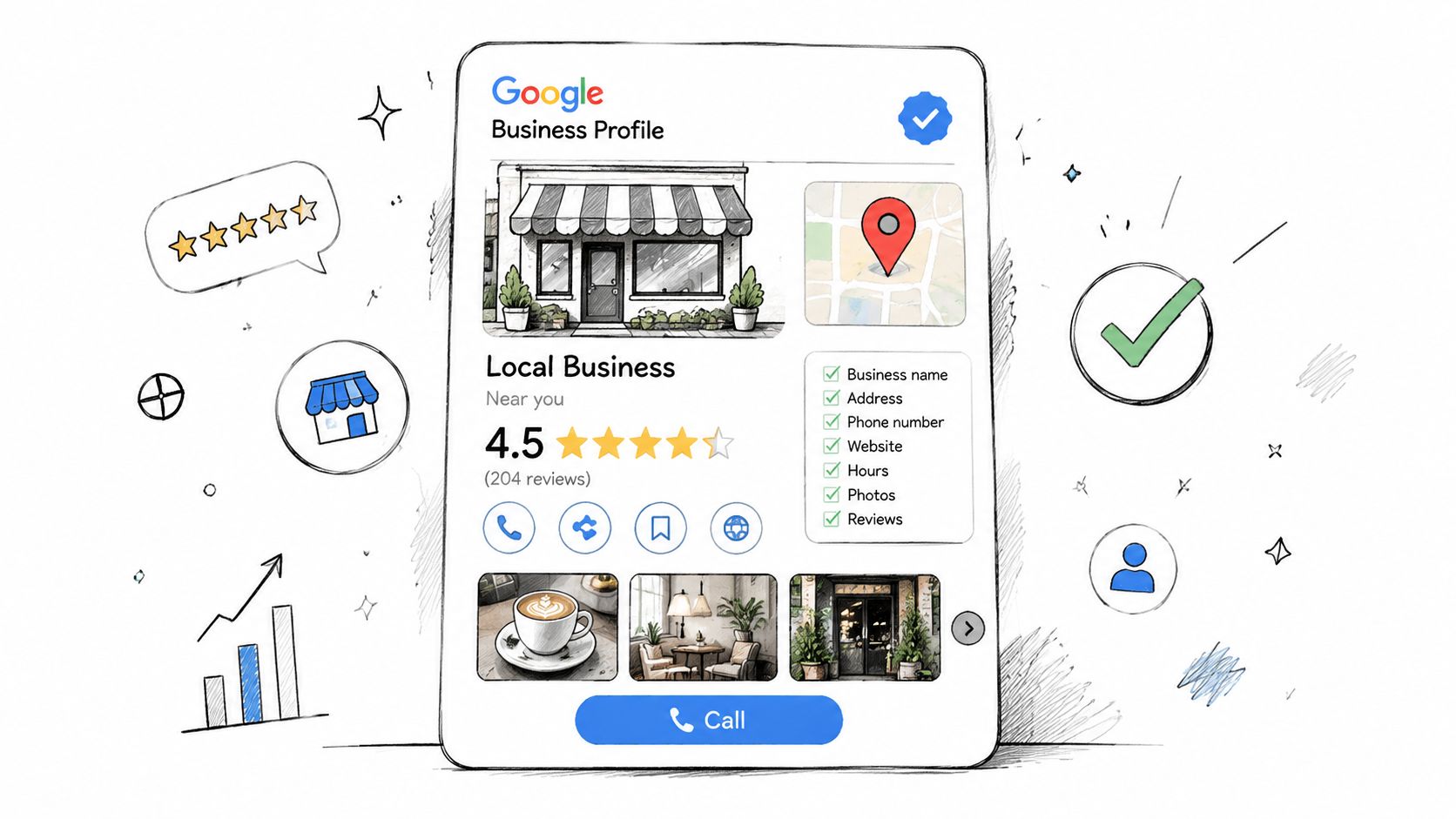
A complete Google Business Profile is the first place to tighten up because it influences both discovery and trust. Google's local-search guidance, as summarized in industry research, says customers are 2.7 times more likely to consider a business reputable when they find a complete Business Profile on Google Search and Maps, and 71% of consumers use Google to read local business reviews (Shno local SEO statistics). For a plumber, roofer, law firm, or dentist, that profile is often the first sales page customers ever see.
Start with the basics that move the needle. Make sure your business name, category, hours, phone number, website, and service areas are correct and identical everywhere they appear. Then add fresh photos, service descriptions, messaging, appointment links, and posts that reflect what people hire you for in the current season.
Practical rule: If a customer could get confused about where you work, when you're open, or how to book, the profile isn't optimized yet.
Use a local keyword naturally in your description, but don't stuff it. A phrase like “licensed electrician serving homes and businesses in Dallas” is useful because it clarifies both service and geography. The same goes for photos, use real before-and-after work, not stock images that could belong to any business anywhere. For multi-location operators, the location setup deserves careful handling. Helios Lab's guide to adding locations on Google Business is a useful reference if you're managing more than one branch.
A simple operating rhythm helps. Update posts every week or two, review your query insights, and refresh hours before holidays. That's not busywork, it's the maintenance that keeps your profile competitive when buyers are comparing multiple businesses in the map pack.
2. Build a Strategic Review Generation and Management Program
Reviews are not a side task, they're a ranking and conversion system. BrightLocal's 2025 consumer research found that 67% of consumers often or always check business reviews after a local business search, and another local consumer study reported that 75% of consumers read at least four reviews before deciding (Shno local SEO statistics). That means the job isn't just getting more reviews, it's creating steady review momentum that makes your profile look active, current, and credible.
The best time to ask is right after a successful service visit, when satisfaction is highest and the experience is fresh. Don't leave the request until later in the week, because the customer's urgency and memory both fade. Use a mix of SMS, email, QR codes, and in-person prompts so customers can respond through whichever channel feels easiest.
Make the request process frictionless
Shorten the path to the review form. A mobile-friendly one-click link beats a long set of instructions every time, especially for customers who are already on their phones. Train technicians, attorneys, or front-desk staff to spot the right moment and ask naturally, not in a scripted way that sounds forced.
Practical rule: The ask should happen at the same moment the customer thinks, “That went well.”
Response management matters just as much. Rio SEO's 2025 consumer study found that 59% of consumers expected a response within 24 hours, and 53% said inaccurate listings would drive them away (Rio SEO local search consumer behavior study). Reply to every review in a professional voice, and use negative reviews as operational feedback, not a debate stage. A quick, calm response can reduce the damage of a bad experience because it shows future customers that someone is paying attention.
If you want to formalize the process, Helios Lab's review management guide is a good starting point for building the workflow around SMS, email, and response handling. The goal is consistency, not a one-time campaign that disappears after a slow month.
3. Target Keywords That Show Buying Intent
Local keyword research works differently from broader SEO. You're not trying to win every informational query, you're trying to show up for searches that usually happen right before a call, quote request, or booking. Google's research on local search behavior found that same-day purchase and store visitation are tightly linked to local, mobile, high-intent searches like service-near-me, open-now, and category-plus-location queries (BrightLocal's local SEO statistics summary). That is the primary reason to focus on transactional modifiers.
Start by mapping the language customers use when they're ready to act. Phrases like call, quote, appointment, licensed, 24-hour, and free estimate matter because they signal urgency and decision readiness. Then combine them with city names, neighborhood names, and service descriptors so your pages line up with how people search in your market.
Pull real phrases from the search surface
Use Google Maps autocomplete, competitor title tags, and your own search query data to see what shows up repeatedly. If you're a roofing company in Denver, “emergency roof repair Denver” is a very different opportunity from a broad informational query about roof repair. The first one is closer to revenue because it describes a buyer with a problem and a location.
Practical rule: If the keyword doesn't imply action, it probably isn't your first priority.
Build your keyword list by intent, not just by volume. A service business often gets better returns from a smaller set of commercial keywords than from a giant list of general terms. Once you have the list, map each phrase to a page, a section, or a service area so the site doesn't blur everything together.
A lot of local SEO fails here because the site says the business “serves the area” but doesn't show which service, where, and for whom. Specificity is what makes the page feel like a real match for the customer's search.
4. Create Location Pages That Feel Real, Not Recycled
Generic copy like “We serve the greater Phoenix area” doesn't give Google much to work with, and it doesn't help a customer decide whether you work in their part of town. Location pages need local detail, not template filler. When done well, they support both rankings and conversions because the page answers a simple question, “Do these people work near me, and do they handle my exact problem?”
The strongest pages usually combine neighborhood language, service specificity, and proof that the business has real experience in that area. A roofing company's page for one neighborhood shouldn't read like a page for another neighborhood with the names swapped. Unique local references, different photos, localized testimonials, and service notes all help.
Build pages that reflect the area
Mention nearby landmarks, driving patterns, parking, service timing, or neighborhood-specific concerns where relevant. For example, a heating contractor can describe emergency response coverage in one part of town differently from routine maintenance coverage in another. A law firm can tailor pages around city courts, commuting corridors, or local case types without turning the page into a thin rewrite of another location.
Use internal links to connect location pages back to the core service pages. That helps users, and it helps search engines understand page relationships. Add structured data where it fits, especially if the page answers common questions or includes service details that AI assistants might extract later.
A location page earns its place when a customer from that area can read it and think, “This is clearly for people like me.”
Keep the content fresh. Recent jobs, updated photos, and local examples are better than archived copy that hasn't changed in years. Search engines and users both respond better when the page looks maintained.
5. Keep Your Citations Consistent Everywhere
Citation consistency still matters because search engines rely on repeated business signals across the web. Your name, address, and phone number need to match across Google Business Profile, your website, industry directories, maps apps, and social profiles. Small inconsistencies, like “Rd.” in one place and “Road” in another, can create unnecessary ambiguity, especially when the same business appears on multiple platforms.
This is one of the least glamorous parts of local SEO, but it's also one of the easiest places to clean up authority. If you operate from multiple locations, the stakes rise quickly because duplicate listings, old hours, and mismatched phone numbers can split signals across branches. A review-rich profile won't do its job if the listing data is stale or contradictory.
Audit before you add more listings
Search your business name in Google, Yelp, Apple Maps, Facebook, and the directories that matter in your industry. Document every variation you find. Then standardize your preferred format for business name, address, suite notation, phone number, and hours before making updates anywhere else.
Use a listing management platform if your business has grown beyond what a spreadsheet can handle. That reduces drift when addresses change, hours update, or a branch closes. It also makes it easier to remove duplicates that can confuse both customers and search engines.
If your business is multi-location, naming conventions matter. Keep each branch's identity stable, and make sure the website, profile, and directory versions all align. Once the citation layer is clean, your other SEO work tends to hold together better because the underlying entity signals are stronger.
6. Add Schema Markup So Google and AI Can Read Your Business
Schema markup gives machines a cleaner way to understand your business. It helps search engines identify your business type, service areas, hours, reviews, and contact details with less guesswork. That matters now because local discovery isn't limited to traditional blue-link search results anymore.
Google's consumer research on local discovery found that only 58% of consumers started local-business discovery in traditional search in 2025, while 14% began in maps apps, 11% via voice assistants, and 8% by prompting AI tools. The same research said 60% clicked AI-generated overviews in Google Search (GatherUp local discovery research). If your data is inconsistent or hard to parse, you're making discovery harder on every surface.
Use schema to reduce ambiguity
Implement LocalBusiness, Service, FAQPage, and Review markup where they fit naturally. JSON-LD is usually the easiest format to maintain, and Google's Rich Results Test can help catch errors before they create problems. If you publish videos, add VideoObject schema too, because that can improve how service videos are understood in search.
Focus on the essentials first. Business name, address, phone, hours, image, service area, and service descriptions are the core fields that matter for a local company. Once those are stable, layer in FAQs that answer real customer questions in plain language.
Practical rule: Schema should clarify the page, not decorate it.
Don't treat structured data as a hack. It's a way to make your business details easier to retrieve in Google Search, maps, voice answers, and AI summaries. That's especially important for service businesses where customers often want immediate confirmation that you're legitimate, nearby, and available.
7. Write Content That Can Be Cited by Google and AI Assistants
Content that performs in AI search has to be easy to extract, specific enough to trust, and grounded in local reality. That means clear service descriptions, direct answers, and page structures that mirror real questions customers ask. If someone types or speaks, “Who handles emergency plumbing in my area?”, your content should make it obvious what you do, where you do it, and why you're relevant.
AI systems tend to prefer concrete information over vague marketing language. That gives local businesses an edge when they publish practical pages with service steps, process explanations, and local context. A law firm, for example, can explain case timelines in a city-specific way. An HVAC contractor can explain response expectations by neighborhood or service type.
Make your pages easy to quote
Use FAQ blocks, short subheads, and plain-language answers. Add author credentials, certifications, or professional affiliations when they're relevant and accurate. If you have recent local case studies or service outcomes, present them with enough detail that they stand on their own.
Content clusters help here. A core service page supported by related articles can build topical authority more effectively than a single broad post. That structure also makes it easier for AI assistants to identify your site as a consistent source on a specific topic.
If you want the content to earn citations, make it readable in small chunks. Long, abstract paragraphs are harder for both people and machines to use. Local specificity, clean formatting, and updated examples give the page a better chance of being pulled into an answer.
8. Build an Editorial System You Can Maintain
A lot of local content strategies fail because the business writes one or two pages, then stops. That doesn't build authority. A repeatable editorial calendar does, because it keeps your service pages, city pages, FAQs, and supporting articles moving in a coherent direction.
Start with the highest-intent topics first. Use search query data, call logs, and service priorities to decide what gets published next. A good editorial system doesn't chase random topics, it maps content to revenue opportunities and discovery surfaces.
Keep production tied to search behavior
If a topic can support both Google rankings and AI citation, it belongs high on the calendar. If it supports a service page, a city page, and a FAQ, even better. The work becomes much easier when each piece has a defined role instead of being “content for content's sake.”
The content calendar should reflect the work your sales team already hears from customers every week.
Automation helps, but only if it supports quality control. Use templates for schema, metadata, and page structure, then fill them with original local information. Track how each piece performs in Google Search, maps-related traffic, and AI referrals so the calendar gets smarter over time.
This is also where many businesses overreach. Publishing more pages is not automatically better if the pages are thin, repetitive, or hard to maintain. A smaller, cleaner system that you can update regularly usually beats a bloated one that falls behind.
9. Earn Backlinks From Trusted Local and Industry Publications
Backlinks still matter, but the quality of the link matters more than the raw count. For a local service business, a link from a trusted publication or local organization is often more useful than a pile of irrelevant mentions. Google's own ranking systems still rely on authority signals, and local relevance strengthens those signals when the link comes from the right source.
Think beyond generic outreach. Local newspapers, chambers of commerce, trade associations, community organizations, and industry publications can all fit if the pitch makes sense. A strong link from a relevant outlet can also send referral traffic, which matters because local SEO should support calls and bookings, not just search rankings.
Pitch something a publication can use
Journalists and editors need a clear angle, not a vague request for coverage. Useful angles include local market observations, seasonal service trends, community involvement, and expert commentary on problems readers already care about. If you can hand over a clean summary, a useful quote, or a local example, you make publication easier.
Helios Lab's local business backlink guide) is a practical reference if your team wants a structured outreach process without buying links. That's especially useful for service businesses that need to build authority gradually and avoid low-quality placements.
A good backlink plan doesn't try to win everything at once. It targets a few high-fit publications, builds relationships, and stays consistent. That steady rhythm tends to outperform random bursts of outreach because local authority compounds over time.
10. Use PR and Local Media to Build Visibility Beyond Rankings
PR is useful in local SEO because it creates the kind of exposure that direct optimization can't always produce on its own. A news story, feature, or local mention can drive referral traffic, strengthen brand recognition, and reinforce trust across the market. It also gives your business more discoverable signals outside the standard directory ecosystem.
The best PR efforts are practical, not flashy. A seasonal service angle, a community project, an industry insight, or a local market observation can be enough if the story is timely and specific. The key is to make the publication's job easy by giving editors clean material they can work with fast.
Give journalists a reason to cover you
Build a list of local reporters, trade editors, and community publications that already cover your space. Then learn what they publish and how they frame stories. Personalized pitches work better than mass email because they show you understand the outlet's audience.
Pitch ahead of the season, not during the rush. If you wait until everyone else is already talking about the same topic, your chance of coverage drops. Local media outreach works best when you bring something concrete, such as a local perspective, a useful quote, or a story tied to a recognizable community issue.
The value here isn't just the link. It's the broader visibility that makes your business feel established when someone searches for you later by name, category, or location.
10-Point Local SEO Strategy Comparison
Tactic | 🔄 Implementation Complexity | ⚡ Resource Requirements | 📊 Expected Outcomes | 💡 Ideal Use Cases | ⭐ Key Advantages |
|---|---|---|---|---|---|
Optimize Your Google Business Profile (GBP) for Local Pack Dominance | 🔄 Medium, initial setup easy; ongoing monthly maintenance required | ⚡ Low–Medium, time or agency management; photos & posts | 📊 High, faster map-pack visibility and higher CTR within 2–6 weeks | 💡 Service-based local businesses seeking top-3 map-pack placement | ⭐ Direct Google signal; low cost; quick wins |
Build a Strategic Review Generation and Management Program | 🔄 Medium, process design + monitoring and response workflows | ⚡ Medium, review platforms, automation, staff to respond | 📊 High, improves ranking recency, conversion, and social proof | 💡 Businesses needing reputation scale (health, trades, professional services) | ⭐ Boosts review velocity, trust signals, and conversion |
Implement Keyword Research Targeting Local Commercial Intent and Service Modifiers | 🔄 Low–Medium, research tools and intent classification required | ⚡ Low, keyword tools and analyst time | 📊 High, higher conversion; faster local ranking on targeted terms | 💡 Businesses targeting call/book intent and transactional searches | ⭐ Increases qualified leads; reduces wasted content/ad spend |
Develop Localized On-Page Content Targeting Neighborhood and Service-Area Keywords | 🔄 Medium–High, many unique pages required to avoid duplication | ⚡ Medium–High, writers, templates, ongoing upkeep | 📊 High, improved local relevance, CTR, and conversion for neighborhoods | 💡 Multi-neighborhood or hyper-local service providers | ⭐ Strong conversion lift; scalable local relevance when unique |
Maintain Citation Consistency Across Local Directories and Listings Platforms | 🔄 Medium, comprehensive audit then periodic monitoring | ⚡ Low–Medium, listing tools and occasional manual fixes | 📊 Medium, validates NAP, reduces ranking confusion, speeds new-location indexing | 💡 Multi-location franchises and businesses expanding regionally | ⭐ Foundational trust signal; prevents inconsistent-data penalties |
Implement Schema Markup and Structured Data for Enhanced Local Rich Results | 🔄 High, technical JSON-LD/schema implementation and validation | ⚡ Medium, developer time, QA, and testing tools | 📊 High, increases SERP rich features, CTR, and AI/voice readiness | 💡 Businesses wanting rich snippets, reviews, pricing, and voice visibility | ⭐ Enables rich results and AI-extraction; measurable CTR gains |
Create Content Engineered for Both Google and AI Search Assistants | 🔄 High, format, authority signals, and schema alignment needed | ⚡ High, skilled writers, schema, and continuous testing | 📊 High, dual-channel visibility; AI citations and long-term brand authority | 💡 Competitive markets plus businesses aiming for AI-driven referrals | ⭐ Future-proofs content; captures AI assistant citations |
Operationalize AI-Ready Content Production and Editorial Calendar | 🔄 Medium, workflow, templates, and QA processes to set up | ⚡ High, sustained editorial resources and content QA | 📊 Medium–High, scalable topical authority and consistent publication impact | 💡 Organizations committing to high-volume, strategic content programs | ⭐ Repeatable cadence; increases chance of AI/SEO signals compounding |
Build High-Authority Backlinks Through Strategic Outreach to Trusted Publications | 🔄 High, relationship-driven outreach and pitch development | ⚡ High, PR time, content assets, and outreach effort | 📊 High, meaningful domain authority gains and referral traffic | 💡 Businesses seeking brand credibility and lasting SEO authority | ⭐ Powerful ranking & referral impact from quality contextual links |
PR & Local Media Outreach for Link Acquisition and Brand Visibility | 🔄 Medium–High, depends on newsworthiness and editorial cycles | ⚡ Medium, press materials, journalist relationships, timed pitches | 📊 Medium, earned mentions, backlinks, and local visibility boosts | 💡 Local events, community initiatives, and seasonal campaigns | ⭐ Earned media credibility and contextual backlinks for brand trust |
Turn the Checklist Into a Repeatable Local Growth System
The strongest local SEO programs don't start with content, they start with control. Fix the Google Business Profile first, then clean up citation consistency so your core business data matches everywhere it appears. After that, establish a review request and response workflow, because reviews shape both trust and conversion readiness. Next, map your commercial-intent keywords, publish differentiated location and service pages, and add schema so search engines and AI assistants can read the business cleanly.
Once that foundation is in place, move into the authority layer. Build content that answers real buyer questions, keep the editorial calendar active, and earn backlinks and media placements that reinforce your local reputation. That sequence matters because each step makes the next one more effective. A polished profile with weak content still leaves money on the table. Great content with inconsistent listings creates avoidable friction. Backlinks without a clean foundation rarely compound the way they should.
Measure the work against outcomes that matter. Track map-pack visibility, rankings for your priority local keywords, website actions, inbound calls, bookings, and the queries that drive real customer interest. Don't let impressions become the main headline if they aren't turning into contact or revenue. For service businesses, the goal is simple, better visibility where buyers are ready to act.
Helios Lab is relevant here if you want this handled as an operating system rather than a loose set of tasks. Its local SEO service focuses on Google Business Profile optimization, review strategy, citation management, content production, backlink outreach, and reporting across Google and AI search channels, which fits the sequence outlined above. That's useful for contractors, law firms, storefront businesses, and multi-location operators that need consistent execution without building an in-house SEO team from scratch.
If you want a local SEO plan that covers GBP management, review workflows, content production, technical cleanup, and backlink outreach in one place, visit Helios Lab. Their local search work is built for service businesses that want measurable visibility across Google and AI search surfaces.