Insight
SEO for Painting Contractors: A Practical Local Guide
Helios Lab
You can do clean work, keep crews busy, and still watch the phone stay quiet. That's the frustration for a lot of painting contractors, the jobs look sharp from the curb, referrals are decent, and yet Google keeps sending the leads to someone else.
The problem usually isn't your craft. It's visibility in the places homeowners use to choose a painter, especially the map results on mobile. Local search has become the front door for service businesses, and the buying decision is often made before anyone clicks through to a website, which is why seo for painting contractors has to start with the map pack, not a generic blog strategy. Local-search research also shows that 46% of Google searches have local intent, 97% of consumers search online to find local businesses, and 78% of local mobile searches lead to an offline purchase. That's a different game than trying to “rank your homepage.”
A painting company can be excellent offline and still be invisible online for three simple reasons. The Google Business Profile is underbuilt, the service pages are too thin for Google to match to real buyer intent, and a nearby competitor has been stacking reviews for months or years. Once you see SEO as a competitive map-pack problem, the work gets clearer, because the goal is no longer “more traffic.” The goal is calls, quote requests, directions, and booked estimates from the searches that already signal commercial intent.
Table of Contents
Why Most Painting Contractors Stay Invisible Online
A painter can have spotless prep, tight trim lines, and a great reputation in town, then lose the first contact to a competitor with a stronger Google presence. That happens because local discovery doesn't reward effort in the shop or on the ladder, it rewards the businesses Google can understand, trust, and surface in the map results. For painting contractors, that distinction matters because the Local Pack sits above standard organic results on most local searches, and local buyers often choose from that surface instead of browsing ten blue links.
The quiet reasons good painters don't show up
Most invisibility comes from a predictable mix of weak signals. The Google Business Profile might be half-finished, the service pages may mention “painting” without telling Google whether the job is interior, exterior, commercial, or cabinet work, and the review profile may be too sparse to compete with a business that's been collecting steady feedback every week. That's why a strong reputation in the neighborhood doesn't automatically become digital visibility.
The competitive pressure is real. Painting-related searches are heavily commercial, and one 2026 industry summary says terms like “House Painters Near Me” and “Home Painters Near Me” each average 135,000 monthly searches in the U.S., while “Painting Contractors” and “Painting Company” each average 60,500 monthly searches; the same source estimates more than 400,000 monthly searches for painting-related “near me” terms in the U.S. alone. It also says the Local Pack appears on 93%+ of local-service results pages and that the top three map-pack positions capture 44% of local search clicks. A separate local-pack roundup reports that businesses in Google's 3-pack receive 93% more actions such as calls, website clicks, and driving directions. Those are the battlegrounds, not page-two blog posts. Painting local SEO statistics for service businesses
If the map pack is crowded, your problem is usually not “more content.” It's that Google can't tell, fast enough, why you're the right painter for a specific local query.
The three things that bury painters
First, weak profiles disappear into the pack. A profile with missing services, generic photos, and no real Q&A gives Google very little to work with. Second, thin service pages don't match intent, so the business never earns relevance for searches like interior repainting, cabinet refinishing, or exterior house painting in a specific city. Third, review momentum gets overlooked, and the competitor who asked every week for a year starts looking like the safer choice.
Local SEO only works when the business becomes legible to Google and persuasive to buyers at the same time. That means treating visibility as a system, not a wish.
Setting Up Your Google Business Profile to Win the Map Pack
A Google Business Profile isn't a listing you fill out once, it's a ranking asset that needs deliberate inputs. Practitioner data ranks GBP signals at 32% of local ranking weight, with review signals at 16–20% and on-page signals around 19%, which is a strong hint about where to focus first. For a painting contractor, that usually means the profile before the blog, the services before the city-page sprawl, and the genuine photos before any broad content push. How Google ranks local businesses
Start with the fields Google actually reads
Choose the primary category with intent. If the business is a residential painter, House Painter is usually a better fit than a broader label that confuses the query match. Then add secondary categories only where they reflect actual work, such as interior, exterior, or commercial painting. Don't stack categories to look bigger, stack them to be clearer.
The service list matters more than most owners think. Write entries the way buyers search, not the way a vendor catalog is organized. “Interior repainting in [City]” speaks the language of the person asking for a quote, while a generic “painting services” entry doesn't narrow the job enough to be useful.
Use photos, Q&A, and service areas like ranking signals
Real job photos carry more weight than stock images because they show actual surfaces, actual crews, and actual outcomes. Upload work from the field on a steady cadence, not a one-time dump of ten identical shots. Use the Q&A area to seed the questions the office already answers on the phone, then reply like a human, not a brochure. Add service areas by zip where it makes sense, and make sure appointment links and attributes are filled in.
A strong profile doesn't try to look complete. It tries to look useful to the exact homeowner searching in that moment.
If you want a practical breakdown of the map pack itself, this map pack guide is a useful companion to the setup work above. The key point is simple, though. A monthly GBP review routine beats a one-time setup every time, because the profile that stays current is the one Google keeps testing in the pack.
Building a Review System That Outranks Bigger Competitors
Review count matters, but review timing matters more than most painters realize. A contractor with fewer total reviews can still win more often if the profile has recent feedback, a steady response pattern, and reviews that mention the actual project type. That's because Google and customers both read recency as proof that the business is still active, still trusted, and still completing jobs at a high level. One local SEO study reported top-three rates rising from 39.3% with only 1–5 reviews to 73.0% with 201–500 reviews, and business description quality added up to +25.8 percentage points at 200+ reviews. The number tells the story, but the operating system behind it is what matters. Top local SEO ranking factors
Build the ask into the job closeout
The cleanest workflow starts before the crew leaves. Send the review text from the job site, while the work is fresh and the homeowner is looking at the finished space. Follow up three days later, then log the result in a simple sheet that shows who was asked, who replied, and who needs a reminder. That gives the office a rhythm instead of relying on memory.
Ask for specifics. “If you mention the kitchen we repainted, that helps a lot” gets you a better review than “please leave us a review.” Detailed reviews do two jobs at once. They help ranking, and they help future buyers picture the same kind of job in their own home.
Respond like the owner is paying attention
Every review deserves a response. Positive reviews should sound grateful and specific, and the negative ones should sound calm, direct, and accountable. A response doesn't need to be long, it needs to sound like someone who knows the job site and the customer's concern.
The review mix also changes with recency. One 2026 home-services review analysis says the top-ranking Google Business Profile averaged 404 reviews and second place averaged 375, while consumer research cited in the same space suggests 74% of buyers only care about reviews from the last three months and 47% won't consider a business with fewer than 20 reviews. That's why the better play is a steady system, not a one-time burst. Google reviews for home service businesses
If you use review tools, keep the stack simple and visible. The operational part matters more than the software name, and a tool only helps if it consistently captures the ask, the follow-up, and the response. Review management tools guide
Service Area Pages That Bring Real Quote Requests
A city page only works when it sounds like it was written for a person who lives there. Template swaps don't do that. Google has seen too many versions of the same page with a different city name pasted into the title, and homeowners can spot the difference almost instantly. If the page doesn't help them decide whether you understand their neighborhood, their surfaces, and their kind of project, it won't earn calls.
Write for the local job, not the city name
A useful service-area page starts with a local opening that mentions landmarks, housing stock, or surface issues people in that area deal with. In some towns that means weathered siding, in others it means stucco repairs, older trim, or commercial repaint cycles. Then add a short project note from a real job in that area, even if it's brief, because local proof beats abstract claims.
The page should also speak to commercial intent. That means calling out the exact services people in that zip request most often, like interior repainting, cabinet work, exterior house painting, or light commercial work. If the business handles different job types, keep each page focused on the dominant intent for that area so the page has a clear search match.
Keep the page architecture tight
Every location page should link to the most relevant gallery cluster, and each gallery cluster should link back to the page. That creates a useful topical loop instead of a pile of isolated pages. Add service-specific schema where it fits, embed a map, and avoid doorway-page behavior that says the page exists only for search engines.
A good test is simple. If a homeowner in that town would bookmark the page, it's probably useful. If you'd be embarrassed to read it out loud on the phone, it's probably thin.
Turning Your Project Gallery Into a Ranking Asset
Most painting sites treat galleries like decoration. That leaves a lot of search equity on the table, because photos are often the most convincing part of the site. A gallery works harder when each project is treated as a crawlable, indexable proof point instead of a stack of unlabeled images. The visual proof matters, but so does the context around it.
Make every project page do a job
Give each project its own URL with a descriptive title. Use alt text that names the surface, the color, and the location, and add captions that explain prep work, the product line used, and the scope. That way the page isn't just showing work, it's telling Google what kind of work it is.
A short written case under each project makes the page even stronger. Keep it simple, the homeowner's problem, the scope, and the outcome. That gives the page enough language to rank for long-tail searches without turning it into a sales pitch.
Use schema and clustering to connect the dots
Wrap project pages in ImageObject and CreativeWork schema so search engines can read the visual and editorial context more clearly. Group projects by service type, then link the service-area pages and city pages into the relevant gallery clusters. This helps the site communicate that interior work lives here, exterior work lives there, and cabinet projects have their own proof.
That structure also plays better with AI-style search surfaces. The more specific the content around a project, the easier it is for systems to use it in answers about prep, finish choices, or likely project scope. Painting content that looks generic in a gallery tends to vanish. Painting content with clear labels, local context, and a short explanation tends to get reused more often.
Local Link Outreach Ideas That Actually Land
Directory submissions are easy, but they're rarely the strongest links for a local painter. Real local relationships outperform generic listings because they look like what they are, proof that other businesses and publishers know you exist. That's especially useful in home services, where trust transfers through neighborhoods, suppliers, and community groups long before it transfers through a keyword-rich anchor text.
Pitch useful assets, not link requests
The best prospects are usually closer to the trade than to “SEO.” HOA newsletters, neighborhood blog roundups, local home-and-garden podcasts, property management resource pages, real estate staging blogs, and regional home-services roundups are all realistic places to look. Don't ask them to link because you want a link. Offer something they can use, like an exterior-painting checklist for older homes, a write-up on local paint-failure patterns, or a co-branded maintenance guide with a roofing or HVAC partner.
A few of the best links come from simple community visibility. Sponsor a local Little League team, help paint a mural, or support a neighborhood event, then ask for a homepage mention from the organization or chamber. Those links are often more believable than a directory entry because they come from actual participation.
The easiest link to land is the one that saves an editor work or gives a community group something concrete to publish.
Reclaiming unlinked mentions also matters. If a supplier, local paper, or partner page already named the business, ask for the clickable link to be added. That's low-friction, and it often beats cold outreach. If you're building the process in-house, keep a simple tracker of who was pitched, what was offered, and whether the editor has covered home-services topics before. If you want a structured outreach option, Helios Lab offers backlink outreach as part of its local SEO and content work, but the principle stays the same whether you do it internally or externally. Quality backlinks for a local business)
Your 90-Day SEO Plan for a Painting Business
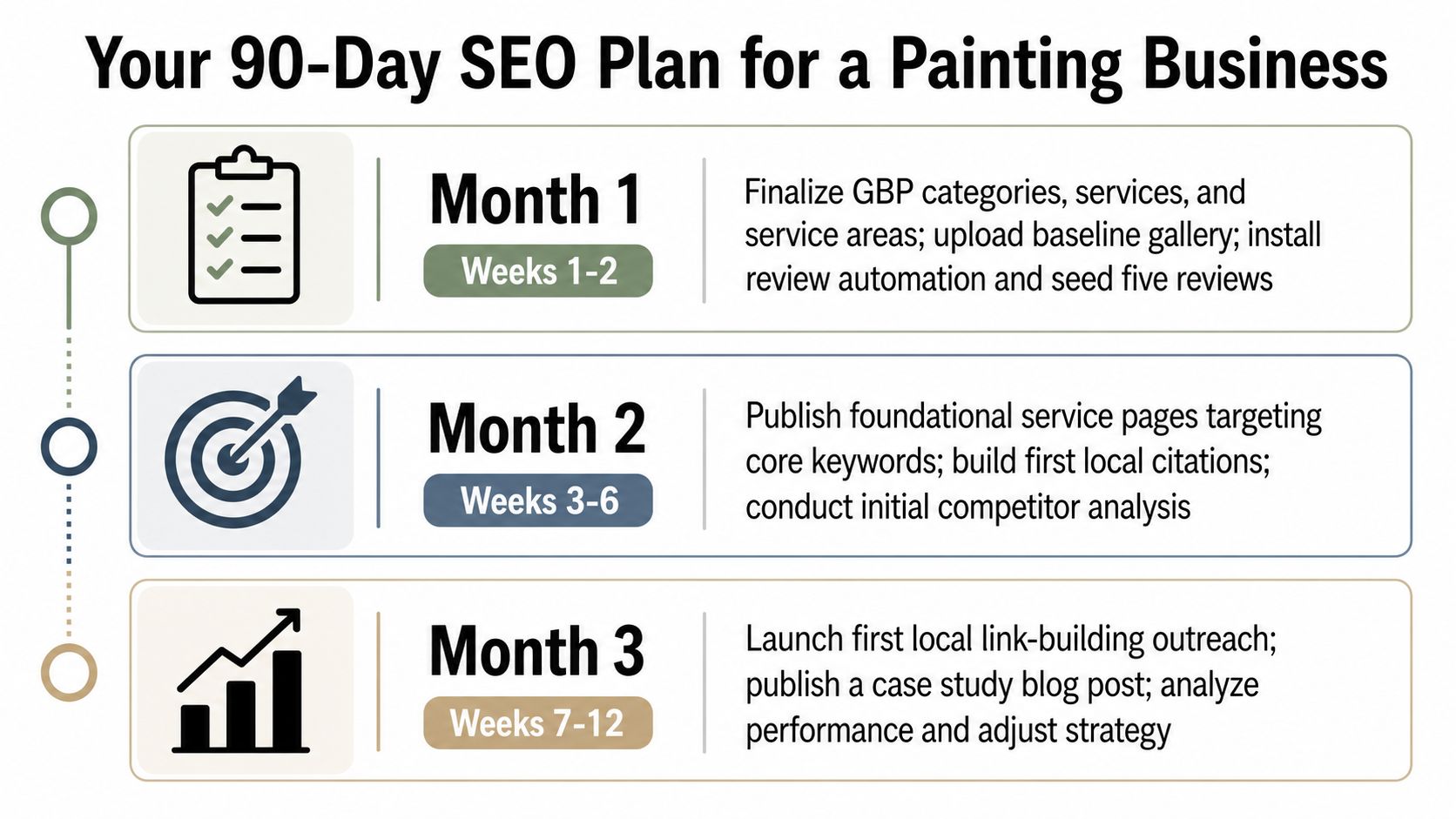
A painter doesn't need to do everything at once. The site, the profile, the reviews, and the link outreach all work better when they're rolled out in a sequence that matches how local search behaves. In the first quarter, the goal is to create enough relevance, trust, and proof that Google starts testing the business more often for the right searches.
Weeks 1 to 2, tighten the foundation
Finish the Google Business Profile first. Lock in categories, services, service areas, appointment links, and a clean photo baseline. Then install review request automation so the office can start sending asks without improvising every time a job closes. If there are a few satisfied past customers who can leave honest feedback, seed those reviews now so the profile doesn't start from zero.
Weeks 3 to 6, build searchable depth
Publish the first wave of service-area pages, and keep them tied to actual local proof. Each page should have a project photo, a local intro, and a path to request a quote. Start a weekly GBP post cadence, then answer a few Q&A entries each week so the profile stays active instead of static.
Weeks 7 to 12, add proof and authority
Expand the gallery into proper project pages with schema, captions, and short case notes. Run one outreach sprint per week targeting suppliers, HOAs, realtors, and local publishers. Watch the ten highest-intent queries in the map pack, and compare those movements against calls, quote requests, and new reviews.
A simple scorecard keeps the owner out of guesswork. Track calls, quote requests, GBP actions, new reviews, and ranking changes every week. That gives you enough data to know what's moving and what's noise.
If you want help turning this into a done-for-you system, Helios Lab works on Google Business Profile optimization, review strategy, content-led local SEO, and backlink outreach for service businesses. Visit Helios Lab if you want a team to build the map-pack, content, and authority pieces around your painting business instead of leaving them to chance.