Insight
Local SEO for Plumbers That Wins More Calls
Helios Lab

At 10 p.m., a homeowner discovers water spreading across the utility-room floor. They search “emergency plumber near me,” scan the first map results, read a few recent reviews, and call one of the businesses that looks available and trustworthy. They usually won't compare a dozen websites. They'll choose from the small group Google presents first.
That's the operating reality behind local SEO for plumbers. The objective isn't just to rank a homepage for a broad phrase. It's to make your plumbing company visible, credible, and easy to call when someone needs help in a specific place and often needs it immediately.
Table of Contents
Why Local SEO Matters for Plumbers
A homeowner with a leaking water heater needs a plumber who serves the address, answers the phone, and can reach the property within a practical driving range. That makes local demand different from national search traffic. The opportunity depends on appearing in the right area, for the right service, when the customer is ready to contact a business.
Google concentrates much of that decision in the Map Pack. Industry benchmarks cited by SEO Sandwitch's local SEO statistics roundup report that the Local Pack appears in 93% of searches with local intent. The same roundup cites a benchmark in which 42% of local search clicks go to the Map Pack, with 93% of those pack clicks going to the top three listings. Another benchmark places the top three businesses at 47% of local search traffic.
For a plumbing company, website rankings alone can miss the most valuable moment. A service page may answer the customer's question well, while a competitor's profile appears first with a strong rating, current photos, accurate hours, and a clear call button. That competitor can receive the phone call before the customer reaches your site.
The Map Pack is the primary storefront
Google's local results give a small group of businesses far more attention than the rest. That changes the work required from a plumbing company. Google Business Profile completeness, review strength, proximity, relevance, and conversion details deserve the same practical attention as title tags and website copy.
Broad national rankings rarely help a service-area plumber unless they create demand in the markets the company serves. An article about drain maintenance can support authority, but it cannot tell Google or a customer where the business operates, which services it provides, or how to contact it. Those details belong in the profile and on focused service pages.
Practical rule: Treat the Map Pack as your digital storefront. The website supports the sale, while the profile often earns the first call.
Visibility must lead to a phone action
Local SEO matters because the visible result can prompt a direct business action. A searcher may tap to call, request directions to a shop or office, visit the website, send a message, or book an appointment. These actions are closer to revenue than impressions or an isolated ranking report.
A plumbing company's local presence should combine:
Local relevance: The profile and website clearly match services such as leak repair, drain cleaning, water heater work, or emergency plumbing.
Geographic fit: The company serves the searcher's actual area and avoids claiming unrealistic territory.
Trust evidence: Reviews, photos, licensing information, clear service details, and professional responses reduce hesitation.
Call readiness: The phone number, hours, emergency availability, and booking path remain accurate when the customer is ready to act.
Manage local SEO as a system for generating calls and booked jobs. Track whether the right searcher saw the business, contacted it, and scheduled work. Seasonal demand, service-page coverage, and review velocity then become operating priorities, not disconnected optimization tasks.
Map Plumbing Keywords to Search Intent
Grouping searches by intent gives a plumbing team a more usable plan than a raw keyword list. Classify each query by the job the searcher wants to arrange, then assign it to the page, Google Business Profile field, or supporting content most likely to generate a call.
Start with four intent buckets:
Intent Bucket | Example Queries | Map To |
|---|---|---|
Core service | drain cleaning, water heater repair | Dedicated service page and GBP service |
Emergency and urgency | 24 hour plumber, burst pipe repair | Emergency service page, GBP service, call-focused profile content |
Location | plumber in [city], plumber near [neighborhood] | Homepage, genuinely useful service-area page, GBP service area |
Commercial and trust | licensed plumber, plumber reviews, cost to replace water heater | Service page FAQs, review profile, educational or decision-support content |
Build the map around jobs, not variations
Prioritize services that produce meaningful work for the company. A business focused on water heaters, drain cleaning, leak detection, and emergency repairs does not need separate pages for every wording variation. One strong page can cover closely related searches naturally, answer the customer's main questions, and provide a direct route to contact.
Seasonal demand should influence the order of work. Emergency plumbing searches rise when failures require immediate attention, while water heater or drain-related demand may create more research before someone calls. Review the services that bring in calls during busy periods, then make sure those pages and the related GBP services are ready before demand increases.
Emergency intent needs its own page treatment because the searcher's priorities change. A burst-pipe page should lead with availability, response process, phone access, immediate safety guidance, and the areas served. A water heater replacement page can give more space to repair-versus-replacement decisions, equipment options, warranties, and preparation.
Location modifiers require restraint. Begin with the primary city and nearby areas where crews regularly work. A keyword tool alone does not justify a page for every suburb. Proximity still affects local visibility, so a large set of near-identical city pages can consume maintenance time without producing meaningful calls.
Use a page decision rule
Create a new page only when all three conditions apply:
The service or location represents a distinct customer need.
The company can provide unique information, proof, or local detail.
The page has a clear conversion path to a relevant job.
Keep a variation on an existing page or GBP field when it only changes the wording. “Leak repair near me” and “local leak plumber,” for example, may fit the leak-repair page and profile rather than separate pages. This keeps the site focused and limits thin content built mainly around repeating a city name. The practical test is simple: if the page cannot support a distinct service conversation and a credible call path, it probably should not exist.
Build Service Pages That Earn Calls
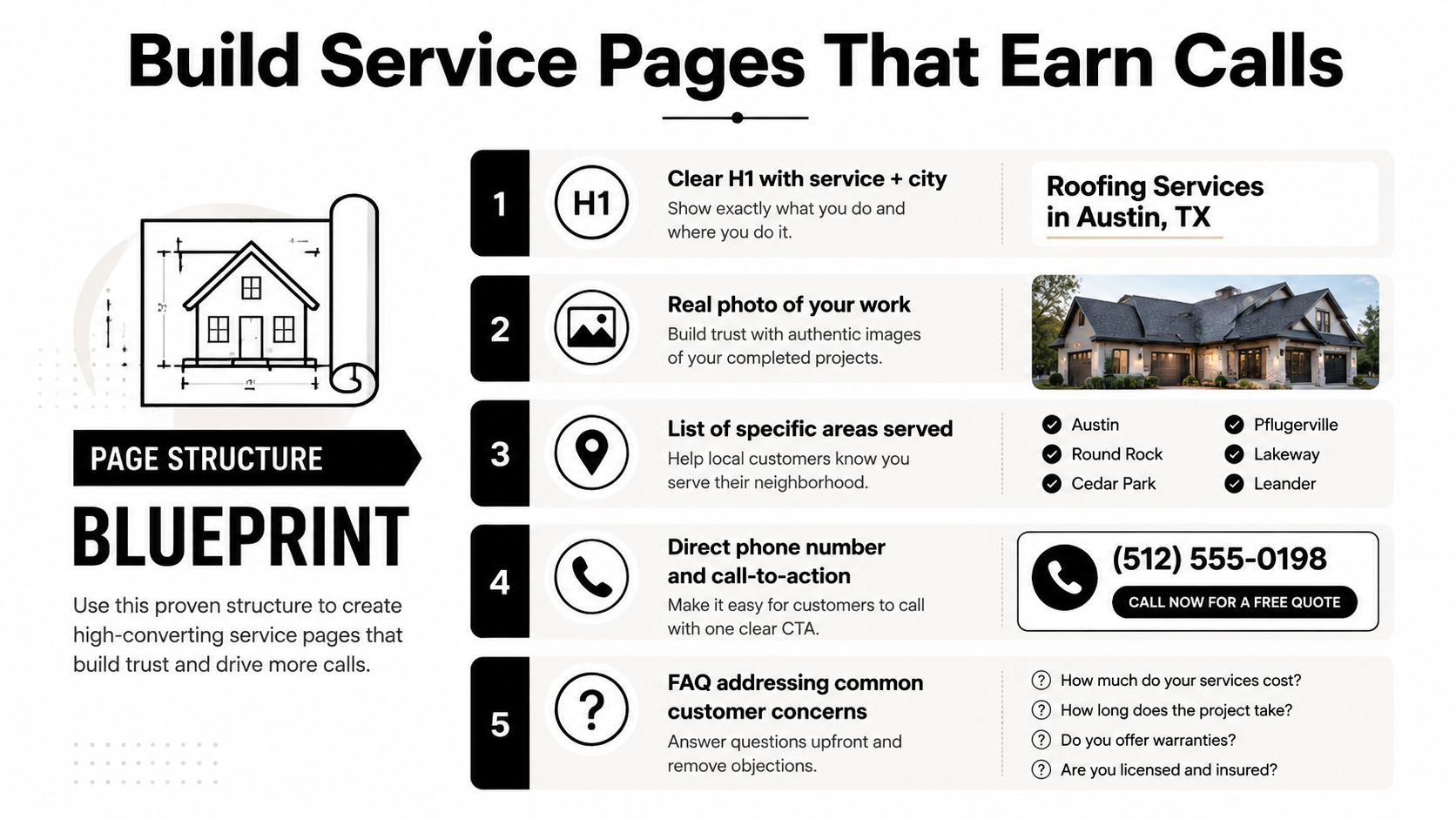
When a homeowner searches for a plumbing service, the page must answer four questions quickly: can you handle the problem, what happens next, do you serve the address, and how can the customer reach you? Write the page like a useful response from the plumbing company, not a doorway page with a city name repeated throughout.
Use a structure that supports both search visibility and booked jobs:
Clear service heading: Name the service plainly and add the primary location when it improves clarity.
Immediate answer: State what the company handles and who should call.
Scope of work: Explain inspection, diagnosis, repair, replacement, cleanup, and relevant limitations.
Commercial clarity: Describe estimates or diagnostic fees when the business can do so accurately.
Trust evidence: Include licensing details, warranties, technician credentials, real project photos, and suitable review excerpts.
Local context: Mention neighborhoods or service areas only where the company works.
Call path: Place a visible phone number and direct call-to-action near the top, then repeat it after major decision points.
Customer FAQs: Answer questions technicians and office staff hear regularly.
A visitor should be able to choose the next step without searching through menus. Someone looking for slab leak detection may also need information about repiping, foundation access, restoration, or follow-up monitoring. Link those related services naturally. Create a separate page only when the topic supports a distinct customer need and a clear path to a relevant call.
Make location pages earn their place
A location-specific service-area page should contain details that help customers in that market. Include neighborhoods served, local housing characteristics, common plumbing problems, access considerations, nearby facilities, or examples of work completed there. A template that changes only the city name adds maintenance work without giving searchers a reason to call.
Use internal links to form a clear service network. A drain-cleaning page can point to sewer-line inspection, while a water-heater repair page can point to replacement. Leak detection can connect to slab-leak work and repiping. These links help customers find the right solution and clarify how the services relate.
The page earns its keep when it reduces uncertainty before the call.
Keep the technical foundation practical. Make the page easy to use on a phone, keep the phone number prominent, write descriptive titles, add accessible image descriptions, and test the contact route. Structured data can clarify business and service information, but it cannot repair weak content or inaccurate business details.
Service pages strengthen local relevance and turn qualified visitors into calls. They do not override proximity. A plumber can publish a strong page and still lose a nearby Map Pack position to a competitor with stronger local signals. Build for the customer first, then support the page with an accurate profile, credible reviews, and a service footprint the crew can cover.
Optimize Your Google Business Profile
A plumbing company's Google Business Profile should answer the customer's practical questions before the website opens. Start with the primary category that best represents the business, then align the description, services, photos, and availability with the jobs you want.
Use this sequence:
Confirm the business identity: Check the name, phone number, website, address or service-area setup, and verification status.
Choose relevant categories: Use “Plumber” as the primary category when accurate, then add only secondary categories that reflect real offerings.
Write a focused description: Connect the company to its core services and actual service region without stuffing keywords.
Complete the services menu: Add specific offerings such as water heater repair, drain cleaning, leak detection, sewer work, and emergency plumbing, but remove services the team doesn't perform.
Define service areas accurately: Base them on realistic drive time, staffing, and response expectations rather than distant cities the company rarely reaches.
The profile's media should show evidence of real operations. Upload before-and-after work, technicians, branded vehicles, equipment, and any legitimate storefront or office imagery. Captions can provide context, but don't add misleading location claims or use stock images as if they were job photos.

Keep the profile active and useful
GBP Posts can support timely communication around freezing weather, storm preparation, seasonal maintenance, or current availability. They're most useful when they point to a real service or helpful page rather than repeating generic promotional copy.
The Questions and Answers area can address common friction points, including service availability, licensing, diagnostic processes, emergency coverage, and scheduling. Monitor it so incorrect public answers don't sit unanswered.
Profile conversion details deserve a final audit. Check opening hours, holiday hours, appointment links, message settings, phone routing, and any accurate attributes such as locally owned or emergency availability. A searcher who sees a strong profile but can't confirm whether anyone will answer may choose another plumber.
Industry benchmark summaries attribute about 32% of local-pack ranking weight to GBP signals and about 20% to review signals, according to Webtonic's plumbing local SEO statistics. Treat those figures as directional benchmarks, not guarantees. The operational lesson is straightforward: profile fields and review management deserve regular attention, not a one-time setup.
For background on the listing itself, see what a Google company listing is and why a business needs one.
Create a Repeatable Review Workflow
A homeowner with a leaking pipe often compares plumbers while deciding who can answer first. Reviews shape that decision before the customer weighs workmanship, availability, or price. BrightLocal's 2023 Local Consumer Review Survey findings report that 98% of consumers read online reviews for local businesses at least occasionally, while 76% always or regularly read them when evaluating local service providers. The survey also found that 87% used Google to assess a local business.
The same findings report that 48% of consumers wouldn't use a business with an average rating below 4.0, and shoppers read an average of 10 reviews before they feel able to trust a local business. A thin or outdated review profile can remove a plumbing company from consideration before its service page or Google Business Profile has a chance to generate a call.
Put the request into the job process
Ask for the review after the work is complete and the customer has seen the result. A text or email containing a direct Google review link reduces friction. The office can send it when the technician closes the job, while the technician can mention it naturally during the wrap-up conversation.
Give technicians a simple framework, not a rigid script. A request tied to the completed repair sounds more credible than a demand for a five-star rating. Office staff should check completed jobs and follow up when a technician missed the request.
Method | Typical Response Rate | Staff Effort | Best For |
|---|---|---|---|
In-person request | Varies by customer and timing | Moderate | Jobs that end with visible, successful results |
Text with direct link | Varies by message quality and customer engagement | Low after setup | Fast follow-up after completed jobs |
Email request | Varies by customer preference | Low | Customers who prefer written communication |
Invoice or receipt link | Usually requires customer initiative | Low | Reinforcing a request already made |
Office follow-up | Depends on timing and relationship | Moderate | Missed technician requests or delayed satisfaction |
Request reviews from every eligible customer. Do not buy reviews, write reviews for customers, or offer incentives that distort feedback. Those shortcuts weaken trust and can create compliance problems.
Respond with consistency
Set an internal standard of responding to every review within two business days. Thank positive reviewers specifically and refer to the service without exposing private details. For negative feedback, acknowledge the concern, avoid public arguments, take ownership where appropriate, and offer a direct route to resolve the issue offline.
Track review velocity and recency, not only the lifetime total. Teams should aim for a review volume and velocity benchmarked to their market, for example, 40 to 80 reviews above 4.5 stars and 20 to 25 new reviews per month to maintain position, according to Webtonic's plumbing benchmark summary. Treat those figures as planning references, not promises of a ranking outcome. A smaller market may need a different pace, while a competitive metro may require a more consistent flow.
Use this guide to review management tools when comparing monitoring workflows and platforms. The platform matters less than assigning ownership, making requests easy, and continuing the process after the initial burst of enthusiasm. A steady review workflow supports map visibility when seasonal demand or emergency searches increase call volume.
Earn Local Links and Citations
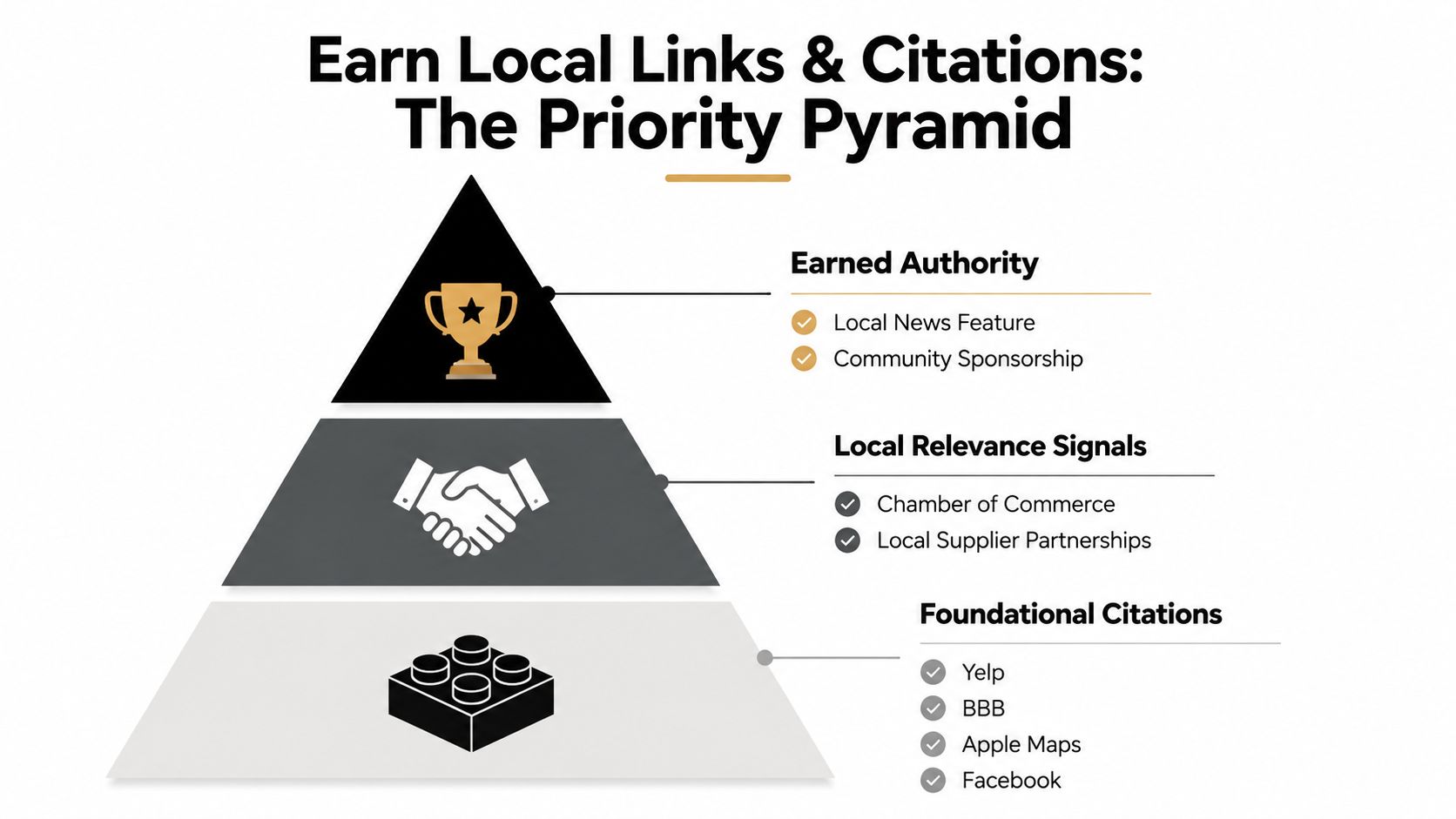
Local authority isn't a contest to collect the largest number of directory links. A plumbing company needs accurate business references first, then mentions that make sense because they connect the company to a real place, community, or trade relationship.
Start with foundational citations. Check the business name, address, phone number, website, hours, and service description across Yelp, the Better Business Bureau, Apple Maps, Facebook, Angi, and HomeAdvisor. Treat these as accuracy corrections, not as a volume campaign. A conflicting phone number or outdated service area can create confusion for customers and weaken the consistency of the local presence.
Prioritize relationships over easy placements
The strongest opportunities usually come from activities the plumbing company would reasonably do even without SEO:
Local participation: Join a chamber of commerce or relevant trade association and keep the profile accurate.
Community sponsorship: Support a youth sports team, neighborhood event, or local charity where the business has a genuine presence.
Useful education: Host a cross-connection control or winterization workshop for property managers, building owners, or community groups.
Trade relationships: Build referral and content relationships with HVAC companies, electricians, restoration firms, real estate professionals, and plumbing suppliers.
Local expertise: Offer practical commentary to a local news outlet covering frozen pipes, storm damage, or seasonal water issues.
Evaluate each opportunity by relevance, geographic connection, credibility, and conversion potential. A mention from a nearby organization with a real audience may be more valuable to a plumber than a link from a large but unrelated site. Don't pay for placements that require questionable claims or exist only to manipulate rankings.
Measure the business effect, not the link count.
Record when a citation or local mention goes live, then compare profile views, calls, website actions, direction requests, and booked work over time. The comparison won't always produce a clean attribution, but it's more useful than reporting a growing spreadsheet of URLs.
For a broader outreach framework, use this guide to earning quality backlinks for a local business without buying them). The core rule remains simple: local relevance and customer access beat raw domain or link volume.
Measure Visibility, Calls, and Jobs
A plumber needs a measurement chain that follows the customer from search exposure to completed work. Rankings matter, but they're only one stage. A profile can receive visibility without producing calls, and a website can receive traffic without producing booked appointments.
Record the first signals
Track Map Pack and organic visibility for priority searches such as “emergency plumber,” “drain cleaning,” and “[city] plumber.” Check rankings by ZIP code or another consistent local grid, because a single manual search from the office won't represent the entire market.
Add notes for:
Search context: Service, city, ZIP code, and device context where available.
Market changes: New competitors, profile suspensions, office moves, or major review activity.
Timing: Weather events, seasonal demand, holidays, and unusual service spikes.
Page destination: Which profile, service page, or location page appears and receives the click.
Avoid reacting to every daily fluctuation. Review the pattern monthly, then compare performance across service areas, services, seasons, and landing pages.
Connect profile actions to leads
Google Business Profile reporting can separate calls, website clicks, direction requests, and messages. Track those actions independently instead of treating every interaction as equivalent. Use a tracked phone number where appropriate, UTM-tagged website links, and booking software that records the original source.
A 2026 plumbing data summary from Webtonic's plumbing digital marketing statistics reports 4.2 times more calls from optimized profiles than from basic or unverified listings, with top performers showing about 180 monthly GBP calls compared with an industry average near 45. The same summary reports roughly 8,500 profile views versus 2,200 for average accounts. These are benchmark figures, not a forecast for every business, but they reinforce why profile actions should be measured separately from rankings.
Follow the job through the pipeline
The office should record:
Inbound calls and messages.
Qualified plumbing opportunities.
Booked appointments.
Completed jobs.
Revenue and service type.
Lead source, such as GBP, organic search, referral, or another channel.
If calls rise while bookings fall, inspect response time, missed calls, dispatch capacity, and the booking path. If impressions rise without calls, check whether the profile matches the service, whether reviews support trust, whether the phone details work, and whether the searcher is outside the practical service area.
Seasonality also belongs in the report. Independent contractor data cited by Blue Grid Media's contractor SEO statistics reports emergency plumbing searches nearly tripling from spring to peak summer and freezing-event demand surging by 609% in winter. Use those patterns to plan emergency pages, mobile call paths, review requests, GBP posts, and outreach around local weather conditions rather than publishing the same content every month.
Helios Lab provides done-for-you Google Business Profile optimization, review programs, local content, citation management, backlink outreach, rank tracking, and call-focused reporting for service businesses. Visit Helios Lab to request a diagnostic audit, then use the findings to prioritize the profile, service pages, reviews, and measurement gaps most likely to affect booked plumbing work.