Insight
How to Resell SEO Services Without Losing Margin
Helios Lab

Most agencies don't lose money on reseller SEO because the wholesale work is bad. They lose it because they treat resell SEO services like a markup, then forget to bill for the stuff that eats the margin, account management, reporting, QA, revisions, and client handholding. The market is already built for this model, with about 58% to 65% of agencies outsourcing at least part of SEO and typical reseller pricing landing at 2x to 3x wholesale cost with gross margins that only hold if you count every real cost line Nico Digital benchmark.
That's the uncomfortable truth. The winning model isn't “buy SEO cheap and sell it higher.” It's designing a delivery system that survives scope creep, keeps the client confident, and still makes money when AI reporting, local visibility, and content demand start compressing what agencies can charge. If you get the operating model right, reseller SEO becomes a stable profit engine. If you get it wrong, you've just outsourced your own margin leak.
Table of Contents
Why Reselling SEO Is an Operating Decision, Not Just a Markup
Choosing Between White-Label, Private-Label, and In-House Delivery
Why Reselling SEO Is an Operating Decision, Not Just a Markup
The first mistake is treating resale as a simple price decision. It changes staffing, sales motion, reporting, and the amount of client friction you absorb when a provider misses a deadline or the client asks for “just one more revision.” That is why I treat reseller SEO as a build-versus-buy decision shaped by the way the business runs.
Markup hides the actual cost lines. Account management time, quality checks, call prep, status emails, and rework can wipe out a spread that looks healthy on paper. The market keeps pushing in this direction, with digital marketing outsourcing projected to grow from $17.1 billion in 2025 to $51.8 billion by 2035 in one forecast Market.us. Buyers do not just want execution. They want coordination they can sell without creating delivery chaos.
Practical rule: If you cannot explain where every hour goes between sale and renewal, you are subsidizing reseller SEO.
Price variation usually reflects scope, quality control, and communication load, not just rank difficulty. For a clear breakdown of the moving parts, see why SEO prices vary so much and what you're really paying for.
The right model is blunt. Price off loaded cost, write SLAs that hold up when work slips, and build onboarding that does not depend on memory. If you do that, reseller SEO becomes a repeatable operating model with room for margin even as AI pushes basic SEO work toward commoditization. If you skip it, the spread looks fine until the service burden shows up.
Packaging Your Resell SEO Services Into Three Clear Bundles
Buyers do not want a vague SEO package. They want a bundle that matches their stage, budget, and appetite for coordination. If you force every prospect into the same offer, scope creep will hit the weakest point and stay there.
Start with a local starter package
Use this for service-area businesses, local professionals, and storefront operators that need visibility in a defined market. Keep it tight. Google Business Profile work, review support, citation consistency, basic technical cleanup, and a small set of local content pieces belong here. For local delivery, the order that usually matters most is profile optimization, review velocity, local landing-page relevance, then local backlinks and citations, as supported by local-ranking research Visionary Marketing.
Build an SMB growth package
This bundle fits companies selling regionally or online that need broader organic demand capture. Add more content, deeper technical work, and ongoing link acquisition. Do not promise everything. Build a package that can support growth without turning every request into a custom quote.
Reserve premium for clients that can actually use it
Premium should mean stronger strategy, more frequent reporting, broader content production, and heavier link outreach. It should not mean a fancier label and a higher invoice. Leave out unlimited revisions, custom dashboards for every executive, and one-off “can you also do social?” requests. Those eat margin fast.
Bundle | Core Deliverables | Reporting Cadence | Ideal Client |
|---|---|---|---|
Local Starter | GBP optimization, reviews, citations, local pages, basic technical fixes | Monthly | Service-area and storefront businesses |
SMB Growth | Content, technical SEO, link acquisition, ongoing optimization | Monthly with mid-cycle updates | Regional brands and growing online businesses |
Premium | Broader strategy, deeper content, stronger outreach, executive reporting | Monthly plus scheduled reviews | Higher-ticket clients with real SEO budgets |
The middle tier is where agencies usually squeeze themselves. It feels competitive, then delivery gets buried under requests that should have been priced separately. Keep the bundles distinct. Sell depth, not everything.
Pricing for Margin Without Pricing Yourself Out
The cleanest reseller math starts with the wholesale invoice, then works backward from the retail retainer you need to charge. A practical operating benchmark is to price reseller SEO at about 2x to 3x wholesale cost, which commonly leaves 40% to 70% gross margin before labor, with a more conservative 40% to 60% band once account management and fulfillment overhead are loaded in Linksman. That's the range worth using, not the fantasy number you wish the client would accept.
A retail retainer in the $1,200 to $2,000 range can work if your wholesale cost is controlled and the service scope is tight. The wholesale market itself varies by depth, with local SEO often sitting lower than broader or ecommerce-focused packages Nico Digital benchmark. That spread is exactly why a “cheap” provider can still be expensive once you add revisions, calls, and cleanup work.
Stop pretending loaded labor is free
Agencies lie to themselves about this. The provider invoice is not your cost basis. Your actual cost includes client calls, internal QA, reporting polish, exception handling, and the back-and-forth that happens when the client wants a different angle on the content or a faster turnaround on a fix. If you don't load those hours, your markup is fake.
A floor price should protect margin even when the account is annoying. Annual prepay can help cash flow, but don't use it to excuse underpricing. If AI-driven reporting and automation compress market expectations, your response isn't to slash price blindly. It's to tighten scope, narrow deliverables, and make reporting easier to produce without degrading perceived value.
I'd also look at what local SEO really costs for small businesses before you set your floor. That keeps your retail offer anchored to realistic delivery economics instead of guesswork.
Retail Retainer | Wholesale Cost | Loaded Labor | Gross Margin % | Effective Multiplier |
|---|---|---|---|---|
$1,200 | Lower scope wholesale | Account time and QA reduce headline margin | Conservative band, after overhead | Around 2x |
$1,500 | Mid-scope wholesale | Reporting and revisions matter more here | Middle of the practical planning band | Around 2.5x |
$2,000 | Deeper scope wholesale | Better room for support and cleanup | Still only works if labor is controlled | Around 3x |
If you want the blunt version, here it is. Price low enough to win attention, then lose money on every account, and you've built a hobby. Price for loaded cost, and you've built a business.
Choosing Between White-Label, Private-Label, and In-House Delivery
Most reseller conversations conflate branding with delivery control. The two move together, but they are not identical. White-label keeps the provider invisible. Private-label gives you more control over dashboards, reports, and client-facing assets while still using outside execution. In-house puts the work and the judgment inside your own team. Each model changes your cost structure, your client experience, and the amount of risk you carry.
White-label is the fastest way to revenue
Use white-label when you need to sell now and keep fixed costs light. The provider does the delivery, your team owns the client relationship, and your operational burden stays lower than hiring an internal SEO team. The tradeoff is obvious. You give up visibility and some control, so your margin depends on tight scope and clean communication.
Private-label sits in the middle
Private-label adds more branding control to the same basic setup. You can shape dashboards, reports, and client-facing assets so the offer feels like your shop, even though the execution still comes from outside. That polish creates coordination overhead, and that overhead is where margin leaks if you do not manage it well. Use it when clients care about presentation and continuity enough to pay for it.
In-house is the long game
If you are building a stable SEO practice, strategy and client-facing roles belong closer to home. Execution can still be partially outsourced, but your own people should handle audits, strategy, and key communication once the economics support it. That gives you tighter quality feedback and cleaner accountability. It also brings payroll and management time into the equation, and those costs hit hard when you scale badly.
Model | Brand Control | Startup Cost | Margin Potential | Best For |
|---|---|---|---|---|
White-Label | Low to medium | Lowest | Good if labor stays lean | Solo operators and early-stage agencies |
Private-Label | Medium | Moderate | Stronger if coordination is tight | Agencies with a stable sales motion |
In-House | Highest | Highest | Best long-term control | Established shops with steady retainers |
My shortcut is blunt. Solo consultants with fewer than five clients usually win with white-label. Agencies between five and twenty clients usually get more room to improve margin with private-label. Established shops with steady retainers should move execution in-house where the economics justify it.
Designing SLAs That Protect You and Your Clients
An SLA isn't paperwork. It's the thing that stops a disagreement from becoming an unpaid emergency. If you don't define response windows, deliverable cadence, reporting standards, and escalation paths, the provider and the client will each invent their own version of “on time” and “done.”

Write the response rules first
Standard tickets need one timeline. Urgent issues need another. If a site goes sideways, the client shouldn't be guessing who answers first or how quickly. Put the response window in writing, then define what qualifies as urgent, because that's where reseller relationships usually get messy.
Lock scope to deliverables, not vibes
State exactly what is included each month. That means report cadence, content count, link updates, and any local SEO tasks the provider is responsible for. If you leave scope in broad language, every unhappy client will reinterpret the contract in the broadest possible way.
Define what happens when things go wrong
You need escalation clauses for missed deadlines, ranking drops, and requests that fall outside contract scope. Credits, make-goods, or service-level penalties should be defined before anyone is upset. Marketing copy can be optimistic. The SLA needs legal review before it goes to the client.
Keep the SLA short enough that both sides read it, and strict enough that neither side can fake confusion later.
The best reseller teams use a one-page SLA template that can be signed without a lawyer on the call. That keeps friction low while still protecting the reseller when a provider slips or a client pushes for extra work that was never sold.
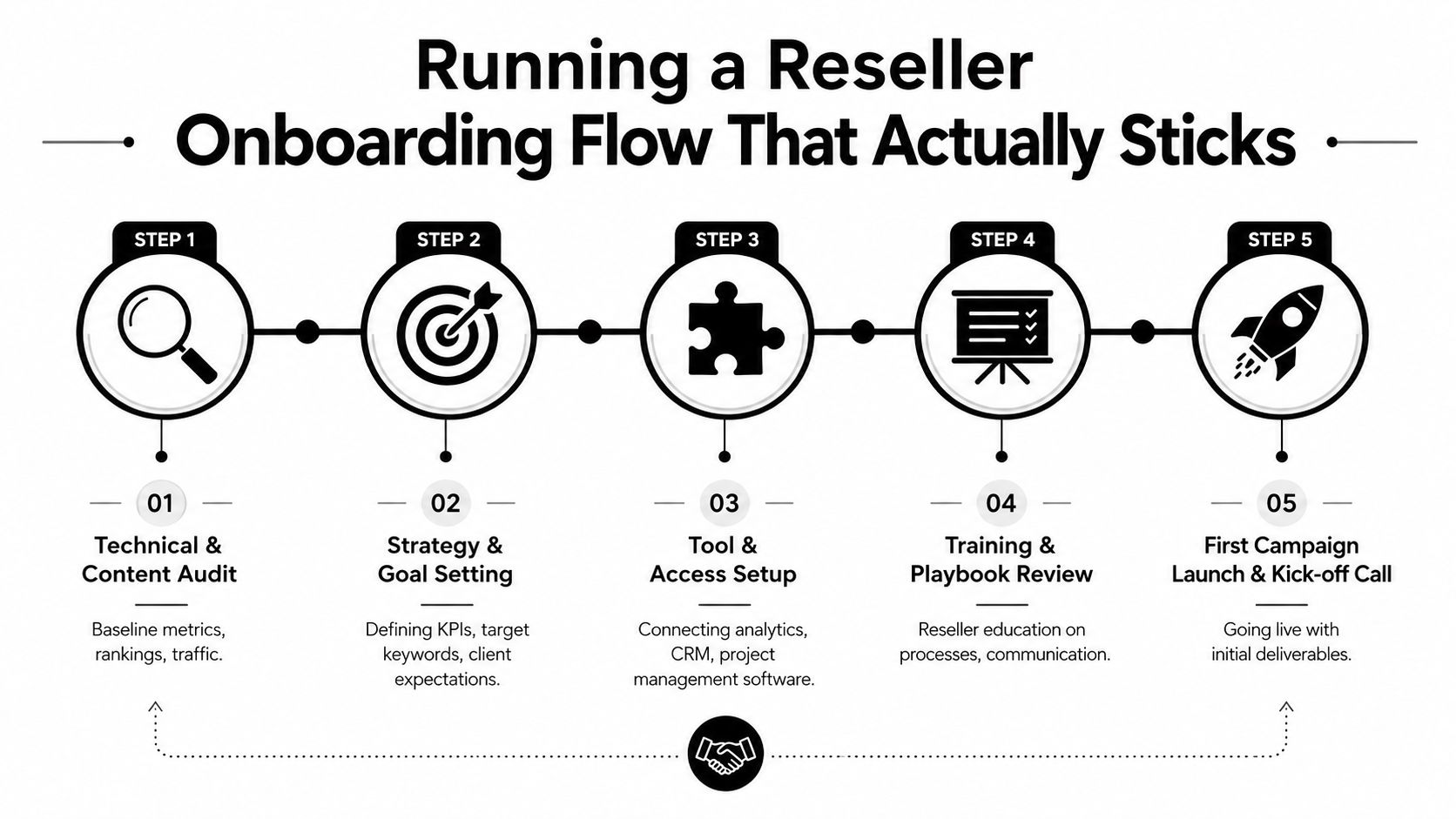
Running a Reseller Onboarding Flow That Actually Sticks
A reseller onboarding flow fails the moment you start work before you have a baseline. Get the audit done first, then run the kickoff, then hand the account into month one with clear ownership. Skip that order and every later conversation gets messier, because nobody shares the same definition of “good” on day one.
The audit needs to cover technical issues, content gaps, and backlink health before anyone promises timing or outcomes. Use a checklist like what an SEO audit should include so the baseline is structured instead of improvised. That gives the reseller, the provider, and the client one shared starting point.
The first 30 days need discipline
The kickoff call should lock scope, goals, access requests, and reporting preferences in writing. Then month one should focus on priority fixes, the content calendar, citation work, and the first monthly report. Every handoff needs a named owner, who controls access, who approves content, and who speaks to the client when questions come up.
The failures are predictable. Access gets delayed because nobody asked early enough. Content stalls because approvals sit in one inbox. Client communication breaks because the reseller and the provider both assume the other side is answering.
A shared project board solves more reseller problems than a fancier reporting tool ever will.
Keep the workflow plain. Use one onboarding checklist, assign one owner to each task, and set one 60-day checkpoint to decide whether the engagement is on track or needs a scope change before month three. That checkpoint matters because it catches mismatch early, before the client decides the whole relationship is broken.
A Reseller Profit Model That Holds Up Under Pressure
The only reseller profit model that matters is the one that still works after churn, revisions, and price pressure. Start with monthly revenue, subtract wholesale delivery, then subtract loaded labor and tools. If the leftover contribution margin is thin, the account is fragile no matter how good it looks in the sales deck.
Here's the kind of working example I trust. A $2,500 monthly client at a 2.2x multiplier against a $1,100 wholesale delivery cost leaves $1,400 gross before account management, tools, and acquisition amortization. That's a solid spread on paper, but only if the operator keeps internal time under control and doesn't keep paying for extra revisions that never got billed.
Stress test the account, not just the retainer
One stress scenario is churn. The other is wholesale price compression from automation and AI-assisted fulfillment. A 15% churn rate changes revenue quality very differently from a 20% drop in wholesale cost, because one affects continuity and the other affects delivery economics. You need to know which one hurts you more in your own book, not in a spreadsheet fantasy.
Scenario | Monthly Revenue | Wholesale Cost | Loaded Labor + Tools | Net Margin | Margin % |
|---|---|---|---|---|---|
Base case | $2,500 | $1,100 | Loaded internal costs apply | Positive if labor is controlled | Healthy only with discipline |
Churn pressure | Revenue becomes less durable | Wholesale stays the same on active accounts | Reacquisition and reset time increase | Margin tightens through churn friction | Lower effective margin |
AI price compression | Revenue may hold short term | Wholesale cost falls | Labor doesn't fall as fast | Margin improves if service stays stable | Better on paper, but only if QA holds |
The weekly numbers I'd watch are cost-to-deliver, realized multiplier, and net margin per client. If those three drift in the wrong direction, you don't have a pricing problem. You have a delivery model that's getting too expensive for the market you're selling into.
Helios Lab offers done-for-you Local SEO, content production, and backlink outreach for service-based businesses, so if you're deciding whether to build or resell those functions, that's the right benchmark to compare against your own delivery math. If you want a partner that thinks in terms of visibility, calls, and operational load, visit Helios Lab and pressure-test your current reseller model against a real operating plan.