Insight
What Should an SEO Audit Include? 25-Point Checklist
Helios Lab
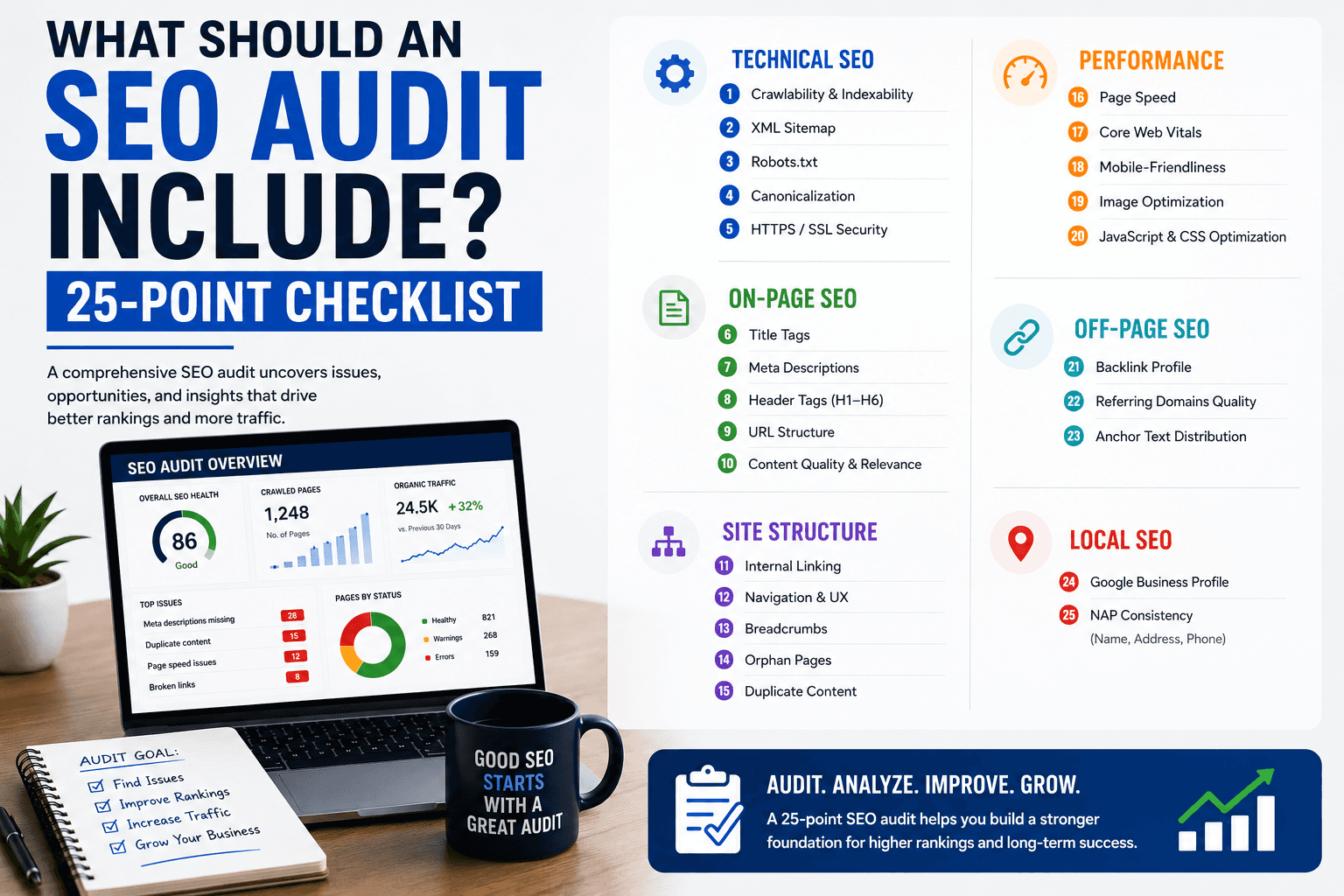
What Should a Good SEO Audit Include?
If an SEO company tells you the first step is an audit, that's usually reasonable.
The harder question is:
What should a good SEO audit actually include?
Some SEO audits are genuinely useful.
They identify why your website isn't ranking, show where competitors are beating you, uncover technical problems, find missed keyword opportunities, and tell you exactly what should be fixed first.
Others are essentially:
A 75-page PDF exported from an SEO tool.
Lots of charts.
Lots of warnings.
Very little explanation about what actually matters.
A good SEO audit should examine technical SEO, crawling and indexing, website structure, on-page optimization, content, keywords, backlinks, local SEO, competitors, user experience, conversions, and measurement—and then prioritize the findings based on business impact.
The last part is especially important.
An audit isn't valuable because it finds 247 problems.
It's valuable because it tells you:
Which problems are actually preventing you from getting found—and what should you do about them?
This guide explains everything a good SEO audit should include, which findings matter most, and how to tell whether you're receiving useful SEO analysis or just an automated report.
What Is an SEO Audit?
An SEO audit is a systematic review of your website and broader search presence designed to identify problems and opportunities affecting your visibility in search engines.
Think of it like an inspection.
Before deciding what SEO work to perform, you first need to understand the current condition of the property.
An audit can uncover issues such as:
Important pages not appearing in Google
Broken internal links
Weak service pages
Poor keyword targeting
Duplicate content
Technical problems
Missing local signals
Weak backlinks
Poor website structure
Slow or frustrating pages
Google Business Profile problems
Competitors with stronger content
Valuable keywords you're not targeting
Traffic that isn't converting
Google itself recommends that businesses considering an SEO provider ask for a technical and search audit that explains what should be improved and why. citeturn926460search5
The best SEO audits don't stop at identifying issues.
They turn those findings into an action plan.
The 12 Core Areas a Good SEO Audit Should Include
A comprehensive SEO audit should generally examine these areas:
Crawling and indexing
Technical SEO
Site architecture
On-page SEO
Keyword targeting
Content quality and gaps
Internal linking
Backlinks and authority
Local SEO
Competitor analysis
User experience and conversions
Analytics and measurement
Let's break each one down.
1. Crawling and Indexing
Before worrying about rankings, you need to answer a more fundamental question:
Can Google actually find and index your important pages?
Google explains that crawling and indexing are foundational to appearing in Search. Pages need to be accessible to Googlebot and contain indexable content before they can become eligible to appear in results. citeturn926460search11turn926460search16
A good SEO audit should investigate:
Which pages Google knows about
Which pages are indexed
Which important pages aren't indexed
Which pages shouldn't be indexed
Robots.txt rules
Noindex tags
Canonical tags
XML sitemap setup
Redirects
HTTP status codes
Crawl errors
Duplicate URLs
Example
Imagine your business has a page for:
Emergency Plumbing Services
It's one of your most profitable services.
But the page accidentally contains a noindex directive.
You could spend months improving the content and building backlinks to that page without solving the fundamental problem.
Google isn't indexing it.
That is why a proper SEO audit starts with technical accessibility.
2. Technical SEO
Technical SEO looks at whether your website is built in a way that allows search engines to efficiently access, understand, and serve its pages.
A technical SEO audit may examine:
Broken links
Redirect chains
404 pages
Duplicate URLs
Canonicalization
Sitemap errors
Structured data
HTTPS
JavaScript rendering
Mobile compatibility
Page speed
Core Web Vitals
Server errors
Google's technical requirements emphasize that Googlebot must be able to access a working page and that the page must contain indexable content. citeturn926460search11
Don't Treat Every Technical Warning as an Emergency
This is important.
SEO tools love finding errors.
That doesn't mean every warning deserves immediate attention.
An automated audit might report:
172 images missing alt attributes.
Potentially worth fixing.
But if your highest-value service pages are accidentally blocked from indexing, that's clearly more urgent.
A good SEO expert separates:
Critical problems
from:
Things that would be nice to clean up.
3. Website Speed and Core Web Vitals
Website experience should also be reviewed.
Google's Core Web Vitals currently focus on real-world user experience related to loading performance, responsiveness, and visual stability. citeturn926460search4
An audit should look for major problems such as:
Extremely slow pages
Large unoptimized images
Excessive JavaScript
Layout shifts
Poor mobile performance
Scripts delaying interaction
However, page speed shouldn't become an obsession.
A site scoring 92 instead of 96 isn't necessarily your biggest SEO problem.
The audit should put technical performance into context alongside content, authority, and search intent.
4. Mobile SEO
Your audit should verify that important content and functionality work properly on mobile devices.
Google uses the mobile version of websites for indexing and ranking under mobile-first indexing. citeturn926460search17
Review:
Mobile navigation
Text readability
Buttons
Forms
Phone links
Page layout
Popups
Missing mobile content
Loading performance
For a local service business, this is especially important.
Someone whose furnace stops working may search from their phone and call immediately.
If your website is technically optimized but the phone number is almost impossible to tap, you're losing opportunities.
5. Site Architecture
Site architecture describes how your pages are organized and connected.
A strong website structure helps both visitors and search engines understand:
What your business does
Which pages are most important
How services relate
How supporting content connects to commercial pages
Imagine an HVAC website structured like this:
Homepage
→ AC Services
→ Furnace Services
→ Heat Pumps
→ Indoor Air Quality
Under AC Services:
→ AC Repair
→ AC Installation
→ Emergency AC Repair
That is much easier to understand than placing 75 unrelated pages into one giant website structure.
A good audit should evaluate:
Navigation
URL structure
Page hierarchy
Orphan pages
Content depth
Service organization
Location pages
Internal linking
6. On-Page SEO
Next, the audit should examine whether important pages clearly communicate what they're about.
On-page SEO commonly includes:
Page titles
Meta descriptions
H1 headings
Subheadings
Page content
URLs
Images
Internal links
Calls to action
Structured data where appropriate
The goal isn't to repeat a keyword 47 times.
It's to make the page clearly useful for the searcher's intent.
Example
Suppose a plumber has one page called:
Services
That page briefly mentions:
Water heaters
Sewer repair
Drain cleaning
Leak detection
Repiping
Meanwhile, competitors have detailed pages for each service.
The audit might recommend creating dedicated pages because one thin “services” page may not adequately address all those distinct search intents.
7. Keyword Targeting
An SEO audit should tell you whether your website targets the searches most likely to produce business.
Not just high-volume keywords.
Valuable keywords.
For example, an HVAC company might encounter:
Informational
“How long does an AC unit last?”
Commercial
“best HVAC company in Denver”
Transactional
“AC repair near me”
Different keywords represent different stages of the buying journey.
A useful keyword audit should evaluate:
Existing keyword rankings
High-intent keywords
Missing service keywords
Local keywords
Informational opportunities
Search intent
Competitor keywords
Pages ranking for the wrong query
Keyword cannibalization
Keyword Cannibalization
This can happen when several pages compete for very similar searches.
For example:
/ac-repair/air-conditioner-repair/air-conditioning-service/ac-service
If all four pages serve essentially the same purpose, your website may have created unnecessary overlap.
The audit should identify whether pages should be:
Combined
Redirected
Repositioned
Differentiated
8. Content Quality
Content is one of the most important parts of a modern SEO audit.
Google's current guidance emphasizes creating helpful, reliable, people-first content rather than content primarily designed to manipulate search rankings. citeturn926460search12
Your audit should evaluate:
Thin pages
Outdated content
Duplicate content
Generic content
Missing information
Weak service pages
Existing articles
Search intent
Content freshness
Expertise
Original information
Ask:
Does this page actually deserve to rank?
That's a better question than:
Does this page have 1,500 words?
What Good Content Analysis Looks Like
Imagine you're a roofer targeting:
“How much does a new roof cost?”
An audit might compare your page against the current search results and find that competitors provide:
Pricing ranges
Cost by roof size
Cost by material
Labor considerations
Tear-off costs
Location factors
FAQs
Your article provides only:
“Roof prices vary. Contact us for an estimate.”
Technically, you have a page targeting the keyword.
Practically, you're not answering the question well.
That is a content problem.
9. Content Gap Analysis
A content audit shouldn't only analyze what already exists.
It should identify what is missing.
For example, your competitors may attract customers from searches such as:
How much does AC repair cost?
How long does a furnace last?
Should I repair or replace my AC?
Heat pump vs furnace
Why is my AC blowing warm air?
If you don't have useful pages answering those questions, you may be missing opportunities to reach customers earlier in their buying process.
A content gap analysis can identify:
Missing service pages
Missing location pages
Missing informational topics
Comparison topics
Cost-related searches
FAQs
Competitor content opportunities
This is where the audit begins turning into an actual content strategy.
If you're interested in how content fits into a broader organic strategy, the Helios Lab SEO blog covers SEO content, local search, backlinks, pricing, and hiring SEO providers.
10. Internal Linking
Internal links connect pages within your own website.
They're easy to overlook.
A good audit should identify:
Important pages with very few internal links
Orphan pages
Contextual linking opportunities
Poor navigation
Broken internal links
Overuse of generic anchor text
Imagine you publish an article:
“How Much Does Furnace Replacement Cost?”
That article should probably link naturally to your:
Furnace Replacement Service
page.
And your furnace service page might link to relevant educational resources.
This creates a logical path:
Informational content → commercial service → conversion
Internal linking isn't just an SEO checkbox.
It helps visitors move through your website.
11. Backlink Profile
Backlinks are links from other websites to yours.
A backlink audit should analyze:
Which websites link to you
Which pages attract links
Whether links are relevant
Whether suspicious links exist
Competitor backlink gaps
Local backlink opportunities
Lost backlinks
Linkable content
The important distinction is quality versus quantity.
A competitor having 2,000 backlinks does not necessarily mean you need 2,001.
You need to understand:
Where is their authority coming from?
For example:
Local organizations
News publications
Industry sites
Associations
Suppliers
Relevant editorial content
Those patterns can reveal realistic opportunities.
12. Competitor Analysis
No SEO audit is complete without looking at who already occupies the search results you want.
Your business doesn't rank in a vacuum.
If four competitors consistently outrank you, your audit should investigate why.
Compare:
Website authority
Service pages
Content
Backlinks
Reviews
Google Business Profiles
Site structure
Local citations
Keyword coverage
The useful question is:
“What do the businesses beating us consistently do better?”
Then:
“Which of those differences can we realistically close?”
Competitor analysis turns SEO from guesswork into a comparison.
13. Local SEO Audit
For a local business, this should be a major section—not an afterthought.
A local SEO audit should evaluate:
Google Business Profile
Business categories
Services
Business information
Reviews
Review velocity
Local rankings
Map pack visibility
Citations
Name/address/phone consistency
Location pages
Local competitors
Local backlinks
At Helios Lab, our current Local SEO service begins with auditing the website, Google Business Profile, local listings, speed, mobile setup, and citations before moving into fixes and ongoing tracking. The site currently describes the process as identifying why the business isn't ranking and then fixing the issues rather than simply handing over a report. citeturn448532view0
Google Business Profile Audit
Review:
Primary category
Secondary categories
Business name
Phone number
Website URL
Services
Hours
Photos
Reviews
Description
Duplicate profiles
For a local business, the website is only part of your search presence.
14. Citation Audit
Citations are online listings or references containing business information such as:
Name + address + phone number
An audit may uncover:
Old phone numbers
Incorrect addresses
Duplicate listings
Missing profiles
Inconsistent business names
These problems are especially common when:
Businesses move
Companies rebrand
Phone numbers change
Multiple locations open
Your audit should identify the important inconsistencies rather than simply promise to submit your business to hundreds of meaningless directories.
15. Review and Reputation Analysis
Reviews influence both conversion and local visibility.
A local SEO audit should compare:
Review count
Average rating
Review recency
Review cadence
Competitor reviews
Review responses
But avoid turning review optimization into something manipulative.
The objective should be establishing a consistent, legitimate process for asking real customers for feedback.
16. Conversion Analysis
This is an area many SEO audits miss completely.
SEO's job isn't only getting traffic.
It's helping acquire customers.
Your audit should therefore look at whether visitors can easily take the next step.
Review:
Phone number visibility
Mobile click-to-call
Contact forms
Quote forms
Booking flows
Calls to action
Reviews/testimonials
Trust signals
Service area clarity
Imagine your website moves from 1,000 to 2,000 monthly visitors but still generates five leads.
You may not need more traffic.
You may need a better website experience.
17. Analytics and Tracking
A serious SEO audit should verify whether results can actually be measured.
Google Search Console can show how Google crawls, indexes, and serves your website and how your pages perform in Search. Google also recommends combining Search Console and Analytics data for a more complete view of how users discover and interact with a site. citeturn926460search30turn926460search19
Check:
Google Search Console
Google Analytics
Conversion events
Phone tracking
Form tracking
Organic traffic
Landing pages
Search queries
For a local business, you eventually want to move beyond:
“Organic sessions increased 34%.”
Toward:
“Organic search generated 23 calls and 11 quote requests.”
18. AI Search Visibility
In 2026, I'd also expect a modern SEO audit to consider how your business appears across emerging AI-powered search experiences.
But don't let someone sell you a fake separate “AI audit” full of unsupported hacks.
Google's current guidance says the same foundational SEO practices remain relevant to its AI Overviews and AI Mode. It recommends clear technical structure, unique content, accurate information, and measuring visibility through Search Console rather than chasing special AI-only tricks. citeturn926460search15
So an AI-search review can reasonably ask:
Is your content clear enough to extract answers from?
Are important claims specific?
Do you publish original information?
Is your business information consistent?
Does your site demonstrate expertise?
Are you earning legitimate mentions and links?
Are your important pages indexable?
The answer shouldn't be:
“Install a secret AI file and you'll rank in ChatGPT.”
What Should the Final SEO Audit Deliverable Look Like?
This may be the most important part.
A great audit shouldn't end with:
“Here are 143 issues. Good luck.”
It should organize findings by priority.
I prefer four levels.
Priority | Meaning | Example |
|---|---|---|
Critical | Blocking search visibility or causing major loss | Important pages not indexed |
High | Strong potential effect on rankings/leads | Missing core service pages |
Medium | Worth improving after major issues | Weak internal linking |
Low | Cleanup or minor optimization | Small metadata improvements |
Then each recommendation should answer:
What's Wrong?
Example:
“Your AC installation page is not indexed.”
Why Does It Matter?
“This is one of your highest-value services, so the page currently has almost no opportunity to generate organic search traffic.”
What Should Be Done?
“Identify the indexing cause, correct it, request recrawling, and verify indexing in Search Console.”
Who Should Fix It?
Developer, SEO specialist, writer, business owner, etc.
What Should Be Fixed First?
Priority.
That's a useful audit.
What Should NOT Be in an SEO Audit?
Be skeptical when an audit is dominated by things such as:
Proprietary SEO scores
Hundreds of low-impact warnings
Keyword density percentages
Arbitrary word-count targets
Huge lists of generic recommendations
No competitor context
No prioritization
No explanation
No business impact
SEO tools are useful.
But software output isn't the same as professional analysis.
Google's June 2026 guidance on third-party SEO tools specifically reminds businesses that external SEO tools do not have access to Google's internal ranking data and that their scores and predictions are their own. citeturn926460search18
Your audit should use tools as inputs.
Not treat their scores as Google itself.
Free SEO Audit vs. Paid SEO Audit
Both can be useful.
Free SEO Audit
A free audit usually works best as a preliminary assessment.
You might expect:
Major technical problems
Current rankings
Google Business Profile issues
Local listing problems
Obvious content gaps
High-level competitor analysis
The purpose is usually to identify whether there's enough opportunity to justify working together.
Helios Lab currently offers this type of initial review, describing its SEO audit process as scanning the website, Google profile, and local listings to identify why customers may not be finding the business. citeturn714291view2
Paid SEO Audit
A paid standalone audit can reasonably go much deeper.
It may include:
Technical crawling
Full indexing analysis
Detailed content audit
Keyword mapping
Backlink analysis
Competitor analysis
Site architecture
Technical implementation recommendations
Content strategy
Prioritized roadmap
The key isn't whether the audit is free or paid.
It's whether its depth matches what was promised.
How Long Should an SEO Audit Take?
There is no universal number.
A five-page local business website doesn't need the same audit as:
A 50,000-page ecommerce site
A national marketplace
A 100-location service company
Scope should depend on:
Website size
Number of locations
Technical complexity
Existing content
Competitiveness
Business goals
Be cautious of anyone claiming they fully audited a complex website in five minutes.
Software can crawl it quickly.
Analysis requires interpretation.
How Often Should You Perform an SEO Audit?
You don't need a massive audit every month.
For most small businesses, an in-depth audit is especially useful:
Before beginning SEO
After a major website redesign
After a domain migration
When traffic drops unexpectedly
When rankings plateau
When acquiring a business/site
When changing SEO providers
Ongoing SEO should then include monitoring so major issues are caught before another full audit is necessary.
The 25-Point SEO Audit Checklist
Here's a simple checklist you can use when evaluating an audit.
A good SEO audit should answer:
Technical
Can Google crawl important pages?
Are important pages indexed?
Are robots/noindex rules correct?
Is the sitemap configured properly?
Are redirects and errors handled correctly?
Does the site work well on mobile?
Are there significant speed or Core Web Vitals issues?
Website
Is the site architecture logical?
Are important service pages present?
Are pages targeting the right search intent?
Are titles and headings clear?
Is internal linking strong?
Content
Is existing content actually useful?
Are important topics missing?
Are pages duplicated or competing against each other?
Are there opportunities to add original expertise?
Authority
Who links to the website?
Are backlinks legitimate and relevant?
Where do competitors earn their authority?
Local SEO
Is the Google Business Profile optimized?
Are citations accurate?
How strong are reviews versus competitors?
How visible is the business in local/map results?
Business Performance
Is organic traffic being measured?
Are phone calls and forms tracked?
Which SEO problems should be fixed first?
If the audit cannot clearly answer those questions, it probably isn't finished.
Frequently Asked Questions About SEO Audits
What should a good SEO audit include?
A good SEO audit should review technical SEO, crawling and indexing, website architecture, on-page optimization, keyword targeting, content quality, internal linking, backlinks, competitors, local SEO, conversion performance, and analytics.
Most importantly, it should prioritize recommendations based on impact.
What is the most important part of an SEO audit?
The most important part is identifying what is actually preventing the website from performing better.
Finding problems is relatively easy.
Prioritizing the right problems is where expertise matters.
What is a technical SEO audit?
A technical SEO audit examines whether search engines can efficiently crawl, render, understand, and index a website.
It may review indexing, robots directives, sitemaps, redirects, status codes, canonicalization, mobile performance, structured data, and other technical elements.
Does an SEO audit include keywords?
It should.
A good audit should analyze what keywords the website currently ranks for, which commercial keywords matter, what competitors rank for, and which valuable searches aren't currently targeted.
Does an SEO audit include backlinks?
A comprehensive audit should evaluate the website's backlink profile and compare it with competitors.
The goal isn't simply counting links. It should identify authority gaps, suspicious patterns, strong existing links, and realistic opportunities.
Should a local SEO audit include Google Business Profile?
Absolutely.
For a local business, the audit should examine the website and Google Business Profile, citations, reviews, local competitors, location pages, and map visibility.
Can I do an SEO audit myself?
Yes.
Tools such as Google Search Console can help business owners identify many issues. Google's Search Console provides first-party data about crawling, indexing, search queries, and Search performance. citeturn926460search30
The challenge is usually determining which findings matter most and how to fix them.
Are automated SEO audits accurate?
Automated tools can identify many technical conditions and potential problems.
They are less reliable at determining business priorities, search intent, content usefulness, competitor strategy, and whether a particular warning is actually important.
Use automated audits as diagnostic inputs—not as the final strategy.
How much should an SEO audit cost?
Pricing varies substantially depending on website size, depth, complexity, and whether the audit includes strategy and implementation.
Some agencies offer limited initial audits at no cost as part of the sales process, while comprehensive standalone audits can be paid projects.
Compare scope rather than price alone.
Should an SEO agency fix the problems it finds?
That depends on the agreement.
Some audits are standalone consulting projects.
Others lead directly into implementation.
Before buying, clarify whether you're receiving:
Diagnosis only
or:
Diagnosis + implementation.
Will an SEO audit guarantee higher rankings?
No.
An audit identifies problems and opportunities. Fixing those issues can improve a site's ability to compete, but no provider can guarantee Google's exact ranking response.
The Bottom Line: A Good SEO Audit Should Tell You What to Do Next
A good SEO audit is not a collection of warnings.
It's a decision-making document.
When it's finished, you should understand:
Where are we losing visibility?
What are competitors doing better?
Which technical problems matter?
Which pages need improvement?
What content are we missing?
Do we have enough authority?
Is our local SEO competitive?
Can we measure leads?
And most importantly:
What should we fix first?
That's the difference between an audit and a software export.
The tool finds problems.
The SEO expert determines which problems matter.
Want to Know What's Actually Holding Your Website Back?
At Helios Lab, we don't believe an audit should end with a giant PDF and a list of things you now have to figure out yourself.
Our SEO approach starts by examining the pieces that affect whether customers can find you—from your website and Google Business Profile to your local listings, content, and broader search visibility.
From there, the priority is identifying what is costing you visibility and what should be fixed first.
If you're still learning how SEO works, browse the Helios Lab SEO blog for more practical guides.
If you want to see what an ongoing campaign includes, review our SEO services and pricing.
Or, if you'd rather have someone look at your website and explain where we'd start, contact Helios Lab about your SEO audit.
A useful SEO audit should leave you with fewer questions about what to do next—not more.