Insight
Local SEO Agency: What They Do and How to Choose One
Helios Lab

You're probably here because the sales pitches sound good, but nothing feels clear. One agency promises rankings, another shows a dashboard you'll never use, and a third talks about “visibility” without saying what they'll do to get you more calls, directions, or booked jobs. A real local SEO agency should make the path obvious, not mysterious.
The buyers who get burned usually don't hire the wrong personality. They hire the wrong operating model. They sign for activity, not outcomes, and they discover too late that the agency was built to impress in meetings, not to move Google Maps, organic local results, or the newer AI search surfaces that are already shaping discovery.
Table of Contents
What a Local SEO Agency Actually Does
A good local SEO partner is not selling “SEO” in the abstract. It's selling visibility where nearby customers are already looking, which is why the market is so large and so habitual. 80% of U.S. consumers search for local businesses online at least once a week, 32% do so daily, and 98% search online for nearby companies. In the same ecosystem, 46% of Google searches are estimated to have local intent. Those numbers justify a very practical focus, Google Business Profile work, reviews, citations, and location-specific content, because local search isn't a niche channel, it's a routine buying environment. Local search statistics and local intent benchmarks
The real job is local visibility, not broad traffic
The owner who asked for help with “SEO” usually doesn't need national visibility. A plumber in Austin doesn't benefit from traffic in Seattle, and a dentist doesn't need blog visitors who will never book an appointment. A legitimate local SEO agency narrows the fight to the geography that matters and works on the assets Google uses to decide who shows up.
That work usually includes the Google Business Profile, local citations, review management, local landing pages, and website signals that make your business look relevant in a specific area. It also means cleaning up duplicate listings, fixing inconsistent business data, and aligning your site with the same address and service language your customers use.
Practical rule: if an agency starts with “traffic growth” instead of “local lead growth,” it's already talking about the wrong goal.
A vendor can be competent at search and still be wrong for local search. Broad SEO teams often chase topic clusters, generic backlinks, and content volume. Those can help in some situations, but local visibility depends on a tighter set of signals and a much more disciplined execution model.
What a serious local specialist should be able to explain
A serious provider should describe how it handles location pages, service-area targeting, profile optimization, citations, and review prompts without hiding behind jargon. It should also be able to tell you what it will do for a single storefront versus a multi-location operator. If it can't explain that difference, it doesn't really understand local search.
If you're building or expanding location coverage, this guide to adding locations on Google Business Profile is worth reviewing before you sign anything. A competent agency should already know that workflow cold.
The best local agencies don't promise magic. They define the local markets they're targeting, explain the levers they'll pull, and show how those levers connect to calls, directions, and appointments. That's the standard you should enforce.
Core Services You Should Expect
A credible provider should hand you a scoped plan, not a fog machine. If the proposal is full of phrases like “improve online presence” and “build authority,” ask for the actual deliverables. You want a line-item view of what gets done, how often it gets done, and what evidence you'll receive.
Here's the short version. If the contract doesn't cover Google Business Profile optimization, citations, reviews, location content, local authority building, and reporting, it's incomplete. If it tries to bury those tasks inside “general marketing,” it's probably trying to sell you a blended retainer with weak accountability.
Google Business Profile work should be active, not one-time
A real local SEO program includes category selection, business description cleanup, photos, services, Q&A, posts, hours, and ongoing edits when the business changes. The profile should be treated like a living asset, not a setup task that gets checked off once.
That matters because local visibility is tied to the profile in a very direct way. The ranking benchmarks in the next section make clear why this asset deserves attention, but the practical takeaway is simple, if the agency doesn't spend real time inside your profile, it's not doing local SEO in the strict sense.
Citations, reviews, and local links need real process
Citations should be audited for consistency, then cleaned up across major directories. Reviews need a workflow, not wishful thinking. Local links should come from relevant community sources, chambers, partners, sponsorships, or local publications that make sense for your market.
A good agency doesn't ask you to “get more reviews.” It gives you a system for requesting them, tracking them, and responding in a way that fits your brand and compliance requirements.
On the website side, ask for location pages, schema markup, and NAP consistency across the site. On the authority side, ask where links will come from and how those placements will be earned. If the answer sounds like directory submissions and random guest posts, keep walking.
The deliverables should look like this
Service Category | Key Deliverables | Typical Frequency |
|---|---|---|
Google Business Profile | Category review, services update, photos, posts, Q&A management | Ongoing, with regular updates |
Citations | Audit, cleanup, submission, NAP correction | Initial cleanup, then monitoring |
On-page local SEO | Location pages, schema markup, title tags, internal links | Initial build, then periodic updates |
Reviews | Request workflow, response management, reputation monitoring | Continuous |
Local links | Community outreach, relevant placements, partner mentions | Ongoing outreach |
Reporting | Rankings, profile actions, lead signals, task log | Weekly or monthly |
A direct recommendation, do not buy PPC management, social media management, or generic content packages unless they're clearly separate from the local SEO scope. Those services can be useful, but they often dilute focus and inflate the retainer. If the agency is bundling everything together, insist on seeing exactly how much effort goes to the local search work you're paying for.
How Google Local Search Rankings Work
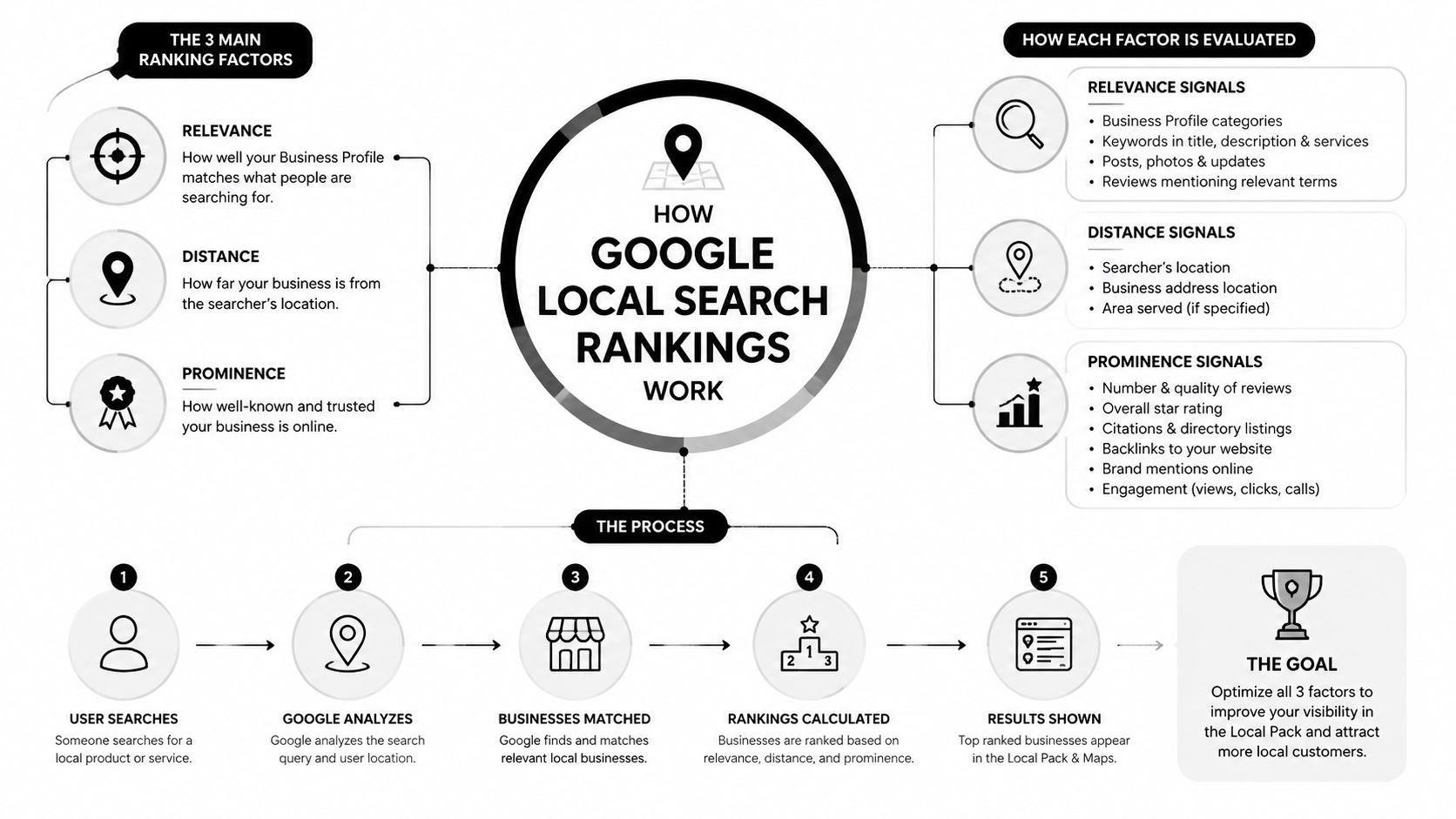
Google's local system is not a mystery box. It runs on a three-part logic, relevance, distance, and prominence. That's the framework you should use when evaluating whether an agency understands the channel or just knows the vocabulary.
The practical implication is sharp. Proximity is mostly fixed, you can't move your office next to every searcher. So the work becomes about improving relevance and prominence, because those are the levers a local SEO agency can influence.
Relevance tells Google what you do
Relevance is about fit. If someone searches for a specific service, Google wants to match that query with a business profile and a website that clearly reflect the offering. That's why category choice, service descriptions, and location pages matter so much.
A business can have solid reviews and still miss if its profile is vague. A weak primary category or a generic service description sends mixed signals, and agencies that ignore those basics are wasting the easiest wins.
Prominence is the trust layer
Prominence is about how well-known and credible your business looks online. That's where reviews, links, citations, and brand mentions come into play. It's also where many agencies overcomplicate the story.
Whitespark's local ranking-factor research puts Google Business Profile signals at the top of local pack influence, with reviews also near the top. The practical takeaway is straightforward, if you want Map Pack visibility, category choice, profile quality, business-name relevance, and review strength matter more than broad-site SEO alone. Whitespark local ranking factors
For a deeper look at link relevance in local search, this guide on backlinks and local SEO is useful because it frames when links help and when they're just noise.
The local results page is concentrated
The Google local results page has long been a concentrated traffic opportunity. Research cited by BrightLocal reports that the Local Pack appears in 93% of searches with local intent, the top 3 businesses in the Local Pack capture 47% of local search traffic, and 42% of local searchers click on Google Map Pack results. BrightLocal also notes that Google Business Profile factors are the biggest influence on Local Pack rankings, while on-page factors matter most for local organic rankings. BrightLocal local SEO statistics
That's why weak agencies fail. They optimize one layer and ignore the others. They'll tweak your website but neglect the profile, or they'll obsess over the profile but never build enough site relevance to own organic local results. The businesses that win usually cover both layers with discipline.
The AI Search Gap Most Agencies Ignore
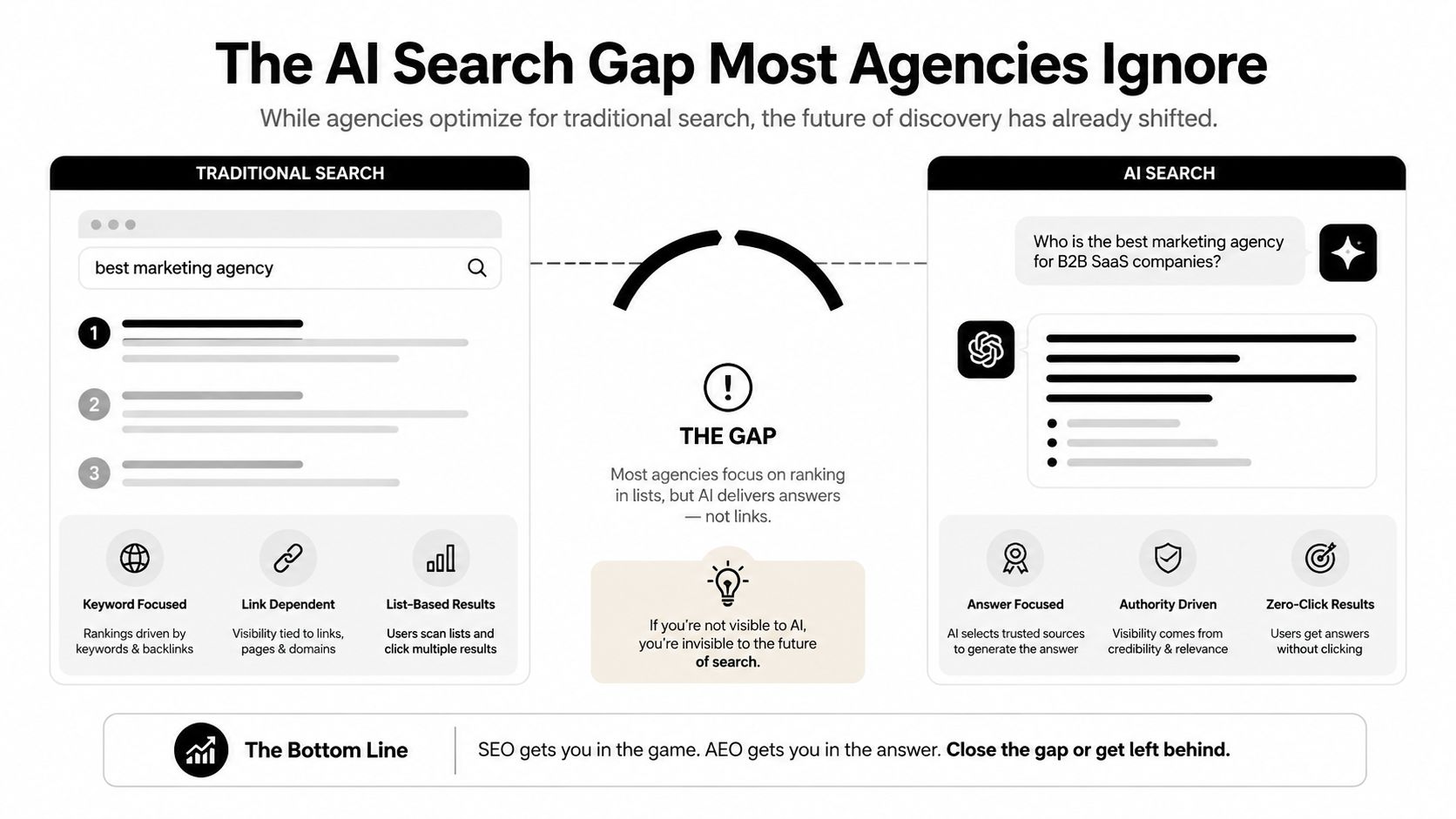
Most agencies still sell local SEO like it's 2021. They talk about the map pack, citations, and reviews, then stop there. That's a problem, because the discovery layer is widening, and buyers are starting to ask questions in AI assistants that don't behave like classic Google search.
Ask the agency what it does for AI visibility
Recent industry coverage says AI search is becoming a distinct discovery layer, and experts expect businesses to need content that is transactional, entity-rich, and consistent across platforms for systems like Gemini and ChatGPT to use. That means the old playbook, citations plus reviews plus a few city pages, is no longer enough on its own. BrightLocal expert predictions for 2026
The question to ask is blunt, what is your strategy for AI search visibility? If the answer is blank stares, generic “content marketing,” or a pivot back to old-school keyword talk, they haven't adapted.
AI assistants reward structured, usable information
AI systems tend to work from entity recognition, structured content, and language that can be reused in synthesized answers. That doesn't mean traditional local SEO is dead. It means your local SEO has to produce content that can be read by machines as well as humans.
The fix isn't gimmicky. It's boring and effective. Use clear service descriptions, plain-language FAQs, consistent business data, and content that shows who you serve, where you serve them, and why you're credible. Agencies that still think optimization is just a rankings game are missing the next buyer journey.
A good test is simple. Ask the vendor how it would make your business citeable in AI answers, not just rankable in a map pack. If it can't answer that directly, it's behind.
How to Evaluate a Local SEO Agency
Sales decks hide a lot. The cleanest way to vet a provider is to pressure-test its process, not its presentation. Ask for the evidence you'd want if you were hiring someone to manage a revenue function, because that's what this is.
Questions that expose real competence
Start with operational questions, not vague philosophy. Ask how it handles Google Business Profile suspensions, whether it has worked with multi-location NAP consistency, and what it does when a location page isn't moving. If it says “we customize every campaign,” follow up with exactly what gets customized and how decisions are documented.
You should also ask for examples of map pack recovery, local citation cleanup, and local link placement sources. If the answers are specific, you're dealing with a working team. If the answers drift into buzzwords, you're dealing with a presentation team.
Red flags are usually obvious if you slow down
Avoid agencies that guarantee specific rankings. Avoid agencies that refuse to show reporting until after you sign. Avoid agencies that can't explain where links come from. Those are not minor weaknesses, they're signs that the vendor wants the contract before it has to prove anything.
If the sales rep won't explain the work in plain language, the delivery team usually can't either.
Green signals matter just as much. Look for an agency that audits your current local search presence before proposing a plan, references the actual categories relevant to your business, and can show case studies with verifiable local ranking movement. If it's willing to talk through the trade-offs instead of pretending every problem has one fixed solution, that's a good sign.
Claims and the evidence you should demand
Agency Claim | Evidence to Demand |
|---|---|
“We'll get you more local visibility” | Baseline audit, ranking tracker, and a defined target market |
“We build authority” | Link source examples, placement types, and editorial standards |
“We manage reviews” | Request workflow, response process, and escalation rules |
“We optimize your profile” | Category choices, service edits, photo cadence, and post schedule |
“We handle multi-location SEO” | Location-by-location plan and NAP governance process |
One more practical move, ask the agency to show its own local visibility. If it can't explain how it earns attention in its own market, you should be skeptical about its ability to do it for yours.
Pricing Models and Contract Terms to Watch
Price tells you something, but contract design tells you more. A cheap retainer with weak accountability can cost more than a higher-priced engagement that ships. You want clarity on model, scope, and exit terms before you ever talk about monthly spend.
The three pricing models are not equal
Monthly retainers are the most common because local SEO is ongoing. That's usually the right model for businesses that need steady profile work, content, and authority building. Project fees make sense for one-time fixes, like an audit, a migration, or a citation cleanup. Performance-based pricing sounds attractive, but it can push the agency toward narrow wins that are easy to measure and hard to sustain.
Use this guide on what local SEO costs for small businesses to calibrate expectations before you let a sales rep anchor the conversation with an arbitrary number. The key issue is not the sticker price, it's whether the scope matches your market and your goals.
Watch the hidden contract traps
Auto-renewals with long cancellation windows are a common trap. So are vague deliverables that let the agency swap in low-value tasks without telling you. Exclusivity clauses can also be a problem if they block you from working with a web developer, PR consultant, or paid media partner who would help your local visibility.
Demand clarity on ownership too. You should retain access to your Google Business Profile, your citations, your content, and your reporting data. If an agency wants to control the keys, assume that's a liability, not a convenience.
Reporting should show movement, not vanity
Ask for reports tied to local search signals that matter. That means rankings for target terms, profile actions, calls, directions, and the work completed that month. If the report is mostly traffic screenshots and impressions without context, it's not helping you manage the investment.
A clean contract protects both sides. It also reveals whether the agency trusts its own work.
The strongest buyers treat the retainer as a working partnership, not a lease on hope. They commit long enough for execution to matter, but they don't give away advantage with sloppy terms. That's the posture you want.
Your Final Decision Checklist

The right decision comes down to five things. First, the agency should have verifiable local results, not vague claims and polished language. Second, reporting should be transparent and tied to the signals that influence revenue. Third, the plan should cover Google Business Profile optimization and local authority building, not just website tweaks. Fourth, it should show a credible approach to AI search visibility. Fifth, the contract should protect you, not trap you.
A strong provider welcomes scrutiny. It should be comfortable showing references, explaining its workflow, and naming the exact metrics it watches. If it gets defensive when you ask basic questions, that's your answer.
Use this checklist before you sign
Local case studies: Ask for examples in businesses similar to yours, with verifiable outcomes.
Transparent reporting: Require weekly or monthly reporting tied to ranking movement, calls, and direction requests.
Strategy for AI search: Make the agency explain how it plans for AI assistants and AI-generated answers.
Client testimonials: Look for references that speak to communication, reliability, and actual results.
Clear KPIs: Define the metrics before work begins, then review them on schedule.
Communication plan: Know who you'll talk to, how often, and what happens when issues come up.
Exit terms: Keep the contract readable, flexible, and easy to leave if performance stalls.
The mindset shift is simple, stop buying SEO deliverables and start buying local outcomes. You're not paying for blog posts, citations, or a dashboard. You're paying for calls, directions, appointments, and the right kind of visibility in the places customers decide.
If you're comparing agencies now, shortlist two or three and run them through this framework line by line. Don't sign until every box is checked.
Helios Lab provides done-for-you local SEO, AI-oriented content, backlink outreach, and transparent reporting for service businesses that need more calls and local visibility. If you want a team that works on Google Business Profile optimization, local content, and emerging AI search surfaces without hiding behind vague retainers, visit Helios Lab and review whether their process fits what you need.