Insight
Why Agency Link Building Matters for Sustainable SEO Growth
Helios Lab

Why Agency Link Building Matters for Sustainable SEO Growth

Agency link building means hiring a specialist team to earn relevant, editorial backlinks to your website. The right agency combines outreach, content, publisher relationships, and SEO strategy to build authority without relying on risky bulk links or private blog networks.
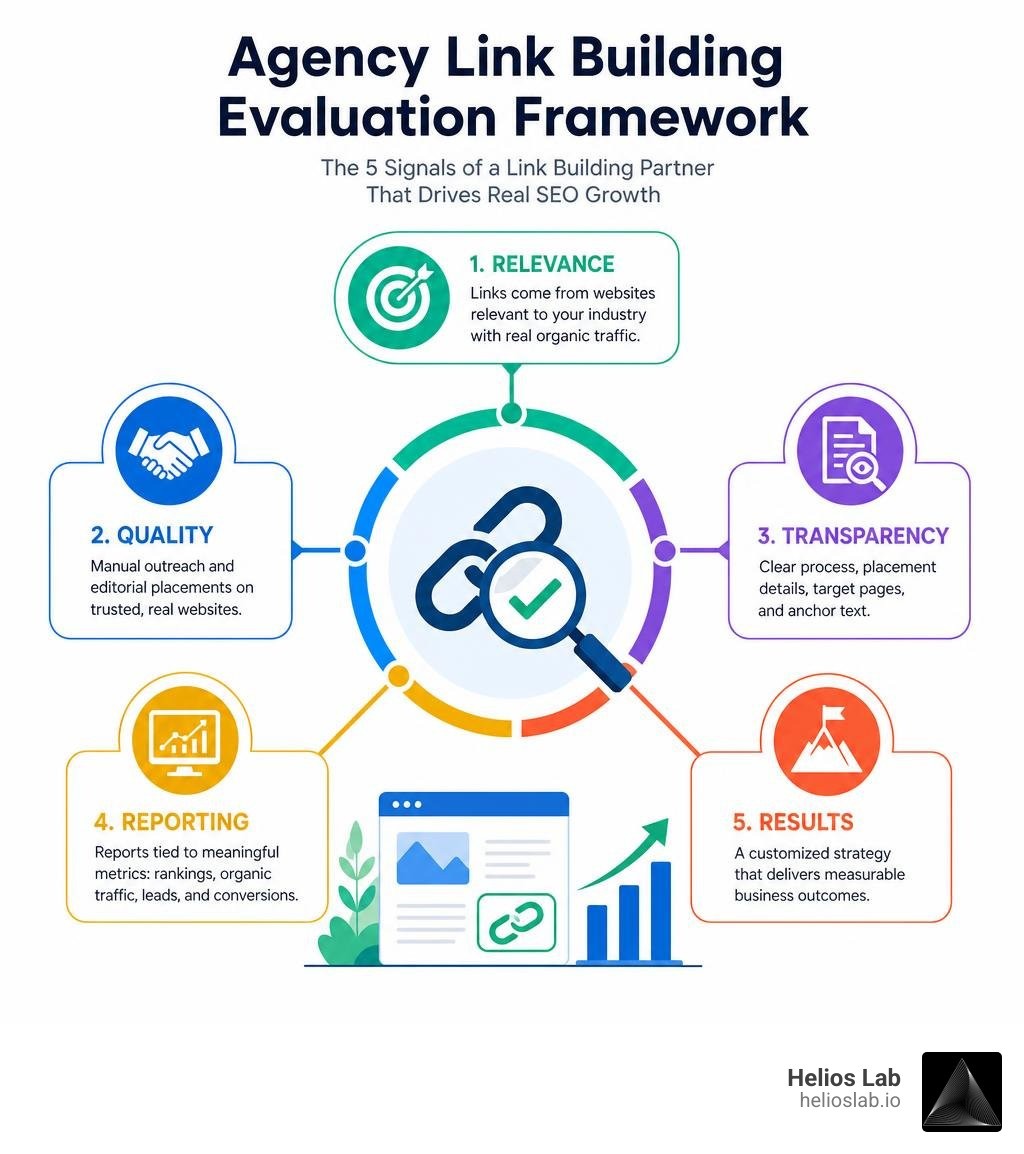
For a quick way to evaluate an agency, look for these five signals:
Relevant websites, not just high DR scores - A link should come from a real site with organic traffic and a clear connection to your industry.
Manual, transparent outreach - You should know how links are earned, where they will appear, and what anchors and pages are being targeted.
White-hat methods - Strong agencies use editorial placements, digital PR, useful content, and legitimate niche opportunities rather than automated schemes.
Reporting tied to business outcomes - Rankings, qualified organic traffic, leads, and conversions matter more than a monthly link count.
A strategy built for your market - A local service company, SaaS platform, ecommerce store, legal practice, and healthcare brand each need different types of links.
Backlinks are still widely viewed as one of Google's top ranking factors in 2026. But the wrong links can waste budget or create risk. The goal is not to buy the most links. It is to earn credible mentions that help search engines and real people see your site as a trusted answer.
This guide will help you compare agencies, spot red flags, understand costs, and choose a partner that can support durable search growth.
In-House vs. Agency Link Building: Key Differences and Benefits
Building backlinks in-house sounds empowering at first. You have complete control over your brand narrative, your internal team knows your product inside and out, and you don't have to onboard an external vendor. However, the realities of modern off-page SEO quickly set in.
Effective outreach requires an extensive tech stack—media databases, email verification platforms, link monitoring tools, and comprehensive SEO software suites. More importantly, it requires dedicated staff who do nothing but build relationships, craft personalized pitches, and secure editorial placements.
When managing this in-house, your team often runs into severe scaling bottlenecks. An internal marketer juggling content creation, technical SEO, and social media rarely has the 30+ hours a week required to conduct cold outreach, handle publisher follow-ups, and negotiate editorial terms.
By contrast, specialized agency link building brings immediate velocity and established publisher relationships. Instead of spending six months hiring, training, and testing outreach templates, an agency connects you to existing pipelines from day one.
If you are currently deciding whether to build internal capabilities or outsource, our guide on Can I Do SEO Myself or Should I Hire Someone? DIY vs. Expert breaks down the true resource allocation required. For most growing companies, working with an agency provides a level of agility that internal teams struggle to match. To understand how external expertise integrates with your broader business goals, take a look at our analysis on whether Is It Worth Hiring an SEO Company for My Business.
Strategic Advantages of Professional Agency Link Building
Why do mid-market brands, SaaS unicorns, and enterprise companies partner with specialized agencies? It comes down to four core strategic capabilities:
Access to Vetted Publisher Networks: Agencies maintain active relationships with editors, journalists, and blog managers across hundreds of verticals. They already know which publications accept editorial contributions, which sites actually generate real human traffic, and which ones are spammy link farms to avoid.
Digital PR and Editorial Integration: Modern link acquisition is no longer just about guest posting. Top-tier agencies craft data-driven stories, conduct original research, and build interactive tools that earn high-tier media mentions naturally.
Generative Engine Optimization (GEO) Alignment: In 2026, search is no longer limited to blue links. Large Language Models (LLMs) like ChatGPT, Gemini, and Perplexity synthesize answers from high-authority sources across the web. Earning backlinks on authoritative, indexable sites ensures your brand gets cited in AI-generated search responses.
AI-Resistant Link Profiles: As automated, AI-generated content floods the web, search engine algorithms heavily penalize low-quality, automated sites. Specialized agencies focus on securing editorial links on sites with strict human moderation and verifiable organic traffic.
ROI Expectations and Timelines for Results
Link building is an investment that compounds over time, but business leaders naturally want to know when they will see tangible returns.
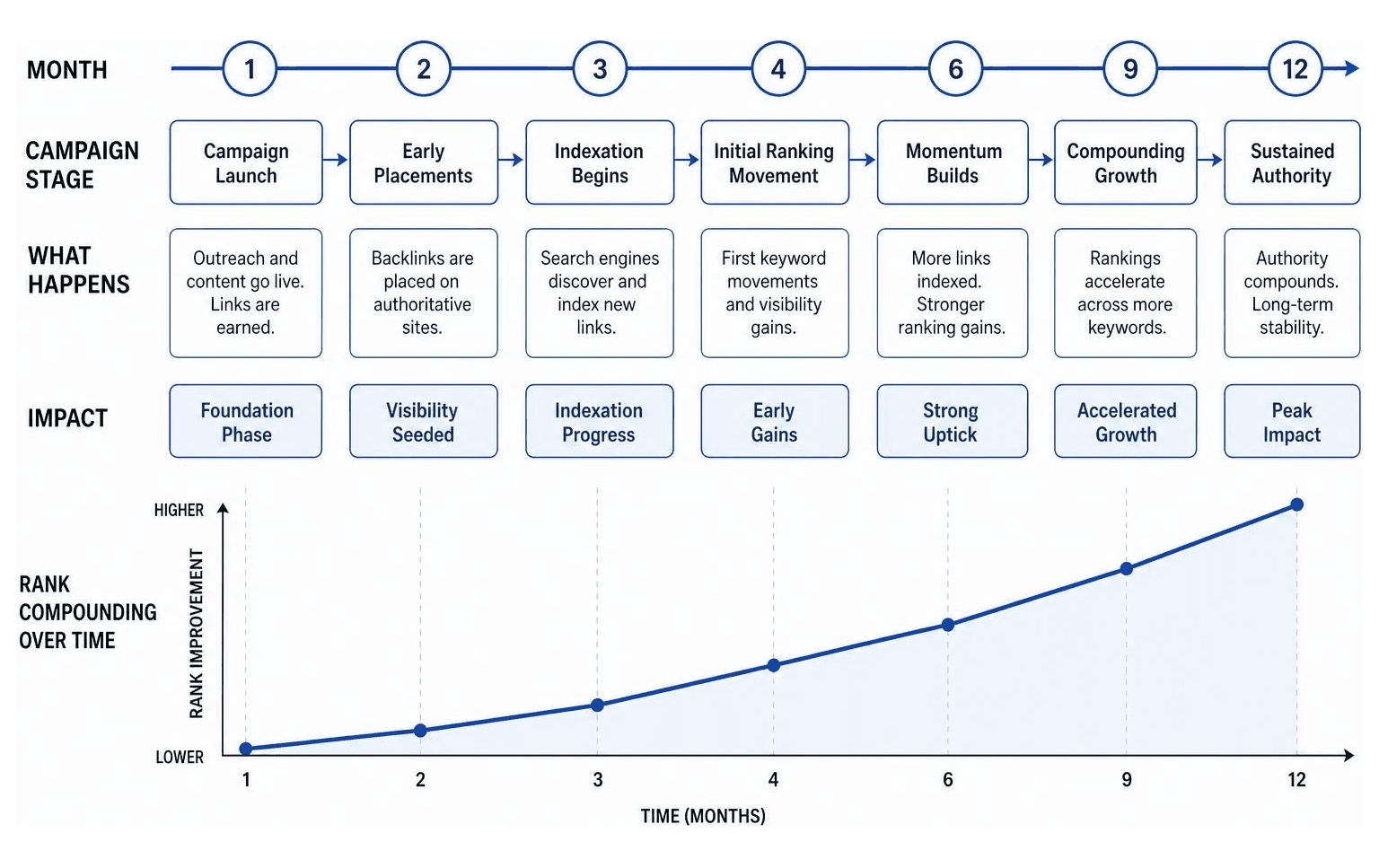
In most competitive verticals, a consistent link acquisition campaign begins generating measurable improvements in organic rankings and traffic within 2 to 4 months.
When backlinks are pointed at high-intent landing pages paired with sound technical SEO, the business impact can be dramatic:
SaaS Acceleration: An AI SaaS provider implemented an aggressive 12-month agency link campaign, earning over 420 high-authority backlinks. The result? Organic traffic surged past 8 million monthly visitors, accompanied by a 1,900% jump in brand mentions across AI search engines.
Service Business Growth: A commercial equipment provider achieved a 75% year-over-year increase in organic search traffic, generating an average of 12 new qualified sales opportunities every single month through targeted authority acquisition.
Ecommerce Scaling: A specialized manufacturer combined technical content optimization with targeted backlink acquisition, yielding a 77% increase in overall search visibility, an 85% boost in organic SEO traffic, and a 79% jump in impressions year-on-year.
Niche Local Expansion: A regional service business expanded its organic search footprint 15-fold in just three months by pairing localized digital PR with targeted portal placements.
Modern Agency Link Building Strategies That Deliver Results in 2026
The tactics that worked five years ago—such as mass directory submissions, article syndication, or private blog networks (PBNs)—will get your site penalized or ignored by Google today. Modern agency link building relies on sophisticated, white-hat methodologies that emphasize context and topical relevance.
Here are the primary strategies leading agencies use in 2026:
Digital PR & Data Driven Campaigns: Creating original surveys, industry benchmark reports, or expert commentary that journalists cite as primary sources.
Niche Edits (Contextual Inserters): Securing link insertions within existing, well-indexed articles that already rank and drive traffic for relevant industry terms.
Thought Leadership Guest Articles: Publishing high-value, highly researched expert guides on prominent industry publications.
Broken Link & Unlinked Mention Reclamation: Finding places where your brand, products, or broken resource links are mentioned across the web and turning them into active backlinks.
Strategy | Primary Benefit | Best For | Typical Turnaround Time |
|---|---|---|---|
Digital PR | Tier-1 media coverage, massive brand awareness, AI/LLM citations | SaaS, Consumer Brands, Enterprise | 60–90 Days |
Niche Edits | Immediate page-level authority, fast indexation, cost-effective | Ecommerce, B2B, Commercial Service Landing Pages | 15–30 Days |
Guest Blogging | Full control over content narrative, target anchor text precision | Emerging Brands, Mid-Market B2B | 30–45 Days |
Evaluating Link Quality Beyond Domain Rating (DR)
One of the biggest traps in off-page SEO is relying solely on third-party metrics like Domain Rating (DR) or Domain Authority (DA). These metrics can easily be manipulated by spammers using automated link loops. A domain with a DR of 70 that receives zero organic traffic from Google is essentially useless for your search rankings.
When evaluating a link building partner, ensure their quality control checklist measures the following:
Verified Organic Search Traffic: The linking domain must receive real, non-branded organic traffic from target search engines. If Google doesn't trust the site enough to rank its own pages, a link from that site carries little value.
Topical Relevance: A link from a low-DR niche site dedicated entirely to your specific industry is infinitely more valuable than a link from a generic high-DR site that publishes articles on crypto, home improvement, and online casinos all on the same domain.
Spam Score Filtering: Outbound-to-inbound link ratios must be balanced. If a site links out to thousands of external domains while having very few incoming links, it operates as a commercial link farm.
Indexation Rates: The page where your link is placed must be active and indexed by search engine crawlers.
Natural Anchor Text Diversity: Your overall anchor text profile should feature a healthy mix of branded terms, exact match keywords, long-tail phrases, and generic calls to action.
Customized Agency Link Building Workflows for Competitive Niches
A generic, one-size-fits-all approach to link building rarely moves the needle in competitive verticals. Experienced agencies tailor their acquisition channels based on industry dynamics:
SaaS & Tech: Focus heavily on integration directories, developer resource pages, technical tutorials, and Digital PR reports comparing industry metrics.
Ecommerce: Emphasize product roundups, gift guides, lifestyle blog reviews, unlinked brand mentions, and category-level niche edits.
Local Services: Focus on geo-targeted business directories, regional news sponsorships, local community involvement, and niche-relevant local blogs. If you operate a regional brand, check out our guide on whether Do You Need Backlinks for Local SEO? Here’s When They Matter and learn practical tactics in How to Get Quality Backlinks for a Local Business (Without Buying Them)).
YMYL (Your Money or Your Life - Finance, Legal, Healthcare): Prioritize medical review boards, legal associations, academic publications (.edu), and recognized industry publications where expert authorship (E-E-A-T) can be verified.
Essential Criteria for Selecting and Vetting a Link Building Partner
With hundreds of link building agencies available across online directories, choosing the right partner requires rigorous vetting.
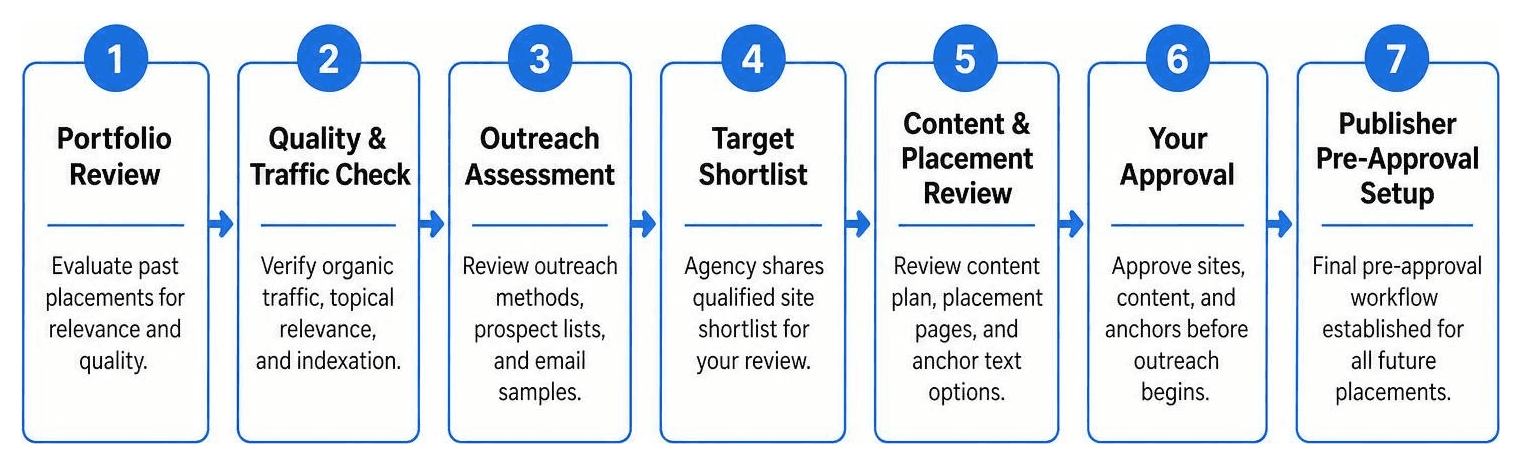
Before signing a contract, ensure you systematically evaluate prospective partners against these criteria:
Publisher Pre-Approval Workflows: Demand an agency process that allows your team to review and approve target websites, content pieces, and anchor texts before placements go live.
Transparent Manual Outreach Methods: Ask to see sample outreach emails and prospect lists. If an agency cannot clearly explain how they source publishers, they are likely using automated networks or private link schemes.
Toxic Link Disavow Capabilities: A complete agency partner should not only build new authority but also audit existing backlink profiles to disavow toxic, spammy links left behind by past campaigns or negative SEO attacks. An insurance company, for example, successfully disavowed toxic links while acquiring high-quality backlinks, leading to a 30% surge in organic traffic and a 47% increase in tool conversions within seven months.
Clear, Business-Driven Reporting: Avoid agencies that only report link counts. Your monthly dashboard should tie link placements directly to targeted landing pages, keyword movement, and organic traffic growth.
To protect your business from predatory practices, review our comprehensive list of 25 Red Flags When Hiring an SEO Agency (Avoid Bad SEO)) and read our detailed guide on How to Hire a Good SEO Expert Without Getting Scammed.
Understanding Link Building Pricing Tiers and Cost Factors
What should you actually expect to pay for professional link acquisition in 2026? SEO pricing varies substantially depending on quality, domain metrics, vertical competitiveness, and outreach difficulty.
Generally, pricing models fall into two categories: per-link pricing and managed monthly retainers.
Per-Link Pricing: Placements range from $55 to $150 for entry-level niche edits on moderate-DR sites, while tier-1 editorial placements from high-traffic, highly authoritative domains cost $500 to $1,500+ per link.
Managed Monthly Retainers: Comprehensive monthly retainers typically range from $1,000 to $10,000+ per month. A $1,000/month retainer might yield a steady stream of 3 to 5 highly contextual links for a local business, while a $10,000+/month enterprise program includes custom Digital PR campaigns, extensive content creation, ongoing backlink audits, and ongoing strategic consulting.
To understand why costs span such a wide range, check out our deep dives on Why Do SEO Prices Vary So Much? What You’re Really Paying For and What’s the Difference Between Cheap and Expensive SEO Experts.
Frequently Asked Questions About Agency Link Building
How much does agency link building cost in 2026?
Agency link building typically costs between $1,000 and $10,000+ per month on a retainer basis, or $55 to $1,500+ per link on a pay-per-placement basis. Pricing factors include target domain traffic, site authority (DR/DA), content creation requirements, and vertical competitiveness.
How do link building agencies prevent search engine penalties?
Reputable agencies maintain strict white-hat compliance by avoiding private blog networks (PBNs), link farms, and automated outreach software. They focus on manual outreach to real publishers with verified organic traffic, maintain natural anchor text ratios, enforce strict contextual relevance, and pre-screen every placement for spam markers.
How long does it take to see organic traffic gains from backlinks?
Most well-executed link building campaigns show measurable keyword improvements and organic traffic gains within 2 to 4 months. Because search engine crawlers re-index pages periodically, backlink equity compounds over time, often delivering maximum impact between months 6 and 12.
Conclusion
Sustained search authority is not achieved through shortcuts or cheap bulk links. It is built systematically by securing relevant, editorially approved mentions on legitimate websites that search engines trust. Partnering with a skilled agency link building provider accelerates this process, helping you build market share while shielding your brand from algorithmic risk.
At Helios Lab, we help businesses establish organic dominance through integrated search strategies tailored to real revenue outcomes:
For Local SEO Growth: We optimize your local profiles, manage citations, refine reviews, and build hyper-local authority so nearby customers find you first. Operating on a simple flat monthly fee with clear reporting, we keep every step of your local growth fully transparent.
For Enterprise & National SEO Authority: We engineer content and backlink campaigns built to rank on traditional Google search and earn top citations across modern AI engines like ChatGPT and Perplexity. By targeting the exact queries your prospective customers use before buying, our work delivers compounding organic visibility that expands over time.
Ready to build durable domain authority that transforms search positions into bottom-line growth? Scale your search visibility with Helios Lab today.