Insight
Do You Need Backlinks for Local SEO? Here’s When They Matter
Helios Lab
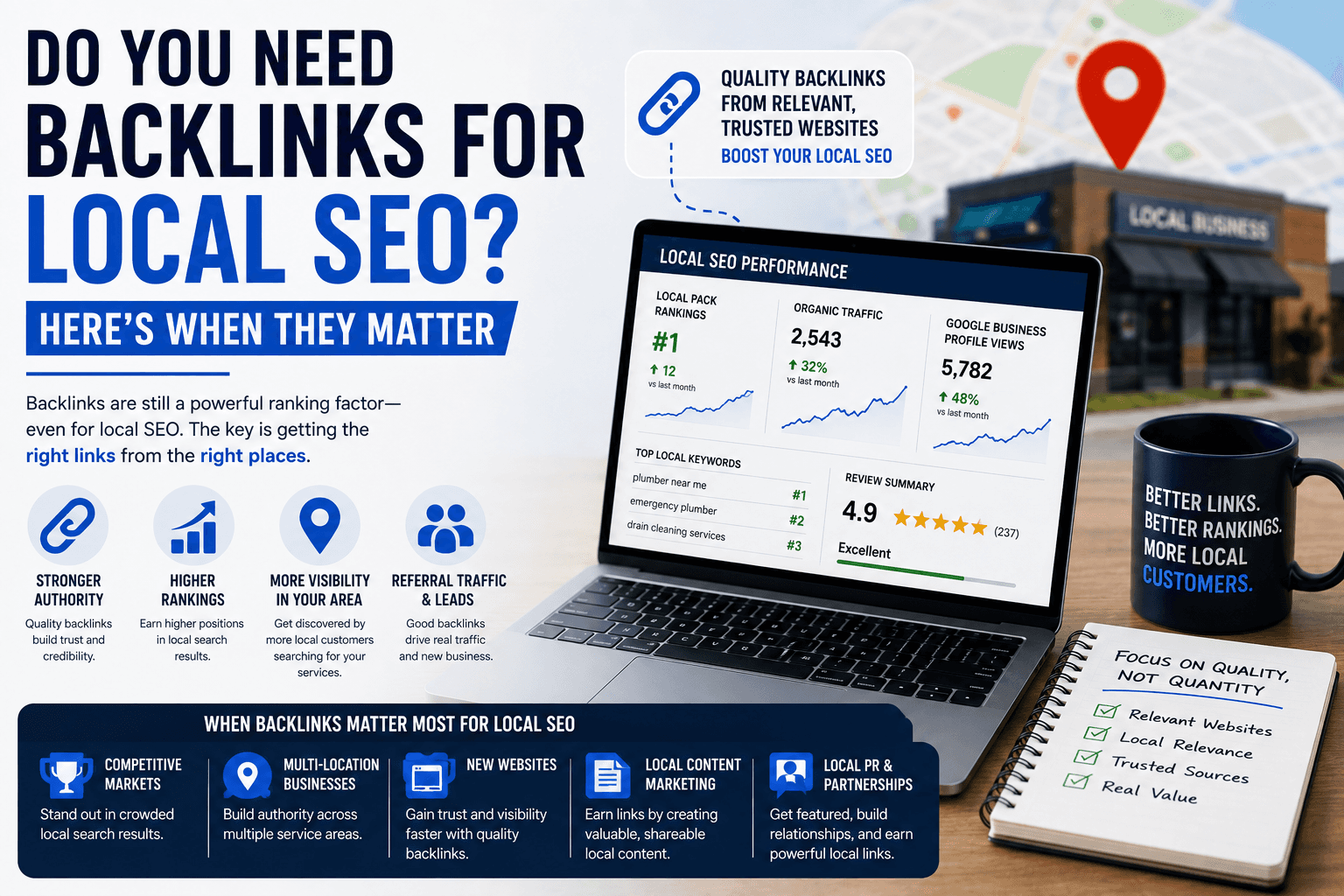
Do I Really Need Backlinks for Local SEO?
If you're trying to rank your local business on Google, you've probably heard some version of this:
“You need backlinks.”
Then someone else tells you:
“Just optimize your Google Business Profile.”
Another SEO company says you need 100 backlinks.
Another says you need 10.
So who's right?
The answer is:
You do not necessarily need a huge number of backlinks to rank in local search—but relevant backlinks can become extremely important when you're competing against established businesses in a competitive market.
For a plumber in a small town with weak competition, excellent local SEO, strong service pages, good reviews, and accurate business information may be enough to rank well without an aggressive backlink campaign.
For a personal injury law firm competing against dozens of established firms in a major city, backlinks and overall website authority may be much more important.
The real question isn't:
“Do backlinks matter?”
They do.
The better question is:
“How important are backlinks compared with everything else my local business needs to rank?”
This guide explains exactly where backlinks fit into local SEO, when you need them, which links are actually valuable, and when your money should probably be spent somewhere else first.
What Is a Backlink?
A backlink is simply a link from another website pointing to your website.
For example, imagine your local Chamber of Commerce has a page listing member businesses and links to your company.
That is a backlink.
Or a local newspaper writes an article about your business and links to your website.
That's also a backlink.
Other examples could include:
Industry publications
Suppliers
Local associations
Business directories
Partners
Local news websites
Trade organizations
Useful online resources
Google says it uses links as a signal when determining the relevance of pages and also uses links to discover new pages to crawl. citeturn641755search12
That means backlinks can contribute to how search engines understand and discover your website.
But that does not mean every link is useful.
Do You Need Backlinks to Rank in Local SEO?
Not always.
Local SEO involves many factors.
Google says local results are mainly based on:
Relevance
Distance
Prominence or popularity citeturn631837search0
Your local visibility therefore depends on far more than backlinks.
Other important areas include:
Google Business Profile optimization
Your physical location relative to the searcher
Service relevance
Reviews
Website content
Local citations
Website authority
Service pages
Technical SEO
Business information consistency
A business can sometimes rank well without building many backlinks because it has strong signals in several of those other areas.
Example: Low-Competition Market
Imagine you're the only dedicated garage door repair company in a small town.
You have:
A complete Google Business Profile
150 legitimate reviews
Accurate business information
A strong garage door repair page
Good technical SEO
Very little competition
You may be able to rank extremely well without spending months aggressively acquiring backlinks.
Now change the situation.
You're one of 75 garage door companies competing across Phoenix.
Several competitors have:
Hundreds of reviews
Strong websites
Years of content
Dozens of relevant links
High local visibility
Now authority becomes much more important.
That's when backlinks may help separate your website from several competitors that are otherwise equally well optimized.
Backlinks Matter More When Everything Else Is Equal
This is one of the easiest ways to understand backlinks.
Imagine Google is comparing two plumbing websites.
Plumbing Company A
Excellent Google Business Profile
300 reviews
Strong service pages
Fast website
Correct citations
Helpful content
Very few backlinks
Plumbing Company B
Excellent Google Business Profile
310 reviews
Strong service pages
Fast website
Correct citations
Helpful content
Many legitimate local and industry backlinks
Company B has an additional authority signal Company A doesn't.
That doesn't mean backlinks automatically determine the winner.
Search is much more complicated than that.
But once competitors have handled the fundamentals, authority becomes a much more obvious area to improve.
What Should You Work on Before Backlinks?
This is where many small businesses get the order wrong.
They pay someone to build backlinks before fixing the website those backlinks point to.
That's like paying for a billboard directing people to a store that's closed.
Before making backlink acquisition your main priority, make sure your local SEO foundation is strong.
1. Optimize Your Google Business Profile
For a local business, this should often be one of your first priorities.
Review:
Primary category
Secondary categories
Business name
Address
Phone number
Website
Hours
Services
Photos
Business description
Your profile should accurately represent what your business actually does.
At Helios Lab, our local SEO process starts with areas like Google Business Profile optimization, local listings, citations, technical issues, and rankings before layering in broader authority-building work. citeturn844490view0
2. Build Strong Service Pages
A backlink can't rescue a page that doesn't properly answer the searcher's question.
Imagine you're an HVAC company trying to rank for:
“AC repair near me.”
But your website only has a homepage with one sentence mentioning air conditioning.
You probably have a content problem before you have a backlink problem.
Your important services may deserve dedicated pages such as:
AC repair
AC installation
Furnace repair
Heat pump installation
Emergency HVAC service
Those pages should clearly explain:
What you offer
Who you help
Where you serve
Common problems
What happens next
3. Fix Technical SEO Problems
Before aggressively building authority, make sure Google can properly access the pages you're promoting.
Check:
Indexing
Broken pages
Redirects
Mobile usability
Page structure
Internal links
Crawlability
There is little reason to earn 20 backlinks to a page that Google can't properly index.
4. Clean Up Your Local Citations
Local citations are references to your business across websites and directories.
These often include:
Name + address + phone number.
Make sure important listings are accurate and consistent.
Common problems include:
Old phone numbers
Previous addresses
Duplicate listings
Incorrect business names
Missing listings
Citations are not the same thing as backlinks, although some directory listings may also contain links.
5. Build a Strong Review Strategy
Reviews are extremely important for local businesses because they affect both customer trust and local visibility.
Google specifically says review count and review score can factor into local ranking. citeturn631837search0
Build a legitimate system for consistently asking satisfied customers for feedback.
Do not buy fake reviews.
6. Create Useful Content
Content helps your website rank for far more searches than your primary service pages alone.
A roofer could publish:
How much does roof replacement cost?
How long does a roof last?
Does insurance cover roof damage?
Should I repair or replace my roof?
How long does roof replacement take?
Good content gives potential customers more reasons to discover your business.
It can also make link building easier because useful resources are naturally more linkable than thin sales pages.
When Should Backlinks Become a Priority?
Backlinks should move higher on your priority list when several of these are true:
Your website is technically sound
Your Google Business Profile is well optimized
Your service pages are strong
Your citations are accurate
You have a consistent review strategy
You're publishing useful content
Competitors still outrank you
Competitors have significantly stronger authority
At that point, the problem may no longer be basic optimization.
It may be authority.
Do Backlinks Help the Google Map Pack?
This question needs some nuance.
Google does not publish a formula saying:
“X backlinks equals Y positions in Google Maps.”
Instead, Google says local results primarily depend on relevance, distance, and prominence/popularity. citeturn631837search0
Backlinks can contribute to the broader authority and prominence of a business's website and online presence.
However, backlinks should not be treated as a substitute for:
A strong Google Business Profile
Reviews
Accurate business information
Local relevance
Correct categories
Good service pages
Local SEO is an ecosystem.
Not one ranking trick.
How Many Backlinks Do I Need for Local SEO?
There is no universal number.
You don't need:
10 backlinks
or:
50 backlinks
or:
100 backlinks
simply because an SEO tool or agency says so.
The number depends primarily on your competition.
Better Question
Instead of asking:
“How many backlinks do I need?”
ask:
“What kind of authority do the businesses ranking above me have?”
Look at your top local competitors.
If their websites consistently have:
Local press coverage
Industry citations
Supplier links
Association links
Relevant editorial links
and your website has almost nothing, that may indicate an authority gap.
If none of your competitors have meaningful backlink profiles, link acquisition may be less urgent.
Quality vs. Quantity: Which Matters More?
Quality and relevance matter much more than simply accumulating a large number of links.
Imagine two options.
Option A
You receive 500 backlinks from:
Random foreign-language blogs
Automated directories
Unrelated websites
Pages containing hundreds of outbound links
Option B
You receive 10 links from:
Your local Chamber of Commerce
An industry association
A regional newspaper
Two suppliers
A respected industry blog
Several legitimate local organizations
Which profile looks more like a real business earning real recognition?
Usually Option B.
Google's spam policies prohibit manipulative link schemes designed primarily to artificially influence rankings. citeturn641755search3
Google has also explained that spammy links can be neutralized, meaning whatever ranking credit those links may have provided can disappear. citeturn641755search29turn641755search36
That means:
More links are not automatically better SEO.
What Are the Best Backlinks for a Local Business?
The strongest opportunities often make sense even without SEO.
That's a useful test.
Ask:
“Would I still want my business mentioned here if Google didn't exist?”
If the answer is yes, it may be a good opportunity.
1. Local Organizations
Examples:
Chamber of Commerce
Local business groups
Community organizations
Local nonprofits
Economic development organizations
These links help connect your business to the area where you actually operate.
2. Industry Associations
A plumber might belong to a plumbing association.
A roofer may belong to construction or contractor organizations.
A lawyer may belong to relevant professional associations.
These connections make topical sense.
3. Suppliers and Manufacturers
If you're an authorized:
Dealer
Installer
Distributor
Partner
ask whether the manufacturer maintains a directory or partner page.
These can be highly relevant links.
4. Local News Coverage
Real community activity can create legitimate local mentions.
Examples:
Business openings
Local events
Charity work
Community projects
Expert commentary
Original research
The key is having something actually worth covering.
5. Partnerships
You may have natural relationships with complementary businesses.
For example:
A roofer might work with:
Restoration companies
Home inspectors
Contractors
Insurance professionals
That does not mean you should create artificial reciprocal-link schemes.
But genuine partnerships sometimes create legitimate opportunities for mentions.
6. Useful Content
This is where SEO content marketing and backlinks work together.
Imagine an HVAC company creates a genuinely useful:
2026 Cost of HVAC Replacement in Phoenix Study
including:
Real customer estimates
Equipment costs
Labor trends
Home-size examples
Historical comparisons
That resource gives other websites something worth citing.
Compare that with:
“5 Reasons HVAC Is Important.”
Which one is more likely to earn a link?
Useful, original information makes link acquisition easier.
Google's current AI-search guidance similarly emphasizes creating unique, non-commodity content rather than simply adding more pages that repeat existing information. citeturn641755search20turn641755search28
Are Directory Backlinks Good for Local SEO?
Some directories are useful.
Others provide almost no meaningful value.
Legitimate directories can be worth maintaining because:
Customers actually use them
They reinforce business information
They establish local or industry presence
They may send referral traffic
But submitting your business to 1,000 random directories just to produce links isn't a strong strategy.
Ask:
Is this a place where a legitimate business in my industry would reasonably be listed?
If yes, it may make sense.
Should I Buy Backlinks for Local SEO?
Be extremely cautious.
Google's spam policies specifically address buying or selling links for ranking purposes. citeturn641755search3
There is a difference between legitimate advertising/sponsorship and purchasing links specifically intended to manipulate rankings.
If an SEO provider sells you:
“50 DA 50+ backlinks for $199”
you should ask exactly:
Which websites?
Why are they relevant?
How are they acquired?
Are they paid?
Are they editorial?
Does the provider own those sites?
At Helios Lab, our content-marketing offering currently combines keyword-driven content planning with backlink acquisition rather than treating backlinks as an isolated numbers game. citeturn844490view0
What About Guest Posts?
Guest posting isn't inherently bad.
What matters is why and how it's being done.
A useful contribution to a legitimate industry publication can make sense.
Mass-producing generic articles purely to place keyword-rich links across hundreds of websites is very different.
Again, apply the common-sense test:
Would this article deserve to exist if there were no backlink inside it?
If the answer is no, reconsider the strategy.
What Is a Local Backlink?
A local backlink comes from a website connected to the geographic market where your business operates.
Examples:
Local news
Local charities
Chambers of Commerce
Community organizations
Local blogs
Local business groups
City-specific resources
A locally relevant link may help reinforce the broader connection between your business and its geographic market.
It can also send actual customers.
That second part is frequently overlooked.
What Is an Industry-Relevant Backlink?
Industry-relevant backlinks come from websites connected to what you do.
For a plumber:
Plumbing publications
Manufacturers
Contractor associations
Home-improvement publications
For an attorney:
Legal publications
Professional organizations
Legal associations
For an HVAC contractor:
Manufacturers
Trade groups
HVAC publications
Construction resources
Ideally, your backlink profile should look like something a legitimate business would naturally accumulate over time.
Are Backlinks More Important for Organic Results Than Google Maps?
Generally, website authority tends to be especially relevant to your organic website rankings, while Google Maps/local pack visibility also heavily depends on Business Profile and geographic signals.
But you shouldn't think of them as completely separate systems.
Your overall online presence is interconnected.
A strong local SEO strategy often combines:
Google Business Profile + website SEO + reviews + citations + content + authority
rather than choosing only one.
Can I Rank Without Backlinks?
Yes.
Especially if:
Competition is low
Your website is highly relevant
Your location is favorable
Your Google Business Profile is strong
Competitors have weak websites
Your content is substantially better
Your service pages directly match search intent
There is no rule stating that a local business must acquire a specific number of backlinks before it can rank.
But as competition increases, ignoring authority completely becomes increasingly difficult to justify.
Signs You Probably Need More Backlinks
You may want to invest more heavily in authority building when:
Your Pages Are Strong but Stuck Below Competitors
You've optimized them well, but competitors continue winning.
Competitors Have Much Stronger Backlink Profiles
Especially when those links come from legitimate relevant sources.
You're Targeting Highly Competitive Keywords
For example:
Personal injury lawyer
Emergency plumber
HVAC repair
Roofing contractor
in major markets.
You're Expanding Into More Competitive Markets
Ranking in a suburb may require less authority than trying to dominate an entire metro.
Your Content Isn't Earning Any Mentions
Great content combined with no authority-building strategy can sometimes plateau.
Signs Backlinks Probably Aren't Your Biggest Problem
Don't immediately spend money on links if:
Your important pages aren't indexed
Your website is technically broken
Your Google Business Profile is incomplete
You have almost no reviews
Your business information is wrong
You're missing core service pages
Your content is thin
You're targeting the wrong keywords
Fix foundational problems first.
One backlink will not fix an irrelevant page.
Neither will 100.
A Simple Local SEO Priority Framework
Here's how I'd prioritize SEO for many local businesses.
Stage 1: Foundation
Fix:
Google Business Profile
Technical SEO
Citations
Business information
Tracking
Stage 2: Commercial Pages
Build or improve:
Main service pages
Location pages where appropriate
Internal links
Calls to action
Stage 3: Reputation
Develop:
Reviews
Customer feedback processes
Trust signals
Stage 4: Content
Publish useful resources targeting questions your customers actually ask.
Stage 5: Authority
Earn:
Local backlinks
Industry backlinks
Editorial mentions
Partnerships
High-quality citations
These stages overlap.
You don't have to finish one completely before touching another.
But the framework helps avoid spending heavily on links when your real problem is something much more basic.
Should Every Local SEO Package Include Backlinks?
Not necessarily.
A local SEO package may focus primarily on:
Google Business Profile
Reviews
Citations
Website optimization
Technical work
Local tracking
A broader SEO content campaign may then include backlinks and authority building.
That's actually how our current services at Helios Lab are structured.
Our local SEO package focuses heavily on the local foundation, while our broader SEO Content Marketing and Complete SEO offerings add content and backlinks. citeturn844490view0
This can make sense because not every business needs an aggressive backlink campaign from day one.
How Long Does Link Building Take?
Good link building is usually slower than bulk link generation.
Why?
Because legitimate links often require:
Research
Relationships
Outreach
Useful content
Editorial review
Actual business opportunities
If someone can produce 5,000 backlinks overnight, ask how.
Speed isn't automatically a benefit.
How Do You Measure Whether Backlinks Are Working?
Don't only track the number of links.
Look for broader trends.
Important Pages
Are the pages receiving authority improving?
Rankings
Are valuable search positions moving?
Organic Visibility
Are impressions increasing for relevant searches?
Referral Traffic
Are legitimate websites actually sending visitors?
Leads
Is organic search producing more calls, forms, or appointments?
The end goal isn't:
“We have 200 backlinks.”
It's:
“More qualified customers are finding us.”
Do Backlinks Matter for AI Search?
Links are not something you should pursue solely because you want AI citations.
Google's current guidance says its AI search systems still rely on its broader ranking and quality systems and explicitly warns against chasing inauthentic mentions around the web. citeturn641755search20
A better approach is to build the kind of external reputation a legitimate company would want anyway:
Real industry mentions
Useful citations
Relevant links
High-quality content
Authoritative partnerships
That helps create an online footprint built around genuine credibility instead of trying to manufacture signals for a particular AI system.
Local Backlink Checklist
When evaluating a potential backlink, ask:
Is the website legitimate?
Is it relevant to my location or industry?
Would a real customer potentially encounter it?
Does the link make contextual sense?
Is the website publishing useful content?
Is the page obviously built only to sell links?
Would I want this mention even if Google didn't exist?
The more often you answer yes to those first questions, the more promising the opportunity usually becomes.
Frequently Asked Questions About Backlinks and Local SEO
Are backlinks important for local SEO?
Yes, backlinks can contribute to a website's authority and relevance, and Google says links are one signal it uses when understanding pages. Local rankings, however, also depend heavily on factors such as relevance, distance, and prominence. citeturn641755search12turn631837search0
Can you rank locally without backlinks?
Yes.
Businesses in low-competition markets can sometimes rank well with strong Google Business Profile optimization, reviews, citations, service pages, and website SEO even with relatively few backlinks.
Competition determines how important additional authority becomes.
How many backlinks do I need for local SEO?
There is no universal number.
Compare your backlink profile with businesses already ranking for your target searches and focus on quality and relevance rather than hitting an arbitrary backlink count.
Are local backlinks better than regular backlinks?
Local backlinks can be particularly useful because they reinforce your connection to the geographic market you serve.
Industry-relevant links can also be extremely useful.
A healthy profile can contain both.
What are examples of good local backlinks?
Examples include links from:
Chambers of Commerce
Local news organizations
Community organizations
Local business associations
Suppliers
Industry groups
Relevant publications
Are directory links good for SEO?
Legitimate directories can be useful, especially for local business information.
Submitting to hundreds of low-quality directories simply to inflate backlink numbers is not the same thing as maintaining legitimate local citations.
Should I buy backlinks?
Be cautious. Google's spam policies prohibit purchasing links for the purpose of manipulating rankings. citeturn641755search3
Ask any SEO provider exactly how links are acquired before paying for backlink services.
Are 100 backlinks better than 10?
Not necessarily.
Ten relevant links from trustworthy industry or local websites can be more useful than hundreds of irrelevant or spammy links.
Should I focus on backlinks or reviews first?
For many local businesses with very few reviews, improving the legitimate review process and Google Business Profile may be more urgent.
If your local foundation is already strong and competitors have substantially more authority, backlinks may deserve greater attention.
Should I build backlinks to my homepage or service pages?
Both can make sense depending on the context.
Links should point to the page that naturally deserves the reference rather than being forced toward a particular URL purely for SEO.
Will backlinks guarantee a top-three Google Maps ranking?
No.
Local rankings depend on multiple factors, and Google does not provide a formula that guarantees a particular map position.
The Bottom Line: Do You Really Need Backlinks for Local SEO?
You probably don't need hundreds of backlinks just because someone told you that local SEO requires them.
Backlinks are one piece of a broader system.
Before worrying about link volume, make sure you have:
A strong Google Business Profile
Accurate local listings
Good reviews
Useful service pages
Sound technical SEO
Relevant content
Clear local targeting
Then look at your competition.
If you're already doing those things well and stronger competitors continue outranking you, authority and backlinks may be one of the next important gaps to close.
The more competitive the market, the more valuable legitimate authority becomes.
Just remember:
You aren't trying to collect links.
You're trying to build a business and website that other credible organizations have legitimate reasons to mention.
That difference matters.
Want to Know Whether Backlinks Are Actually Your Problem?
Before paying someone to build links, determine what's really preventing your business from ranking.
Maybe it's backlinks.
But it could also be:
Your Google Business Profile
Your reviews
Missing service pages
Poor technical SEO
Weak content
Broken citations
At Helios Lab, we look at the entire local search picture before deciding what should be prioritized.
You can explore more SEO strategy guides in the Helios Lab blog.
You can also review our Local SEO and SEO Content Marketing services to see how we separate local optimization from content and backlink authority building. citeturn844490view0
Or, if you want someone to identify where your website is currently losing visibility, talk with Helios Lab about your SEO.
The goal isn't to sell you as many backlinks as possible.
It's to figure out what your business actually needs to outrank the competitors in front of you.