Insight
Taking Control of Customer Reviews with a Google Review Management Tool
Helios Lab

Why a Google Review Management Tool Matters for Local Growth

A google review management tool helps a business collect, monitor, respond to, and display Google Business Profile reviews from one organized place.
For local businesses, reviews are not just feedback. They shape whether a potential customer trusts you enough to call, visit, or buy. Research cited in this guide shows that 81% of consumers read Google reviews when evaluating a business, while 92% read online reviews or testimonials before making a purchase.
A good tool makes the work more consistent by helping teams:
Request honest reviews after a real customer interaction.
Get alerts when new feedback arrives.
Reply promptly to positive and negative reviews.
Track ratings, response times, and recurring customer concerns.
Share approved review content on website pages where trust matters most.
Google's own Business Profile tools let verified owners read, reply to, flag policy-violating reviews, and check removal-request status. Review management software adds workflow automation, reporting, multi-location oversight, and connections to systems such as CRM, email, SMS, and support platforms.
The goal is not to hide legitimate criticism. It is to turn customer feedback into a clear, repeatable reputation process that supports trust, local visibility, and conversion.

What Is Google Review Management and Why It Matters in 2026
Google review management is the active process of monitoring, analyzing, collecting, and responding to customer feedback posted on your Google Business Profile. While it used to be enough to check your profile once a month and reply to an occasional compliment, modern local commerce demands a far more strategic approach.
In 2026, Google remains the single largest online review destination for consumer decision-making. When prospective clients search for a service nearby—whether it is a specialized law practice, a dental clinic, or an home services provider—your review profile acts as your digital storefront's front porch.
Managing these reviews goes beyond customer service; it is a primary driver of search engine visibility and local ranking algorithms. Google’s local search algorithm evaluates review volume, star ratings, review velocity (how frequently you receive new feedback), and how actively business owners respond to their reviews. A business that maintains a high volume of fresh, well-managed reviews signals to Google that it is active, trustworthy, and popular among local residents.
Beyond algorithms, managing your public feedback builds undeniable consumer trust. When people see that you take the time to acknowledge every reviewer—thanking happy customers for their patronage and resolving issues for dissatisfied ones—they gain confidence in your operations. Effective review management bridges the gap between passive online searches and active phone calls or site visits.
Why Every Local Business Needs a Google Review Management Tool
Trying to manage customer reviews manually works fine when you get one or two reviews a month. But as your business grows—or if you manage multiple business locations—manual tracking quickly becomes chaotic. Reviews slip through the cracks, response times lag, and valuable insights are missed.
This is where a dedicated google review management tool becomes essential. Relying on manual processes often leads to delayed responses, missed customer service recovery opportunities, and lower overall review generation rates.

Consider these core reasons why adopting a specialized software platform is vital for modern local growth:
Consistency in Review Requests: Human memory is imperfect. Relying on team members to manually email or text every single customer for a review leads to inconsistent collection. Software automates these requests directly after a transaction or service call.
Conversion Rate Impact: 69% of consumers feel optimistic about using a local business that boasts positive recent reviews. Maintaining a steady stream of fresh feedback directly boosts your conversion rate from search engine results.
Star Rating Optimization: A small shift in your average star rating—say, moving from a 4.1 to a 4.6—can dramatically increase buyer confidence. Review software helps capture legitimate positive sentiment from happy customers who might otherwise forget to leave feedback.
Proven Return on Investment: Industry data shows that 94% of businesses using dedicated review management tools report tangible investment returns through increased web traffic, higher call volumes, and expanded revenue.
At Helios Lab, we see this firsthand. Through our specialized Local SEO services, we help local businesses optimize their Google Business Profiles, oversee citations, and streamline review acquisition so they consistently land in top local search results.
Key Features to Look for in a Google Review Management Tool
Not all software is built equal. Some tools cater primarily to large corporate chains with hundreds of branches, while others focus on simple testimonial display widgets for solo creators. When selecting the right google review management tool for your organization, you should look for features that simplify your day-to-day operations while driving measurable local growth.
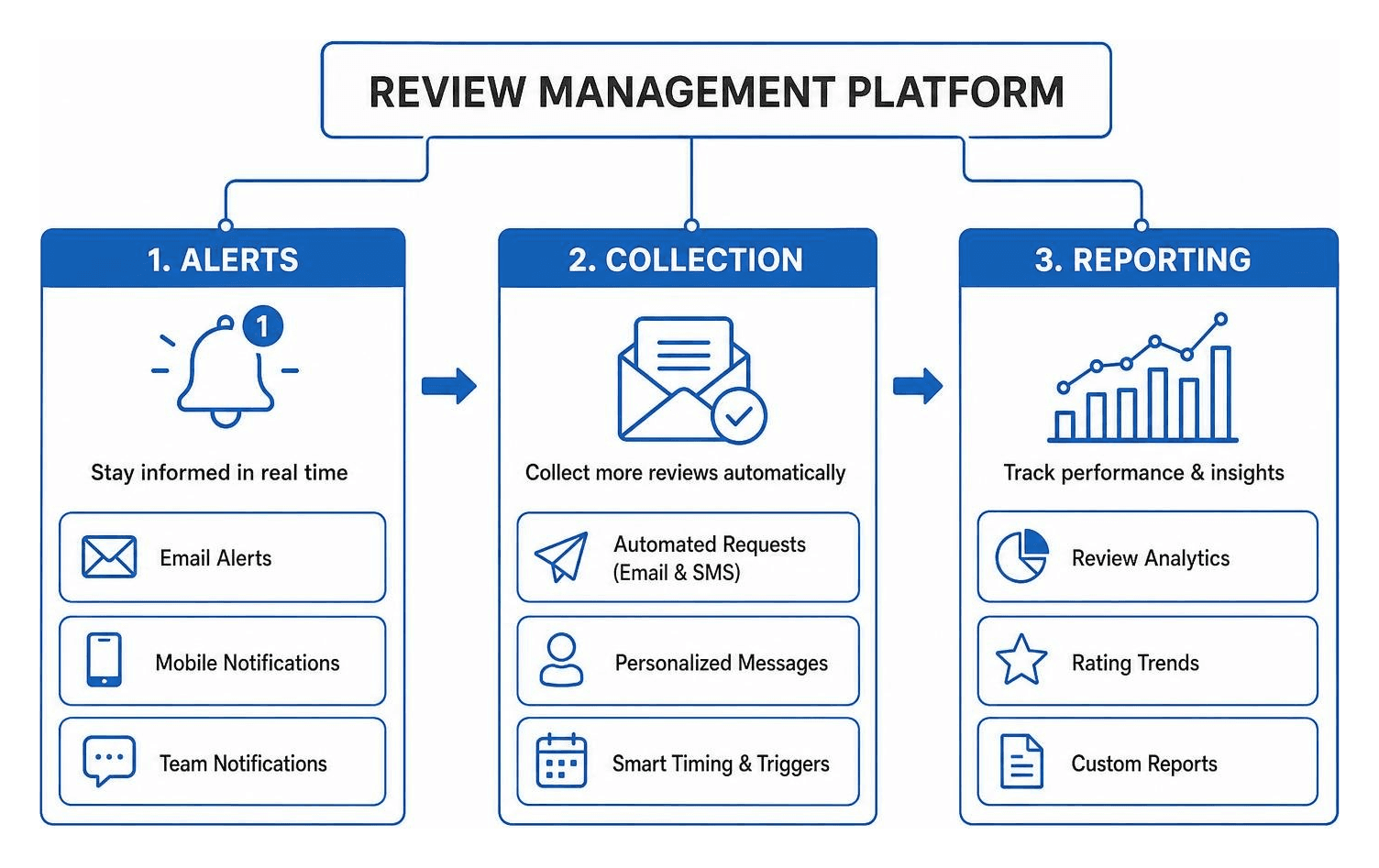
The best platforms serve as a centralized hub. Essential capabilities to look for include:
Centralized Inbox: Consolidates incoming reviews across all your verified locations into a single dashboard so your team never has to switch logins.
Real-Time Notifications: Sends immediate alerts via email, mobile notifications, or internal communication channels whenever a new star rating or comment is posted.
Automated Collection Sequences: Allows you to schedule personalized request triggers via SMS and email after key customer milestones.
Customizable Review Display Widgets: Enables non-technical staff to build clean, responsive review displays for landing pages and pricing tables.
Comprehensive Reporting Metrics: Tracks sentiment trends, response latency, average star ratings over custom date ranges, and performance per location.
Leveraging AI for Response Generation and Sentiment Analysis
Artificial intelligence has transformed how businesses handle local reputation management. Rather than starting every response from scratch, modern review software uses natural language processing (NLP) to assist your team in drafting contextually accurate replies within seconds.
These AI models read incoming review text, identify the customer’s tone, and extract key operational details (such as specific staff names, product mentions, or service categories). The platform then suggests personalized reply options that sound natural, warm, and professional.
In addition to drafting replies, AI sentiment analysis categorizes vast amounts of feedback into clear thematic clusters. Instead of manually reading thousands of reviews to spot trends, sentiment engines extract actionable operational insights. For example, the software might highlight that while 95% of reviews praise your technical quality, 20% mention frustration with billing clarity or parking access. This allows management to fix operational bottlenecks before they damage your reputation.
Multi-Channel Automation and System Integrations
Collecting reviews consistently requires meeting your customers on their preferred communication channels. A robust review platform supports multi-channel automation workflows through both SMS and email messaging.
Text messages (SMS) consistently yield higher open and click-through rates for local services, making them ideal for quick review requests after an in-person appointment or service delivery. Email sequences work exceptionally well for B2B services, professional firms, or e-commerce purchases where customers prefer detailed interactions on their desktop.

Furthermore, a top-tier tool connects directly to your existing tech stack through robust API integrations and middleware like Zapier. Key integrations include:
Customer Relationship Management (CRM) Systems: Automatically trigger a review request when a deal stage changes to "Closed-Won" or "Service Complete."
Point of Sale (POS) Platforms: Send a text request 15 minutes after a transaction occurs at a retail store or restaurant.
Field Service Management Tools: Prompt home service clients for feedback as soon as a job ticket is marked finished by a technician.
Legal and Case Management Software: Automate client satisfaction surveys immediately after case resolution or consultation milestones.
Best Practices for Review Collection, Responses, and Website Display
Having software is only half the battle; how you execute your review strategy dictates your ultimate local success. Establishing structured internal protocols ensures your team collects reviews ethically, responds appropriately, and showcases your reputation to prospective buyers.
Handling Positive and Negative Review Replies
Replying to reviews is not just polite customer service—it directly affects your public reputation and search presence.
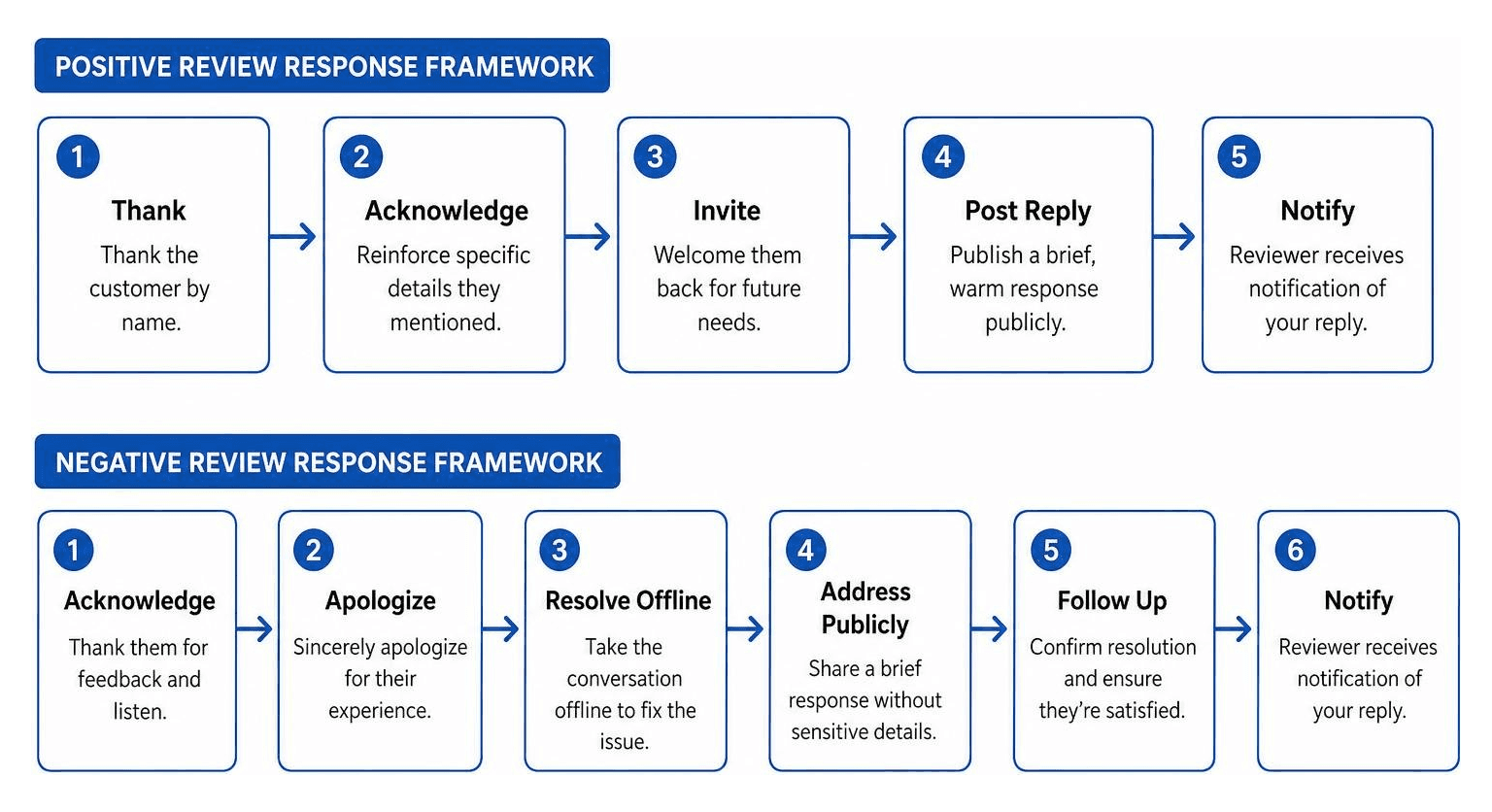
When you post a reply on your Google Business Profile, it is published publicly under your business name. Google policy dictates that business replies undergo moderation, which typically takes up to 10 minutes, though manual checks can extend up to 30 days. Once approved, the original reviewer receives a notification with your message. If your reply resolves their complaint, the reviewer has the option to update their star rating and review text, which will refresh the review date on your profile.
Here is a quick framework for managing both positive and negative feedback:
Replying to Positive Reviews
Express Genuine Gratitude: Thank the customer by name for taking the time to write a review.
Reinforce Specific Details: If the customer mentioned a specific service or staff member, acknowledge it in your response (e.g., "We're thrilled to hear that Sarah made your onboarding seamless!").
Keep It Brief and Warm: Avoid overly salesy language, but invite them back for future needs.
Replying to Negative Reviews
Maintain Professional Calm: Never argue, get defensive, or attack the reviewer publicly, regardless of how unfair the comment seems. Prospective clients evaluate how you handle criticism far more than the criticism itself.
Acknowledge and Apologize: Validate their feelings without admitting legal liability (e.g., "We are sorry to hear that your experience fell short of our high standards.").
Take the Conversation Offline: Provide a direct email address or phone number belonging to a manager so the issue can be investigated and resolved privately.
Demonstrate Policy Compliance: Show that you care about operational quality by stating the steps you are taking to investigate the matter internally.
Embedding Google Reviews on Your Website to Boost Conversions
Collecting great Google reviews is fantastic for local map visibility, but bringing those testimonials over to your website maximizes their commercial value.
Integrating dynamic review widgets on high-intent website pages—such as your primary landing pages, service descriptions, pricing tables, and contact forms—provides immediate social proof to prospective clients when they are closest to converting.
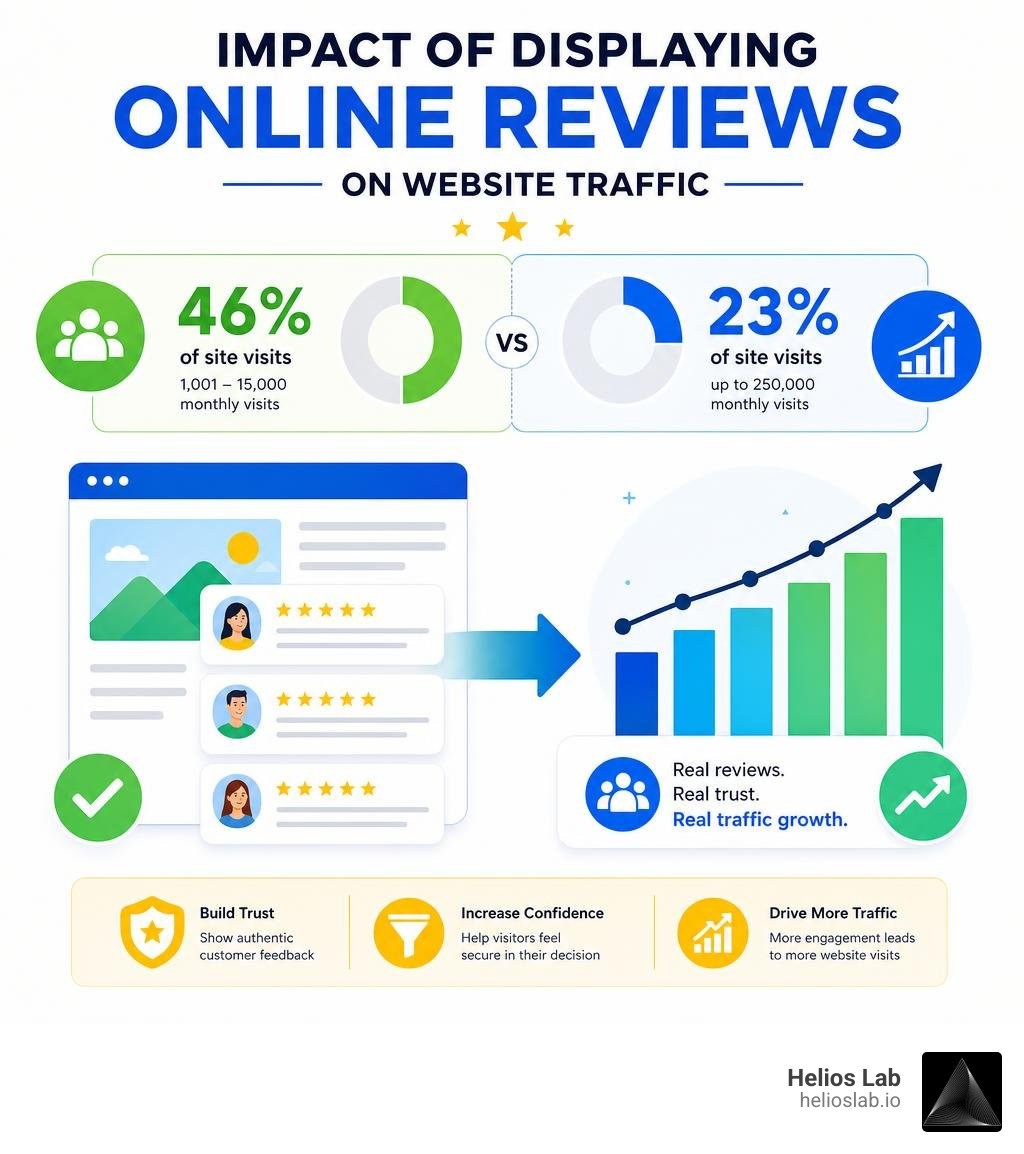
Data shows that displaying verified reviews directly on your website can drive substantial traffic and conversion growth. In fact, 46% of business website owners interviewed report receiving between 1,001 and 15,000 monthly site visits attributed directly to elements that incorporate dynamic user reviews and social proof, while 23% generate up to 250,000 monthly visits.
When implementing review widgets:
Use clear, modern display layouts like grid cards or badge carousels.
Highlight specific, detail-rich reviews rather than generic "Great service!" comments.
Ensure all review widgets include schema markup so search engines recognize your review structured data.
Keep the widgets dynamic so new 5-star Google reviews appear automatically on your website without requiring manual developer updates.
Common Pitfalls to Avoid and Measuring Software Success
While review management software simplifies your marketing efforts, misusing these tools or violating platform guidelines can lead to severe penalties, including profile suspensions or removal of accumulated reviews.
Here are the primary pitfalls to avoid:
Review Gating: Review gating is the practice of pre-screening customers with a private survey (e.g., "Rate us 1 to 5 stars") and only directing 4- and 5-star raters to public Google review links, while routing 1- to 3-star raters to a private contact form. This explicitly violates FTC regulations and Google's terms of service. Software must send all customers to public review links regardless of their rating.
Offering Incentives for Reviews: Offering discounts, gift cards, free products, or entry into raffles in exchange for Google reviews is strictly forbidden. Reviews must be uncompensated and organic.
Posting Fake or Self-Generated Feedback: Google employs advanced automated spam detection algorithms to detect artificial review activity. In addition, business owners can use native tools to report policy-violating or spam reviews for moderation. Attempting to post fake reviews will cause profile penalties.
Measuring the ROI of Your Google Review Management Tool
Investing in dedicated management software should yield clear financial and operational returns. To evaluate whether your software is delivering a strong return on investment, monitor the following metrics over a 6- to 12-month period:
Review Velocity and Growth: Track the total volume of new reviews collected per month compared to pre-software baselines.
Average Rating Increase: Measure changes in your overall star rating across all business locations.
Local Map Pack Visibility: Monitor your ranking positions for core high-intent keywords in Google Maps local listings.
Website Conversion Lift: Measure the percentage of site visitors who complete contact forms or call your business after arriving on pages featuring review widgets.
Organic Search Traffic and Inquiries: Track phone calls, direction requests, and website visits triggered directly via your Google Business Profile insights.
When combined with our broad-scale SEO Authority Content solutions, optimizing your local review ecosystem creates a compounding organic marketing flywheel that elevates your brand authority both locally and across traditional search engines.
Frequently Asked Questions About Google Review Management
How does automated review collection comply with Google policies?
Automated review collection complies fully with Google policies as long as your request workflows treat all customers equally. You must send direct links to your public Google Business Profile review form without pre-screening raters (review gating) or offering compensation. Modern tools utilize Google's recommended sharing formats, allowing customers to leave open, unbiased feedback effortlessly.
Can a review management tool delete negative Google reviews?
No software platform has the authority to directly delete a legitimate negative Google review. However, review tools help manage negative feedback by instantly notifying your team so you can resolve issues privately, prompting the customer to voluntarily edit or update their review score. Additionally, review tools streamline the process of flagging fake, abusive, or policy-violating reviews to Google's moderation team for official removal.
How quickly do software responses post to Google Business Profiles?
Replies submitted through review software typically sync via Google’s Business Profile API within minutes. However, Google inspects all business replies for policy compliance before displaying them publicly. Most responses are published within 10 minutes, though occasional automated or manual flags can extend moderation reviews up to 30 days.
Conclusion
Taking full control of your online reputation requires moving beyond reactive, manual feedback tracking. By deploying a modern google review management tool, your business can automate review request collection, leverage AI for empathetic and rapid responses, discover deep operational insights, and showcase high-converting social proof directly on your site.
Building a dominant local presence combines smart review processes with robust search engine strategy. At Helios Lab, we specialize in helping growth-focused organizations conquer local markets and scale search authority. Explore our insights on our Blog, or reach out directly through our Contact page to discover how our tailored Local SEO and content strategies can make your business the go-to provider in your target market.