Article
Apr 7, 2026
Stop Writing Tips Posts Publish This Instead
“Tips” posts don’t rank or convert. Here’s what to publish instead: 7 proven formats that earn clicks, leads, and authority.
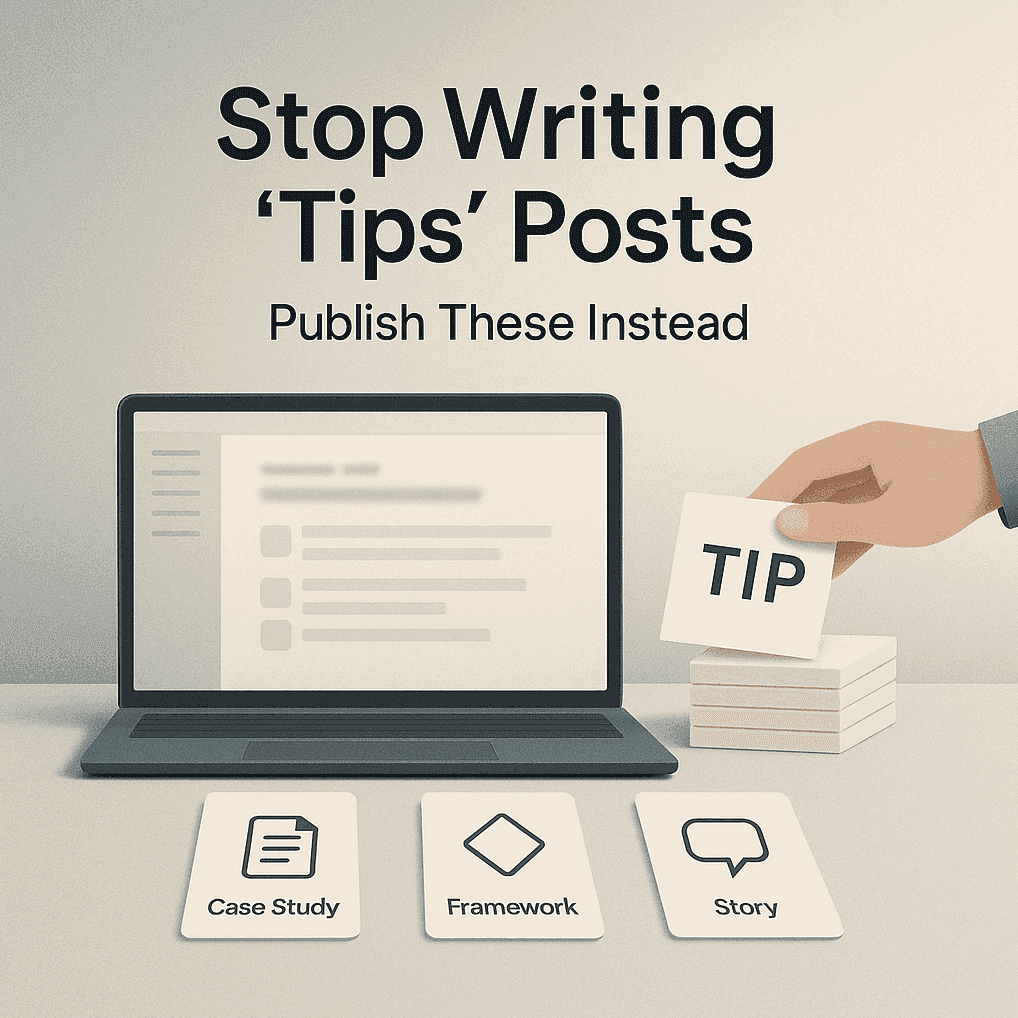
If you run a small business and you’ve been “doing content,” there’s a good chance your blog looks like this:
17 Tips for Better [Thing]
9 Tips to Improve Your [Thing]
12 Tips Every [Person] Needs to Know About [Thing]
And look, I get it. Tips posts feel safe.
They’re easy to outline. Easy to outsource. Easy to publish. They make you feel productive because you can crank one out in a couple hours and hit publish and move on.
But they also quietly train your business to publish the least memorable kind of content.
Not always useless. Just… thin. Interchangeable. And honestly, kind of exhausting for readers. If I see “10 tips” now, my brain assumes I’m about to read:
Be consistent
Use quality tools
Know your audience
Track results
Stay updated
Like. Thanks.
The bigger problem is that “tips” posts are usually written to be completed instead of written to be useful. They’re designed to be scanned, not trusted. They rarely build authority. They rarely earn links. They rarely become the page that AI search tools quote when someone asks a real question.
So let’s fix that.
Below are content types that work better than tips posts in 2026. They’re not complicated, but they require one thing tips posts usually avoid: commitment. A point of view. Specifics. Real examples. Actual decisions.
Why “tips” posts stopped working (for most businesses)
A few reasons, and they stack up.
1. They’re too easy to copy
If a post is just “15 tips,” it’s basically a list of common knowledge. Which means anyone can publish the same thing, including massive sites with higher authority than you.
Google sees ten near identical pages. It picks one. It’s usually not yours.
2. They don’t match search intent anymore
When someone searches “how to price a service” or “how to write a landing page,” they don’t want random tips. They want:
a process
examples
a template
mistakes to avoid
what to do in their specific situation
Tips posts often dodge the hard part. The “what should I do first, second, third, and what happens if…” part.
3. They don’t get cited (by humans or by AI)
If your content is generic, nobody quotes it. Nobody links to it. And AI tools that summarize the web have no reason to pull from you because you didn’t say anything distinctive.
Being “correct” is not enough now. You have to be reference-worthy.
4. They rarely show that you’ve done the work
Readers can feel it. Tips posts often sound like someone who has read about the topic, not someone who has done it.
And for a small business, trust is the whole game.
So. What do you publish instead?
1. Publish “The Playbook” posts (a real step by step process)
A playbook post is what most tips posts are trying to be, but failing.
It’s not “here are ideas.” It’s “here is the exact sequence, with decisions, and what to do if you get stuck.”
Example topics:
The exact onboarding workflow we use for new clients (with email templates)
Our 7 step process for ranking a local service page in 30 to 60 days
How to launch a blog that brings leads without posting every day
What makes a playbook work:
A clear starting point and finish line
A numbered flow that builds on itself
Decision points: “If X, do Y. If not, do Z.”
Screenshots, templates, examples, or at least specific wording
Playbooks are the kind of content people bookmark. And forward. And cite.
If you want an easy conversion angle, this is where it fits naturally:
“Here’s our process. If you want us to just do it for you, that’s literally what we offer.”
Helios Lab (https://www.helioslab.io) is basically built around that idea. SEO content, done for you. No weird long contract energy. Simple packages. Which is refreshing, because content is one of those things that small businesses keep meaning to do… and then it’s suddenly six months later.
2. Publish “Examples” posts (show, don’t tell)
Most tips posts are advice without proof.
Examples posts flip that. They teach by showing.
Example topics:
12 high converting service page intros (and why they work)
Real blog outlines that rank for [your niche]
Before and after: turning a vague homepage into a lead generating one
If you sell a service, examples are unfairly powerful because they answer the reader’s real question:
“Okay, but what does good look like?”
And you can do this without exposing client secrets. Use anonymized versions. Or build “generic but real” samples.
What matters is that the reader can copy the structure.
A simple format that works
Here’s the example
Here’s what most people do instead (and why it fails)
Here’s what makes this one work
Here’s a template you can swipe
This kind of post also tends to get pulled into AI summaries because it contains concrete, reusable patterns.
3. Publish “What we would do if…” posts (scenario based content)
This is one of my favorite swaps for tips posts, especially for small businesses.
Instead of “10 tips for marketing,” write:
“What I’d do if I had to get 10 leads this month with a $500 budget.”
Now it’s real. There are constraints. The advice becomes specific.
Example topics:
What we’d do if we were a plumber starting from zero reviews
What we’d do if we had a high ticket service and no case studies
What we’d do if our traffic dropped 30 percent overnight
The trick is to actually pick a path. Don’t list options forever. Commit to a plan, then explain the why.
These posts build trust fast because they sound like a person who has made decisions before.
Not a person collecting tips.
4. Publish “Mistakes” posts (with the real consequences)
Generic tips posts are optimistic. They’re all “do this, do that.”
Mistakes posts feel more honest. They also pull in readers who are already struggling, which is usually who you want.
Example topics:
7 reasons your blog isn’t bringing leads (even if traffic is up)
The SEO mistake we keep seeing on small business sites
What happens when you publish AI content without editing it
If you want this to work, don’t write mistakes like a school lecture.
Write them like a postmortem.
What the mistake looks like
Why people make it (usually a reasonable reason)
What it costs (time, money, rankings, leads)
How to fix it
How to prevent it next time
And if you can add a quick mini story, even better. “We had a client come in with 80 posts and zero calls. Here’s why.”
People remember consequences more than tips.
5. Publish “Comparisons” that don’t pretend everything is equal
Most comparison posts are fake. They’re like:
“Tool A is great for beginners. Tool B is great for teams. Tool C is great for scaling.”
So… nobody is best. Cool.
A real comparison post makes a call.
It says, “If you are in situation X, pick Y. Here’s why. Here’s the tradeoff.”
Example topics:
SEO blog vs Google Ads: what we’d pick for a local service business
Blogging vs posting on LinkedIn: where should a small brand start
Hiring a writer vs DIY: the actual cost breakdown
These posts rank because the query is high intent. People searching comparisons are close to action.
And if you write it with a clear point of view, it’s also the kind of content that gets cited.
6. Publish “Templates” and “Scripts” posts
Tips are often too vague to be useful. However, templates provide tangible, usable resources.
When you publish a strong template, it encourages readers to return. They save it for future reference, share it with others, and develop a sense of trust in your expertise.
Example topics:
Cold email script for following up after a discovery call
FAQ page template that actually helps SEO
A template post doesn’t need to be lengthy. It needs to be clear and comprehensive.
Include:
When to use it
The template itself
A filled-in example
Common tweaks
Mistakes to avoid
If you offer a service, templates can also serve as a gentle funnel. The reader tries out the template, realizes it works well, then starts to see the value in having someone else handle it regularly.
That’s when a done-for-you option starts sounding really appealing.
7. Publish “Case studies” that aren’t fluff
Many case studies end up being nothing more than brag posts with vague statistics like “Traffic increased by 300 percent.”
However, what readers really want to know is how that increase was achieved. From what starting point? Over what period? With what specific content? What changes were made? What strategies didn't work?
A real case study should serve as both a playbook and proof of success.
A solid case study structure includes the following elements:
Context: Describe the business, the offer, and the market.
Starting point: Provide metrics such as traffic, leads, rankings, and assets.
The goal: Clearly state the specific goal.
The strategy: Outline the strategy in simple terms.
The execution: Detail what actions were actually taken.
Results: Include results with timelines.
What we’d do differently: Reflect on potential improvements.
What someone can copy from this: Provide actionable takeaways.
If you don’t have client case studies yet, consider doing internal ones instead.
Document your own content experiments - even the small wins can provide valuable insights. For instance, if you updated 10 old posts and saw impressions rise within 28 days, that's useful information worth sharing.
For more detailed guidance on crafting effective case studies, refer to this comprehensive guide on how to write a case study.
8. Publish “Opinion” posts (but grounded ones)
This scares people because they think an opinion post is just a rant. However, it's not. A good opinion post is a clear stance plus reasoning plus examples.
Example topics:
Why posting daily on social is overrated for small businesses
SEO isn’t dead. But your content strategy might be
Most small business blogs fail because they chase keywords, not buyers
Opinion posts do something tips posts never do. They create a signal. A personality. A brand voice.
You don’t need to be polarizing for the sake of it. Just be honest. Say what you believe and back it up. This approach can help you stop sounding like everyone else.
9. Publish “FAQ hubs” that actually deserve to rank
Most businesses have an FAQ page with five questions like: “What are your hours?” That’s fine, but it’s not what I mean.
An FAQ hub is a set of pages (or one big page) that answers real buyer questions in depth. The questions that show up on calls. The questions people ask right before they purchase. The questions that create friction.
Example questions:
How long does SEO take for a small business
How many blog posts do I need per month
What should a blog post cost if it’s SEO optimized
Should we blog if our industry is boring
These posts are insanely practical because they meet people where they are, not where your keyword tool wishes they were.
Also, AI search experiences love FAQ style content because it’s structured and direct. If you want to be cited, answer questions cleanly.
In addition to these strategies, consider incorporating elements from successful opinion pieces in literature, such as those by Nicola Barker, which can provide valuable insights into creating compelling and engaging content that resonates with readers.
10. Publish “One problem, one solution” posts
This one is simple. And it’s the opposite of a tips post.
A tips post tries to cover everything. A one problem post goes deep on one thing.
Example topics:
How to write a service page that converts without sounding salesy
How to choose blog topics that attract buyers, not random readers
How to update old content for quick SEO wins
If you publish these consistently, something nice happens.
You end up with a library of focused pages that each rank for a specific intent. And together, they make your site feel like an actual resource.
Not just a blog you update because someone told you to.
A quick cheat sheet: what to publish instead of tips
If you’re stuck and just want a fast replacement, use this:
Instead of “10 tips for X,” write “The step by step process for X.”
Instead of “tips,” write “examples you can copy.”
Instead of “best practices,” write “mistakes and how to fix them.”
Instead of “ways to improve,” write “what I’d do in this exact scenario.”
Instead of “ultimate guide,” write “template plus filled in example.”
You’re still teaching. You’re just teaching like someone who actually wants the reader to succeed.
How to choose the right format for your business
Here’s a simple filter. Ask:
What does my buyer ask me on calls, repeatedly?
What do they misunderstand before they buy?
What do they try that fails, before they hire someone?
What would I do if I had to get results in 30 days?
What can I show, not tell?
Pick one question. Pick one format from the list above. Publish.
That’s it.
And if the bigger issue is that you already know what to publish, you just don’t have the time to keep up with it, that’s where a service like Helios Lab makes sense. Done for you SEO optimized posts, straightforward packages, no contracts. You can check it out here: https://www.helioslab.io
Wrap up
Tips posts aren’t evil. They’re just overused. And in a world where everyone can generate “tips” in 30 seconds, they’re not a competitive advantage.
If you want content that ranks, gets cited, and brings in the right leads, publish things that can’t be faked easily:
Playbooks. Examples. Templates. Case studies. Mistakes. Comparisons with a real point of view.
Stuff with fingerprints on it.
And honestly, once you start writing like this, you’ll probably find it’s more fun too. Because you’re not padding a list to hit 12 items. You’re actually saying something.
Moreover, incorporating practical elements such as how to write an outreach email can further enhance your content's effectiveness and engagement level.
FAQs (Frequently Asked Questions)
Why are 'tips' posts no longer effective for small business content in 2026?
Tips posts have become too easy to copy, often containing generic advice that massive sites with higher authority can replicate. They don't match the current search intent, which favors detailed processes, examples, and specific guidance over generic tips. Additionally, tips posts rarely get cited or linked because they lack distinctive insights, and they often fail to demonstrate real experience, which undermines trust.
What content types work better than 'tips' posts for small businesses today?
Content types like 'Playbook' posts (step-by-step processes), 'Examples' posts (showcasing real-life applications), and 'What we would do if...' scenario-based posts work better. These formats provide commitment, specifics, real examples, and actionable decisions that build authority, trust, and are more memorable and useful to readers.
What is a 'Playbook' post and why is it effective?
A Playbook post outlines an exact sequence of steps with clear starting points, decision points (e.g., 'If X, do Y'), and practical resources like screenshots or templates. This format helps readers follow a proven process and makes the content bookmark-worthy and shareable. It also naturally aligns with conversion by showcasing your expertise and offering services based on the presented process.
How do 'Examples' posts improve content usefulness compared to tips lists?
'Examples' posts teach by showing rather than telling. They provide concrete samples such as high-converting service page intros or before-and-after transformations that illustrate what good looks like. This approach answers readers’ real questions with reusable patterns and templates that they can copy, making the content more practical and trustworthy.
What does it mean to publish 'What we would do if...' scenario-based content?
This type of content explores specific situations or challenges a reader might face and provides detailed advice on how you would handle them step-by-step. It moves beyond generic tips by addressing real-world scenarios with actionable decisions, helping readers understand how to apply knowledge in their unique context.
How can small businesses build trust through their content instead of relying on generic tips?
Small businesses can build trust by publishing content that demonstrates they've done the work—offering detailed processes, real examples, decision-making frameworks, and scenario-based guidance. This shows expertise and authenticity rather than just repeating common advice, which helps establish authority and encourages readers to engage with their brand.